Showing posts with label Florida. Show all posts

Monday, June 7, 2021

Pulled Pork Barbeque in the South


Pulled pork, smoke houses, and barbeque houses are ubiquitous across the American South. Although perhaps not the best for one’s diet, eating at these establishments is a culinary treat and an adventure in history and tradition. Hungry as we made our way toward the Georgia Coast, we spotted The Pig Bar-B-Que in Callahan, Florida. Still wary about inside dining because of the pandemic, and wanting to save time, we decided to place a takeout order at the obviously popular local restaurant. We pull into line with only three cars ahead of us. It seemed easy, and fast. But the wait was interminable; with three cars ahead of us it took us thirty minutes to get to the microphone where we ordered. Because I worked in restaurants for years, I am patient about such things. A Sunday after-church-rush can be brutal, and the crush of people can easily delay everything in a restaurant. My father always commented that those who have just been to church seemingly forgot today’s sermon in their impatient demands for immediate food and service. No one is very kind to a server when their food is delayed. Yet waiting in the car while it is hot is no fun. While I was not hungry when our car joined the line of customers, the expectation of food made me desirous of an afternoon meal. To pass the time I watched anole lizards dart back and forth, on the hot concrete from beneath the bushes, occasionally puffing out their reddish pink throats to attract a mate. We finally reached the pickup window and received out generous sandwiches, overflowing with pulled pork, and iced tea. The young woman, probably in high school, did not say a word about the long wait, but told me to “Have a blessed day!” Pulling around to the front of the restaurant we understood the delay. A firetruck and ambulance sat idling in front of the restaurant. Apparently, a medical emergency had occurred as we waited to order. 

Vandy's Bar-B-Q (Statesboro, GA)


Located at the corner of West Vine and South Walnut, in downtown Statesboro, Georgia, Vandy’s Bar-B-Q has been a local institution since its inception in 1929. The eatery even elicits a historical plaque outside the front door of its restaurant, where it relocated to in 1943. Vandy’s is situated across the street in what was once called “Blue Front,” the African American commercial district of Statesboro. In the 1930s and 1940s, the area was a vibrant area with barber shops, dry cleaners, restaurants, and other local businesses; however, by the end of the 1960s all the businesses were gone. Today, this square block is little more than a parking lot. Despite its proximity, Vandy’s was not a part of this commercial district offering a separate window where blacks could order food prior to the civil rights movement. During the racial strife of the 1960s, the restaurant was targeted and severely damaged after being firebombed.

Serving breakfast and lunch, Vandy’s is, of course, famous for their barbeque pulled meat sandwiches, which have a distinctive woodsmoke flavor. Served on Sunbeam white bread, the sandwiches are not pretentious. The blue-and-white checked floor, the cinderblock walls, and the straightforward menu that meets the expectations of locals, all harken to earlier days. It is difficult to walk into the restaurant and not feel like you are stepping back in time. 


We only spent two nights in Statesboro and only learned about Vandy’s after its weekday closing time of 4pm. The next morning, on our way out of town, we stopped by to take two sandwiches, and an order of coleslaw to go. We happened to arrive at shift change, so there was a bit of confusion, exacerbated by some cultural misunderstanding. I was unfamiliar with the ordering process; the workers were perplexed by my accent. I forgot to order unsweetened iced tea, receiving the sweet version instead, and the young woman who endeavored to help me had a difficult time understanding why I wanted another cup for tea. A nice young man stepped in to translate and remedy the situation. Despite the momentary confusion, we soon put our sandwiches in a cooler to keep them warm and made our way north on US25. A couple of hours later, outside a McDonald’s in South Carolina, we had our delicious pulled pork sandwiches. I felt smug eating a much better lunch than those lined up in their cars, spending their lunchbreaks waiting for a burger that is replicated billions of times over, instead of the prepared in the back of a famed restaurant. My barbeque sandwich was prepared the same way it had been for decades, but with a completely unique and local taste. 

Loaves of Sunbeam Bread, in case you need more


Thursday, June 3, 2021

Gas Station, Columbia County, FL


There are parts of Florida that remain remote and harken back to a time before swamps were drained and theme parks were the primary attraction of the state. When tourists and travelers first started venturing to the sunshine state, automobiles traveled the US Highway System rather than the interstates. About fifteen miles north of Lake City on US441, an abandoned gas station is a reminder of that old Florida. Today, this portion of US441, not far from the Georgia state line, is a lonely road; we went miles without seeing any other cars. It is easy to see why gas stations are few and far between today.


Monday, May 24, 2021

Montbrook

 A small green sign directs the attentive motorist on US41 to an unimproved (read: dirt/sand) road that constitutes the community of Montbrook, Florida. Today, it is a collection of modest houses with rather large plots of land. At one time, in the early part of the twentieth century, the town of Montbrook was a stop on the rail line. It is difficult to say whether the town was prosperous. Today, all that remains are two structures from that era: a general store/post office and a former hotel. I have yet to find any information regarding the general store, which has set abandoned and uninhabited for many years. On the other hand. the hotel, built in 1904, is a private residence. It was moved to its current location in 1974, about 400 feet to the west from its former location. During the move, the former hotel acquired a brick façade. Now a residence, the building still retains its original flooring made from Dade County Florida pine.  Originally, the railroad tracks ran adjacent to the general store making it a short walk from the train stop to the hotel. At some point, however, the railroad tracks have been moved about a quarter of a mile east where it is still an active freight line.

The former hotel 

General Store / Post Office

Pine Floor 


Sunday, December 2, 2018

A Rainy Florida Evening

We were riding in the back of the minivan together. A chance to have a little chat, to ask her questions, to show that I think about her and care. It is short ride from the restaurant to their house. Before we pull out of the parking lot, she turns her back to me at a 45-degree angle, puts her earphones in, and stares out the window. There will be no conversation this evening. I will not force the situation; I know she feel awkward talking to her uncle and I understand how that feels. Nevertheless, as I watch the back of her head, with the occasional flashes of her face reflected in the window when we pass beneath streetlights, she continues to look passively at the never-ending rows of strip malls, and an 11-year-old cuts me to the quick. 

Monday, January 15, 2018

Notes from a Forgotten Coast: 5 Lynn’s Oysters

In every sense of the word, Lynn’s Quality Oysters is a seafood dive. The small cinderblock building is nestled between US98 and the bay in Eastpoint, even has its own dock that allows fishermen to deliver directly to the restaurant-shop. Inside there is a display case with fresh seafood on ice, and a wooden case, which could easily be converted to bookshelves, containing impressively numerous hot sauces, seasonings, and breading.  There are only two tables and a L-shaped bar, seating seven. The total seating capacity for dining patrons must be about fifteen. The walls are adorned with various items: faded photographs of the store in the aftermath of Hurricane Dennis in 2005, a stenciled print of Dale Earnhardt, and beer advertisements. A steel cargo holder for a pickup truck is located along the wall near the bar, it is full of beer on ice. Hanging over it is a home-made wooden sign, a bottle-opener attached at the bottom, reading, “the best beer is an open beer.”

Oyster Flag from the outside wall
“Are these from the bay?” the patron at the bar asked. The amiable man shucking oysters behind the bar slowly shook his head no. He confessed that they were from Pine Key, some three hours away by automobile, about 120 miles across the bay. He explained that the oyster in Apalachicola Bay were too small to harvest at this point. The patron continued, understanding the problem, by asking if there were any recovery in sight. The large man, with a full red beard, a Lynn’s t-shirt and ballcap, looked despondent and exhaled a “no.” After a pregnant pause, he continued, “some people are saying that we might have to shut down harvesting for a few years.” The two men, lamenting the fate of Apalachicola oysters, laid the blame on upstream cities taking too much water from the Apalachicola watershed. Others in the raw bar listened to the conversation silently, as did I. I judged the mood of three employees and the owner of Lynn’s to be one of resignation, rather than anger. But there is no doubt, local identity is closely tied to oyster harvesting along the Apalachicola Bay. 


Lynn's Gumbo
Many come to Lynn’s for the oysters. It is common to see local people stopping by for a beer and a snack after work. I come for the best gumbo I have ever had. Made from the recipe of the owner’s mother, I hear employees often express their pride in creating the stew. We occupied the smaller table on a Friday afternoon. An older couple shared the larger table with two men, who had been friends for a long time judging from their conversation. After eating a dozen oysters, one of the men ordered a bowl of gumbo while his friend enjoyed a second dozen. After a few bites, he exclaimed, “I don’t know who makes the gumbo, but they deserve a raise.” 

Sunday, January 14, 2018

Notes from a Forgotten Coast: 4 Liquid Gold

The small city of Wewahitchka, established in 1875, is located about 25 miles north of the coast in northeast Gulf County. The city takes its name from Native Americans and is believed to mean “water eyes,” because of the shape of two oblong lakes on the edge of town. The lakes are separated by a noticeable ridge that resembles the bridge of a nose. More importantly, situated along the swamps of the Apalachicola River, the city is the center of tupelo honey production. 

Most people are surprised at the cost of tupelo honey. In order to get the purest product, existing honey must be removed prior to the production tupelo trees blooming. Then, the harvest season is very short, only two to three weeks. Finally, tupelo trees are cluster in remote swamps making the retrieval of honey very difficult. Nevertheless, tupelo is considered one of the best and rarest of honeys in the United States.

The Mailbox at LL Lanier
We visited L.L. Lanier & Sons Apiary in Wewahitchka, a family business that began in the 1890s. Located on a small avenue on the edge of town, at first glance it is hard to believe that this modest operation is the source of the rare honey. Jars of the liquid gold are displayed outside the storeroom, a converted house, and the staff are employees that help in all phases of the production. While many local shops will claim to carry tupelo honey, at much more reasonable prices, caveat emptor: quality and purity vary.


Sunday, January 7, 2018

Notes from a Forgotten Coast: 3 Food and Eating

Abandoned seafood processing house in Apalachicola
Eating along the Forgotten Coast can be an adventure; in a good way. Eastpoint, the small hamlet on the eastern shore of the Apalachicola River and the bay, is widely regarded for its oysters. A local Apalachicola resident told us when he was a young man, Eastpoint and Saint George Island were poor and underdeveloped. Oyster boats dotted the bay between the two towns, so thick he said, that “you could walk from boat to boat from the island to the mainland.” Perhaps a bit of hyperbole, but an indication of the thriving industry. Several restaurants cater to locals and tourist alike, touting the best oysters in the United States. We met a group of German university students who were thrilled to have a chance to try the local oysters, even if it was not their favorite new food. Seafood processors and canneries once lined the riverfront in Apalachicola. Declining oyster production in the Apalachicola Bay, because of both natural and human activities, has had a devastating effect on the local seafood economy. Today, the processing plants are closed; the buildings derelict or converted to other commercial enterprises focusing on entertainment and retail. Nevertheless, seafood remains a significant part of the local economy and heritage. 

In addition to oysters, several restaurants offer traditional foods not found in many restaurants in the United States: gumbo, alligator, conch, frog legs, among others. Richard and I had lunch at the Red Pirate in Eastpoint, an establishment that is frequented by the local population and includes miniature golf as a diversion. Having looked at the menu I noted, out loud, that Richard could enjoy a gator or frog leg basket for lunch. He chuckled and said that he had not had frog legs in about twenty years.
After our orders had been placed and we were settled, I told Richard about a famous family story. Growing up in Louisville, one of the most popular places to eat after church on Sundays was KingFish, a small local chain that began in the late 1940s. I still fondly long for a fish sandwich from KingFish from time to time. A number of fellow Louisvillians would disagree with my assessment of KingFish, claiming that the best fish sandwich in town is Moby Dick’s (“A Whale of a Sandwich,” the advertisements suggest), but I digress. On a particular Sunday, when my brother would eat only chicken, he wanted to order a second helping of chicken from the kid’s menu. My cost-conscious parents tried to provide him with food from their meals, but he adamantly refused seafood of any sort. My dad eventually offered my brother the “chicken” from his sampler platter, which he happily devoured in a matter of a few minutes. Dad asked how he liked the chicken, to which my brother expressed satisfaction. Dad then confessed that my brother had just ate the frog legs; my brother was sullen and horrified. Richard laughed, thinking that it was a good story.
Richard then told me about a restaurant in Montezuma, Ohio, the next town east of Coldwater. That restaurant, which was little more than a house converted into a small dining room, in the 1940s served frog legs and turtle soup. He remembered that the restaurant paid high school boys to take flashlights at night and hunt frogs. Some of the legs, he claimed, were as big as chicken legs. Richard mentioned that no one eats turtle soup anymore and pondered why. I mentioned that several turtle species were protected, and it was illegal to harvest. He smiled and remembered that his father, who wintered in the Tampa area after retirement, could never pass up a bargain. One winter he went to a grocery supply store and bought two cases of canned turtle soup because it was a good bargain. He brought them back to Coldwater, and everyone in the family ate turtle soup for a long time. When they cleaned out the house, years later, after his mother died, they still found cans of turtle soup in the basement.
In a society where there is an astounding homogeneity of food choices, simultaneously with a desire for diverse food tastes and experiences, the decline in turtle consumption might have portended the decline in oyster production. The reason why turtles are not widely consumed in the United States today is largely because of overconsumption in the past, not because of changing culinary habits. Green sea turtles were hunted to the brink of extinction; governments banned the production of turtle soups. Today, even some of those in the oyster industry have called for radical solutions to save a heritage industry. One wonders what people fifty to a hundred years from now will think about oysters as a part of our diet.  

Friday, January 5, 2018

Notes from a Forgotten Coast: 2 Saint George Island State Park

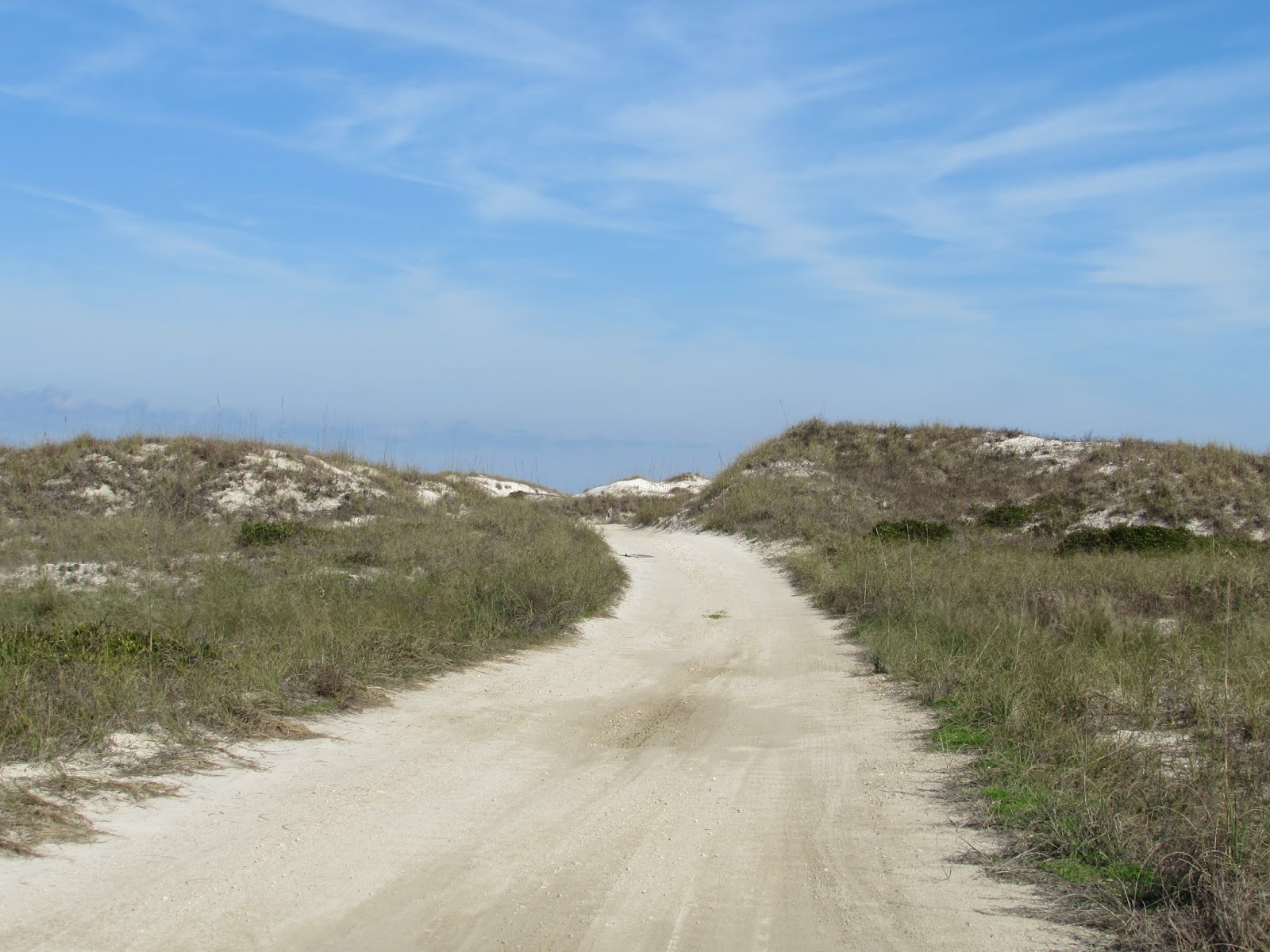
St. George Island is a 28-mile long barrier island near the mouth of the Apalachicola River in Franklin County, Florida. The Dr. Julian G. Bruce St. George Island State Park occupies the eastern most nine miles of the island, containing undeveloped shorelines and numerous hiking trails. The last four miles of the island, and the state park, are gated for the protection of an ecologically sensitive area. It is open to the public but there is limited vehicle usage allowed. The limited access, the remoteness, and the chance to observe nature was an appeal: It was the allure of the secluded.
My first inclination was to walk the five miles to the end of the island; however, a bike ride afforded me more time to explore once I arrived at the east end and I would have reserved some energy for that exploration. The adventure began after Angie dropped me and the bike off at Sugar Hill Beach area. As I rode the bike through the gate, rap songs from the early 1980s, by the Sugarhill Gang, played through my head.
A ruddy turnstone
The road was bumpy and desolate. It was a beautiful day and there was exhilaration in exploration of the remote and barren dunes. I am not used to riding a bike, so I stopped after two miles into the journey to explore. Thus far I had passed three other cyclists going the other way. They would be the only people I met on my outbound journey. The island was becoming very narrow, perhaps only 100 yards to the water from either side of the road. I walked to the ocean side first and saw several shorebirds. A couple of Ruddy Turnstones were a little wary of me coming too close, but were largely unconcerned about my presence. Once I remained still, the turnstone went back to its business of finding lunch beneath the seaweed that washed ashore. 

There is something compelling, and even satisfying, about crunching shells as I walk. They were all largely broken anyway – I was not denying collectors a great find or animals a home. But that crunch is a sound that sticks with me. As I explored the bayside of the island, it was a different sensation. The sand, textured by the rain of two days before, providing a wonderful tactile experience on the soles of my shoes.
A tree used in turpentine production
With a few exceptions there are not many trees, and virtually all are loblolly pines. Beginning in the 19th-century, and lasting well into the next, these trees had slashes cut into the trunks in the shape of “cat-faces” as part of the process to collect sap for the production of turpentine. It was a major industry in Florida's history and led to the acquisition of the island from Creek Indians in 1803.  There are still a few trees visual, in the State Park, that bears the cat-face marks dating from the 1950s. 

My smartphone app indicated that I had rode 4.4 miles when I arrived at the small parking lot near the east end of the island. I walked from the parking lot to the point in splendid isolation. Across the strait, I could make out a few houses on Dog Island, the next barrier island to the east. Although one can buy a special pass to drive to the end of St. George Island form the state park, I reveled in the decision to bike to the end. It allows us to observe and appreciate. As I walked the shoreline, careful to avoid damaging any dunes, I spied several plovers and willets. Here, on a natural beach with very little human traffic, sponges were plentiful along the shore. Near the point, there was a sailboat that had run aground on a sandbar just offshore. As I was riding out, I saw the mast in the distance and figured that some boaters had docked in a remote location. I dreaded any interaction with partiers. Walking around the dune, I saw that the boat was damaged, its mast at a 60-degree angle; I realized that I was still alone. Later, when leaving the park, I asked Joshua, one of the rangers at the State Park, how long the boat had been there. It had been abandoned shortly after running aground a month before, and the owner had decided not to retrieve it. The park was in the process of declaring it derelict so that it could be removed. I expressed surprised how much damage had been done to the vessel in as little as a month. Joshua noted that there was going to be a big job to remove the boat; water and sand had gotten into it and it was going to be very heavy to move anywhere. 
The road to the end (of the island)

I turned back and walked the shoreline on the bayside for about a mile or so. I imagined it be the least trafficked part of the island. But it was disappointing to find how much trash and garbage littered the shoreline. I found shoes, containers of smokeless tobacco, soft drink cans, and plastic bottles galore. It ruined the effect of walking in one of the under-explored places of the state. Nevertheless, it was a beautiful day and a unique experience. Yet, there was a price to pay for my exploration. That evening, I found that a tick had burrowed its way into my inner thigh. In removing it, the parasite took with it a huge chunk of flesh. A small price to pay,

Tuesday, January 2, 2018

Notes from a Forgotten Coast: 1 Introduction

The “Forgotten Coast” is a stretch of Gulf of Mexico shore that encompasses Gulf, Franklin, and Wakulla counties in the panhandle of Florida. The popular legend is that a couple of decades ago, when the state was designing a new highway map, the names of several towns and islands from the area were left off. Perhaps more to the point, the coast is a place that has been neglected by development and time. This is not the Florida of Miami Beach; you are more likely to see beach houses with the names such as, “Cowboy Boots & Bathing Suits,” than high-rise, opulent condominiums. For many, this is “real” Florida.
Although the coast is sparsely population today, human settlements along the coast date back for at least 10,000 years. From the tenth through the fifteenth centuries, known as the Fort Walton period, Native Americans practiced agriculture, as well as harvesting local waters for shellfish and other resources. While up to 100,000 Native Americans might have lived in Florida prior to European contact, by the beginning of the nineteenth century the entire state of Florida had been depopulated of indigenous people, through introduced disease, slaughter, and forced relocation.
Prior to the establishment of the United States, western Florida had been controlled by the Spanish, the British, and returned to the Spanish rule in 1783. It is little remembered that at the time of American Revolutionary War, Florida was divided into two colonies. History books often focus on the thirteen colonies that formed the eventual United States; very few mention that there were fifteen British Colonies south of Canada. Today, there is very little that remains in the Forgotten Coast region to remind us of Florida’s colonial history. In fact, there are several points of west Florida history that are not well remembered.

With the nearest interstate about eighty miles away, the primary thoroughfare, paralleling the coastline, is U.S. Route 98. It is a desolate road in many areas, because it traverses swamps and forests. Once, we were touring a historic house in Apalachicola, when the tour guide noted living in the small remote town was usually a blessing. But, she noted with some regret, that the nearest Walmart was some two hours away. Every person on the tour took that as a positive. In the modern world, there is a seeming need for convenience. But, I would argue that this is part of the charm of the area. People make due, the scenery is largely unspoiled, and there are opportunities to focus on diversions. 

Wednesday, February 15, 2017

Souvenirs in Apalachicola

I was waiting to have my growler filled with Hooter Brown, a wonderful beer made with Tupelo honey, at Oyster City Brewery in Apalachicola. A man and woman, obviously from the area, were laughing hysterically as they made their way to the bar. The local man told the bartender that they had just come from a tourist shop and were tickled to find that the proprietor was selling oyster shells, ten for a dollar.

The bartender responded that he reckoned that he had about twenty dollars’ worth of shells sitting in the window in the brewery. Still laughing, the patron asked if anyone really bought the shells. The bartender looked serious, nodded his head, and assured the man, “Oh yeah.” In my travels, I have seen tourists spend money on even more bizarre souvenirs.

Friday, January 6, 2017

The Hazards of Walking

While I was walking on West Gorrie Drive, there was a car approaching straddling the yellow line in the middle of the road. It is customary on the island to acknowledge one another, whether on foot, bike, or motorized vehicle, but since the car was more than a block away this seemed a bit over the top. People in automobiles are seemingly more sensitive to pedestrians because it is a resort area and there is a noticeable lack of sidewalks. I have observed that most drivers take care to give walkers (and joggers) plenty of room and overtly signal that there are aware of the pedestrian’s presence. The standard procedure is for walkers to acknowledge drivers for their consideration. I usually provide a polite wave and, in return, the driver provides a similar response. Most drivers return the wave, but some just raise an index finger while they grip the steering wheel.

The car in question was giving me a great deal of leeway as it approached. As it approached I raised my hand as a gesture of gratitude; however, the driver did not even look at me. It soon became apparent what was going on. The driver was completely oblivious to my acknowledgement of thanks because she was preoccupied with other things. Her forearms were resting on the steering wheel as she typed out a message on her pink smartphone. What I thought was a kind gesture had nothing to do with me. As far as I could tell, she did not even know I existed. 

Saturday, January 9, 2016

U.S. Route 98

Although not as well-known as U.S. Route 1 or 101, which follows the east and west coast respectfully, U.S. Route 98 less dramatically follows the southern coast of the United States along the Gulf of Mexico. When it was originally established in 1933, it simply ran from Apalachicola to Pensacola, Florida. Today, its 964 miles takes it from Washington, Mississippi to Palm Beach, Florida. The road’s approximation of the shoreline of the Gulf of Mexico in northern Florida, the so-called “Forgotten Coast,” is where the rarely seen America can be found. 
Abandoned building in the waterfront district of Carrabelle
Carrabelle, supposedly named for Miss Carrie Hall, the “belle” of the town, is a small town that was built on fishing. The town today looks as if many of the commercial fishermen have left, yet some of the private ones remain. Several of the buildings in the center of town, near the port, have been abandoned. For baseball enthusiasts, the most famous person to hail from Carrabelle was Buck O’Neill, of the Negro Leagues, Cubs and star of the Ken Burns documentary, Baseball.
The 13-mile drive from Carrabelle to Eastpoint is an enticing drive with Pine Trees on one side and the Gulf of Mexico, literally a few feet from the road, on the other. The welcome sign upon entering, reads: “Eastpoint…Oysters since 1898.” Seafood dives are the only restaurants in town and they are unpretentious and filled with character. 
The remains of a local business
Interestingly, Eastpoint was the site of an experimental cooperative living community in the early twentieth century. In 1901, the Reverend Harry C. Vrooman helped to organize a cooperative plan in which residents purchased shares in the Co-Operative Association of America, which would distribute profits to all workers. Investors, who would be guaranteed a job, had the choice of living and working in either Eastport or Lewiston, Maine. Vrooman wrote, “Industrial co-operation cheapens production and distribution and makes possible a just and equitable division of the wealth created.” This 19th-century optimism is rarely found in the world today. Much like the Shakers and Christian socialists, Vrooman’s belief in a world where equality and fairness can be achieved is rarely found today. Most people in Eastpoint would not even recognize it as a viable option.
An old trailer in Eastpoint
Today, Eastpoint, especially the center of town where US98 transits, is a poor community. Walking through town, one can see that economic prospects are tough. Some still make a living on oysters and seafood, but compared to neighboring communities, especially Saint George Island and Apalachicola, Eastpoint faces many difficulties.
The bridge that crosses the mouth of the Apalachicola River is a six-mile span that is named for the 19th century inventor John Gorrie. In the 1840s, Gorrie devised a machine that would make ice. Although his goal was to provide a way to cool patients who were suffering from fever, the machine would have several practical applications in an era where refrigeration was limited to where ice could be shipped. After he died in 1855, Gorrie’s invention was all but forgotten. Yet accounts of the machine appeared in the September 1849 issue of The Scientific American, as well as the American and British patent offices. His friend, the famed botanist and author Alvan Chapman, did much to revive his legacy. Chapman lived forty-six years longer than Gorrie and would constantly praise his late friend’s work and invention. Gorrie is commemorated at a State Park and Monument in the town of Apalachicola.
The buildings in the business district of Apalachicola is a veritable cornucopia of late-19th and early-20th century rural architecture. The Cook Building, which today is the home of Tamara's Café, was the former A&P Grocery Store and later a five and dime. The interior is a fascinating mix of pressed tin ceilings painted rust red, exposed bricks, and original wooden floors. Yet, the most famous house in town is the Raney House. Built in 1838, the home belonged to some of the most prominent families in town, including the man who built the house, David Raney, who made his fortune in cotton, and his son a Confederate naval hero. One of the stunning features of the house was an original stairwell made from what the guide called Cuban Mahogany, more commonly known as West Indian Mahogany, which only grows in Florida and the Caribbean. The mahogany is a threatened species and is now protected nationally and internationally. I was surprised that we were allowed to walk on it and use the stairs to access the second floor.
 Our guide through the Raney House, who had moved to Apalachicola from Birmingham, Alabama two years earlier, was fixated by the low crime rate in her adopted home. She told the group on the tour, who hailed from England, Spain, South Africa and Pennsylvania, that it was the best thing about living in the area. She went to say that the worst thing was that there was not a lot of shopping around; as a matter of fact, the nearest Walmart was nearly two hours away she lamented. I think she was startled when just about everyone in the group voiced the opinion that this was a good thing.

To be continued… 


Thursday, December 31, 2015

Walking on Saint George Island

Original bridge, now a fishing pier
St. George Island is located in the bay that is formed by the mouth of the Apalachicola River. Thought to be named for the patron saint of England, the island was inhabited by Native Americans as early as 1100AD. There is only one four-mile bridge that runs from Eastpoint to the island. The first bridge to the island was completed in 1965 and was declared unsafe in the early 21st century. Today it is used for a fishing pier, with both sides extending approximately three-quarters of a mile into the by. The current bridge, which was built between 2002 and 2004, is the third longest in the state of Florida.
The island itself is long (28 miles) and narrow (1 mile at the widest). St. George can be divided into three section: The northeast portion of the island is where the St. George Island State Park is located; the southwest portion of the island, which is forested and contains a gated community known as the Plantations of St. George; and, a central portion that has a few shops, a lighthouse (re)constructed in 2005, public beaches and homes.
A slash pine at sunset
Walking on the island is more satisfying than I would have anticipated. The plantation of St. George has large areas of preserved grasslands and pine forests. There are few more satisfying sounds in life than the sound of wind rushing through slash pine trees pine (Pinus elliottii), and because St. George Island is a barrier island, there is always an ocean breeze. The slash pines are very popular with woodpeckers. In addition to the beach walks, and cycling paths, there are a few walking path especially in the area around Nick’s Hole, a wild cove managed by the Apalachicola Estuarine Research Reserve. I found and walked a trail that follows the perimeter of the cove as well as one side of the local, privately owned, airport. While stalking birds among pine trees I spotted several woodpeckers. At first, I was excited to think that they might be the rare red-cockaded woodpeckers; however, since the bird require old (living) pine tree (60-120 years old) I realized that the birds were downy woodpeckers.
December proved to be quite warm and humid. The fog was so dense on Christmas morning that when I returned from my walk each of the hairs of my arm had a small droplet of water attached to the end. In my three weeks on the island, fog became commonplace and created interesting optics. On a walk around Nick's Hole I found several columned stinkhorns (Calthrus columnatus). I read one account from the nineteenth century about the mushroom that was attempting to determine if it were eatable. The writer concluded that it smelled so bad that whether it was poisonous was beside the point. (Apparently, it is not poisonous)
Columned stinkhorn
One evening, near sunset, while walking with Angie and Cody, I looked up ahead and saw in the distance a large animal. Since the island reportedly has no bears, I assumed that it was a large dog. When it got spook, it bounded into the brush; however, when it did it did not move as a dog. Angie became convinced that I had seen a bear. I still had my doubts, hearing repeatedly that there are no bears on the island. A couple of days later, we were at the State Park and mentioned the incident to a park ranger. She smiled and said, "If you think you saw a bear, then you probably saw a bear."
On two places on the island I came across a "Witness Post" sign, indicating that a survey marker was nearby. Both of the signs appeared to be older and invited the reader to write a letter to the Director of the National Geodetic Survey in Washington DC for more information.
Much of the island has beach homes that are rent by visitors. Yet, one suspects, the gate also enforces conformity and keeps bad behavior concealed.  I find it funny that virtually every beach community I have visited in the US has a house names “A Shore Thing.” The idea of a gated community is ostensibly to keep undesirables out, thus making the resident and inhabitants feel safe. I am reminded of the film, The Sure Thing (1985), which, of course, came to the conclusion that there is no such thing. Given the propensity of using the name, do people name their house ironically, or do they think it is a clever pun?
St. George Island is a somewhat odd community along the “Forgotten Coast” of Florida. Most of the coast is underdeveloped and a throwback to an earlier era. It strikes me funny that the only magazine at the checkout stand at the Piggly Wiggly Express is Wine Spectator


Wednesday, December 30, 2015

Fort Gadsden

James Gadsden Highway Marker on Florida Route 65
Reading a guide to Florida from the 1930s, I came across a reference to an incident at Fort Blount. Upon further research turned out to have many names, including the current usage Fort Gadsden. Turning north onto Florida Route 65 from U.S. Route 98, there is an old marker that appears to have been forgotten. It is partially obscured by trees and bushes that have grown in front of it. The sign, its paint faded, simply notes that the highway was designated the James Gadsden Highway by the 1969 Florida State Legislature. The condition of the sign is a presage of what is to come as you travel north. Both the fort and the highway are named for the man who played a significant role in American history, including the removal of Seminole Indians from Florida and Georgia along the Trail of Tears, the Gadsden Purchase of territory that would become southern Arizona and New Mexico, and the antebellum politics of the American South.
The twenty-mile drive north of U.S. 98 can be somewhat monotonous. The adjacent lands are part of the Apalachicola National Forest and Tate’s Hell State Forest and are dominated by pine forests, small streams and waterways. Occasionally, you can catch a glimpse of a little used, or abandoned, railway. There are not many roads that branch from Florida 65 and those that do are what a 1939 guide would call “unimproved,” consisting of crushed gravel. The name of some of these roads conjure interesting and imaginative ideas in our minds; for example, Bloody Bluff Road.
After beginning to doubt my directions, a sign indicated that I should turn west onto Brickyard Road to reach the entrance of Fort Gadsden. Although there is a prominent sign on the highway that indicates the direction of the fort, you would be forgiven if you immediately stopped and reconsidered your turn from the highway - I did. Making our way through tall pine trees, dodging the puddles that dotted the road, and after stopping to ask a group of hunters for directions, we found the entrance to the site – only to find that it was closed. There was a temptation to have a walk back to see the fort, but the obvious closed sign and the number of hunters roaming in the same area I thought better of it.

I was drawn to the site because what happened there is one of those stories that is rarely heard. In 1814 the fort, then known as Fort Blount, was in the hands of the British who helped runaway slaves and offered protection to Native Americans. It was a place of refuge. Former slaves who had a chance for a free live begin establishing farms and communities; however, American forces, under orders from General Andrew Jackson who wanted the fort destroyed and the slaves returned to their owners, attacked the fort on 24 July 1816. The attack lasted for four days, ending only when a cannon ball landed in the powder magazine destroying the fort and killing most inside. Only sixty of the 334 inhabitants of the fort survived. Only three people escaped injury; of those three, two (a black and an Indian) were executed shortly afterwards.

Sunday, November 23, 2014

Shopping in Sunrise

Like many things in South Florida, Sawgrass Mills Mall is an artificial destination. Built in 1995 as the Sunrise Galleria, the mall is a sprawling shopping destination for local and international visitors alike. When I was a kid the area was nothing but swamp and farmland. Today, it is difficult to discern that there was once farmland where a gigantic mall and parking lot now stands. The highway that leads to the destination, which also contains the BB&T Center, is modern and congested. 
As a shopping experience, Sawgrass is almost daunting.  My visit to the mall on a Saturday evening (in mid-November) was not a shopping experience. I was there to kill a few hours while waiting for companions to attend a show at BB&T. I noticed that patrons were engaged in an orgy of shopping. It was surprising the number of shoppers, many international, who had purchased rolling luggage and were in the process of filling their bags up with clothes, toys and the latest electronic gadgets. The mall has even tried to transform nature. It moved people almost imperceptibly from outside to inside. If it were not for the change in temperature and humidity, most patrons might not even know that where he/she was. As I watched several people busily explore their avarice laden desires, I was struck about how the mall might have resembled a traditional market on a Saturday, the major difference being that no traditional market would be open at 9PM. 

Friday, January 3, 2014

Food and Restaurants 2013

Food is one of the most important aspects of culture. Some of the best travel stories, domestic or international, are food stories. Some travelers even see the kind of food consumed on a trip as a measure of authenticity. I have consumed some interesting and fun food on my journeys this year. Lately, I have been thinking about food, memories and nostalgia lately and my trips to some classic American diners have helped me to reminisce.
1930 White Castle building on East Cermak, Chicago
We live in a society where fast food is ubiquitous. The lure of cheap, quick food has multiple implications. The ease of fast food threatens to impose itself on communities. This year we saw one Australian community, located on the edge of a national park, trying to prevent the construction of a McDonald’s. At the same time, I find it fascinating to discover the remnants of old franchises. I smiled when I found a 1930 White Castle building in Chicago. It reminded me of the many adventures and late night meals I had at a White Castles in Louisville. Long before Harold and Kumar made their quest, I drove 45 minutes while in college to get a White Castle meal.
This summer I read Great Expectations by Charles Dickens and it revived some childhood memories. It was not about “the tickler,” the utensil of physical punishment Pip’s older sister employed during her capricious rants. Although I do remember our next door neighbor making her nephew (or grandson) retrieve a “switch,” a green branch from a tree so that she could administer corporal punishment. Even as a child I thought it was cruel to make the victim choose the instrument of his/her punishment. Instead, I was struck by the name of the establishment where Pip and his family celebrated his bounding to apprenticeship: the Blue Boar. This was the same name of a popular small chain of cafeterias in Louisville. On Sunday afternoons my family would gather for a Sunday meal after church. I distinctly remember my grandfather ordering peaches with cottage cheese as we would walk through the displays of different foods. It was one of his favorite salads and he would order it often.
Another dining establishment from my early childhood was Sandy’s Restaurant on Dixie Highway. I do not remember a lot about the restaurant except that it was one of my favorites as a small child. I think one of the big attractions for me was that the waitresses were very friendly and made a big fuss of me. More importantly, however, was this was the place where I could get trees. My idea, formulated in my juvenile mind, was that the small trees used to decorate the plates could be taken home and planted. Of course, the small trees were, in fact, parsley sprigs – a quaint method of decorating plates. I would dutifully collect the trees from my parents’ and grandparents’ plates for eventual replanting. Rarely, if ever, did I follow through, but I did have the best of intentions in my mind. If I had been able to replant these small trees in our backyard, no doubt my parents would have had a virtual tiny forest of parsley trees. Sandy’s is no more; it appears to be a nail salon. It is difficult to define the link between these restaurants and classic, nostalgic restaurants of today. My culinary tastes are definitely become more international; however, I still find classic American cuisine, especially breakfast, compelling.
Shippensburg has three classic nostalgic places, the oldest of which is Goody’s Restaurant. Today, the interior resembles an old diner with an additions surrounding the core of the diner. In the back of the restaurant building are three small cabins, today storage buildings, which are holdovers of a bygone era. During the 1930s and 1940s the business also had cabins where travelers could spend overnight with many amenities of the day. The cabins are reminiscent of the auto park and cottages in the film It Happened One Night. An old advertisement in the restaurant for Geyer’s Cabin Camp reads: “Heated Cabins, hot showers, kitchen, laundry, complete line of groceries, gas & oil, garage.” Located along historic Route 11, the cabins were a popular stop along the highway that runs from the New York-Canadian border to New Orleans. Today the restaurant is only open for breakfast and lunch and has a candy display case that was probably much fuller in the past. The food is cheap, and the clientele is typically local. Breakfast, consisting of two eggs, hash browns, orange juice and coffee, costs $5.36. The chatter in the diner, especially on bustling Fridays, usually revolves around the weather. The day after Halloween, after a particularly hard storm, one waitress exclaimed, “The rain was wicked…thought my roof was going to fly off…at least it is better than snow!”
Eddie's Paramount Diner, Rome, New York
The most authentic diner in which I had a meal this year was Eddie’s Paramount Diner in Rome, New York. The diner has eight booths and about twenty stools at the counter in an establishment that resembles an actual railway car. I had breakfast, sitting on a stool at the counter, on a busy Friday morning in August. My breakfast consisted of eggs, home fries and whole wheat toast with coffee. During my breakfast, I sat across from the pie safe, which housed a number of homemade delights. Most of the cooking is done on a flat top grill that looked to be in great condition, although well-used. At the far end of the diner there is a sign for a public telephone above a wooden door. When I finished my breakfast I went to the restroom, ostensibly to wash my hands. In fact, I wanted to have a peek at the kitchen in the back and to see if there was actually a telephone. The restrooms were functional, the kitchen chaotic bur clean, and just beyond the closed door was a wooden shelf where a public telephone was once mounted.
Summit Diner, Somerset, Pennsylvania 
The Summit Diner in Somerset, Pennsylvania was opened in July 1960. Sitting just off the interstate, the diner serves both local patrons and travelers willing to spurn the predictable fast food chains nearby. On my way to Pittsburgh in July, I stopped in for a lunch of grilled ham and cheese, homemade coleslaw and unsweetened iced tea for $6.50. In September two women came in while I was eating my lunch, one carrying a young baby. An older waitress called across the diner, “How old is that baby?” The woman, a little timidly replied, “five weeks.” The waitress exclaimed, “Good. You have to be at least a month old to come into this diner. We may have to card him.”  
The Egg & You Diner in Fort Lauderdale, operating since 1956, is an old hangout of my uncle. It is diner-style restaurant that serves traditional food in a classic diner atmosphere, complete with stools across the front of the dining room. While visiting in November I was treated to a gyro, fries and coleslaw.

The diners serve as a window to the past and the communities where they are located. It is difficult to imagine the disappearance of these gathering places for the sake of eating nondescript predictable food from chains that have more money to advertise.