Showing posts with label New Zealand. Show all posts

Tuesday, June 9, 2015

Drinking History: An Introduction

Food and drink are evocative memory generators that can help us relive past experiences. Furthermore, old recipes can help us experience the lives of our ancestors. It has become fashionable to drink beers that are brewed from old recipes. In a sense, what we are doing is drinking history. In our travel explorations, both physically and temporally, we endeavor to make connections with other cultures, our memories or our heritage. In many ways it is a natural response to the globalized food and beverage world of the early 21st century.
Growing up in Louisville there were often a number of bars around that would display Oertels ’92 signs. It was a local brewery that was long out of business by the time I was old enough to try beer. I often wonder what the beer taste like (I understand that it would have been, most likely, disappointing). There is a connection, in my mind, between the history of Louisville and Oertels. Many of the neighborhood “beer joints,” as my grandparents referred to them, proudly displayed the name of the tavern on beer’s logo. Although my grandparents occasionally imbibed, the so-called beer joint on the corner was a source of great consternation. No doubt it was contrary to their German-American belief in the essential necessity of consistent work as they cornerstone to success and salvation. Yet, at the same time, drinking beer was a part of their German heritage. 
Concerns about alcohol became prevalent as industrialization and the modern world began to take hold. Most of these concerns were focused on the working class. Reformers were concerned that workers would not be able to adequately perform their jobs if they imbibed too much during their off-hours. If too many workers resorted to alcohol use, then factories would not run at peak efficiency, or at worst stand idle. Thus, one of the motivations to limit access to alcohol was economic in nature. In the United States, a dalliance with prohibition reset the brewing history of the country. Prior to the First World War there were over a thousand breweries that dotted the country. Anti-German sentiments and proposals by the Anti-Saloon League for a ban on the sale of grains to brewers and distillers, helped to cut the number of breweries by half within the first months of the war. Beer became synonymous with treason in the United States because the public thought most beer was from Germany. No one mentioned the beer from Belgium or Ireland during this time.
A water fountain, in Rehoboth Beach, Delaware,
placed by the Women's Christian Temperance Union
during prohibition in 1929.
The introduction of prohibition, through constitutional amendment, shuttered most of the remaining breweries across the United States. The emergence of a temperance movement in the late nineteenth century by the puritanical impulse meant that between 1920 and 1933, alcohol was not allowed to be sold. This had a devastating effect on American beer production and, in many ways, reset the history of American beer. Some brewers, such as Budweiser, made non-alcoholic beverages during this time. Budweiser was called Bevo, but when you are on tour at the Budweiser factory do not ask any questions about it. You get a polite, no comment and the tour moves on.
As with many families, there are vignettes about life during prohibition. My grandmother tells a story about her father in upstate New York. One night, while she was staying with him, a police officer came to the door and took her father into town. It turns out that there was a federal agent in town and the local law enforcement agency needed to demonstrate its effectiveness in enforcing prohibition. Apparently my great-grandfather helped to stage a bootlegging operation, was arrested in front of the federal agents, and when the agents left town, was released.
Following the lead of the United States, and with the help of American Dry forces, New Zealand nearly instituted Prohibition in 1919.  In April 1919 a national referendum on prohibition yielded 49% of the vote to prohibition. As the first votes were reported it appeared that dry forces had carried the day. It was not until after the votes of New Zealand soldiers who were still overseas were counted tipped the scales, was it realized that proposal was defeated. Today the referendum is referred to as the soldier’s vote.
In Britain, the emancipation of women after the First World War led to concerns about the effect of alcohol on females. The idea of returning to a romantic past, where women did not drink is ahistorical. Prior to the modern age, many people, especially in Europe, drank some form of alcohol because it was imminently safer to drink than water.  Yet in a 1926 article in the Manchester Guardian, a doctor complained that ‘girls’ had been consuming more alcohol and it “was distasteful to those who remembered the healthy lives that women lived formerly.”  The doctor went on to suggest that the increased partying among women was having an effect on the health and beauty. The article intimated that the partying without appropriate sleep led to “the lines that rightly belonged to the woman of middle-age” in girls as young as 20. In calling for a return to the Victorian Era, the article suggested that young girls had “acquired the habit of living for excitement so much so that they found themselves unable to break the habit and live a normal life with any prospect of happiness.”
Despite these concerns, the real problem with alcohol was, and is, the overindulgence. Early nineteenth century French thinker Jean Anthelme Brilat-Savarin, in his classic work on food, remind us: “Those persons who suffer from indigestion, or who become drunk, are utterly ignorant of the true principles of eating and drinking.” The culture of massive alcohol consumption obfuscates refined techniques and craftsmanship. It hides a legacy of sharing a drink and conversation passed from one generation to another. It diminishes a history of common people, who worked hard enjoyed time away from their labors.


Sunday, January 4, 2015

Rangitoto

The island of Rangitoto from Devonport
The Bach Museum
Rangitoto is an island in Auckland bay, just a few minutes from the city, where native plants and bird species are protected. The island was just formed 600 years ago by a massive volcanic explosion. Footprints of Māori and their dogs exploring the island shortly after the eruption can still be found in hardened lava flows. In an effort to return the island to its original natural habitat, and to help struggling endemic species, there are several traps around the island to facilitate the eradication of pests. Each trap had an egg inside so that mice and rats will be tempted by these rather than the eggs of native New Zealand birds. In addition to a few World War II defensive installations, there remains a few holiday bungalows, locally known as baches; however, since 1937 no further building has been allowed. A Museum Bach near the Wharf provides great insight into holiday life of the early 20th century, complete with examples of china, tins, clothing and radios from the period. 

The Kowhai Grove Walk
Despite an interesting human presence on the island, the real draw to Rangitoto is its natural and rugged beauty. I spent approximately four and a half hours on the island, exploring, hiking and taking photographs. I traversed the Kowhai Grove and the Kidney Fern areas before ascending the Summit and volcano crater. The number of different types of trees and ferns were too numerous to identify; however, pohutukawa trees, alternatively known as New Zealand Christmas trees, were ubiquitous on the island. 

The climb to the top of the extinct volcano was arduous for many, even though the tourist map suggested it was a moderate climb. True, no special equipment was required. Yet, the trail went from sea-level to 259 meters (850 feet) in about 2.5 kilometers. Near the summit was the crater of the island and all along the way was evidence of the lava flow from the distinctive black rocks. Once at the top, I smiled when I overheard a father, referring to his young son, state: “Yes, he was the first one to the top…aside from all the other people who were here.”  Walking down the hill I had a better view of the struggle many faced on their ascent to the top. One woman was wearing Beats headphones as she walked up the hill. Perhaps it was motivation; however, I do not think she was communing with nature. 

New Zealand Fantail
There were several interesting birds to observe and photograph. A photograph of the tui remains elusive. However, while walking through an area with a number of ferns I became fascinated with a small bird, which was very vocal, darting around from limb to limb. The bird seemed to be displaying its feathers, and although active and seemingly not shy, I had difficulties focusing on the bird through the lens. After several minutes I heard a group of people walking toward me that included two young boys. I knew that the birds would most likely flee with the approach of loud humans. I took a picture that, although blurry, I thought I could use it to identify the bird and awaited the arrival of the party. Before long a young boy, age about seven, stood less than six feet from me an yelled back to his parents and grandmother, “Hey there’s a person here.”  The mother smiled at me knowingly as she passed and I pressed on. I began the climb up the summit in earnest and there on a tree branch, just a few feet away, were three birds of the same species. The bird were New Zealand fantails, a fairly common bird in rural New Zealand but interesting, vocal and very approachable by humans. I spent all that time, standing among the ferns, well off the trail, with no luck. Ten minutes later,  with a number of people passing, the fantails almost posed for me. 
European Thrush

Because I had read many New Zealand birds were flightless, I was excited about coming into close contact with a brown bird, about the size of a North American robin, who stuck to the ground and only hopped away when it was approached. Under a big sprawling tree I spent several minutes remaining relatively still so that I could snap as many photos as possible. When I asked the volunteers at the historical batch about the birds I had seen and photographed, one woman said, “Ah yes, that’s a thrush, a European transplant.” As I explained my theory about flightless birds in New Zealand, she said that in her garden in England you could not get close to a thrush. In New Zealand, they seem to have no fear at all. Perhaps like many from Britain, they found New Zealand a better place to live. The prohibition of animals (not only rats and mice, but dogs and cats as well) helped all the birds, not just those endemic to the South Pacific. 

Saturday, January 3, 2015

Rotorua

There is a tendency to believe that landscapes remain unchanged. Trees and vegetation might grown or recede, to obscure or reveal, but the essential features of the landscape are permanent and unchanging. People take comfort in visiting national parks or great monuments believing that as they age the scenic beauty that they hold so dear will not. It is a comforting thought that long after we are gone, such places of natural beauty will live on. 

Nowhere is the fact that the earth and landscape is undergoing constant change more evident than in New Zealand. It is a land where seismic changes shape and reshape the landscape constantly. While there are great seismic activities elsewhere, the direct result is more obvious in New Zealand. The Bay of Plenty region is a fantastic place to observe the changing earth. Captain James Cook named the area when he came ashore to reprovision his ship and saw how well the Māori were living and his stores following his visits. 

It is a little disconcerting to see warning signs around the lake and nature paths advising walkers that the area is a thermal area and the approximate temperatures of geysers and water is near boiling. As the local say, the crust of the earth around Rotorua is very thin. Sometimes referred to as Sulphur City, there is a smell that emanates from the lake that is difficult to describe, which is produced from hydrogen sulphide. While sulphur is often unpleasant, the smell in Rotorua is not. Every once in a while, one catches a strong whiff of sulfur; however, most of the time, the smell has a distinctive earthy tone to it and is not unpleasant. 
Rotorua Museum

Artifact found in the basement of the
building following the closure of
Tudor Towers
This aspect of the local terrain has been put to good use by the New Zealand government and the local inhabitants. What is now the Rotorua Museum is a beautiful ornate Edwardian building, done in a Tudor style,  that was originally contained a bath house where one could “take the cure.” Opened in 1908, the building and area were developed as a tourist destination for people suffering from afflictions and maladies. The tour is a fascinating glimpse into tourism of a century ago. After the initial tourist phase, the baths were used by the government for wounded soldiers returning from the First World War. As medical understandings grew, and changing taste in tourism developed, the popularity of the spa declined. The plumbing in the building was ill-suited for the movement of the sediment-laden water and constant repair was needed. The building housed a famous restaurant and nightclub, the Tudor Towers, from the 1960s to the 1980s. Apparently, there are a number of stories to be told from that era. Today the museum, featuring both the history of the bath house and local Māori culture, is a welcomed introduction to both the tourist era and the indigenous population.  

Hot Lake at Whakarewarewa 
Vintage Post card of the White Terraces 
Normally I would abjure such activities, but I decided to take walk to the Māori village of Whakarewarewa, approximately three kilometers out of town. I am concerned that such shows are faux cultural tourism that minimize the actual culture of the local population. Despite this, I was intrigued by the existence of a human settlement situation in and among the thermal activity of the area. This area of New Zealand has long been a tourist destination. Famously, the area around Mount Tarawera, where 19th century European tourist came to bath in the thermal waters, was destroyed by  an eruption in 1886. The eruption, which was felt as far away as Auckland, destroyed the famous Pink and White Terraces, a favorite place of European bathers and a natural history wonder. The beauty and interests are legendary. Several surviving members of the Māori community, including early guides, came to live in the area afterwards. The tradition of Māori guides, typically females, introducing the natural beauty and customs of the area has been typical throughout the last 150 years and is still used in Whakarewarewa. Viewing several carvings, pre-contact huts and the walks through thermal areas was a day unlike many. 


Wednesday, December 24, 2014

'Twas the night before Christmas at Auckland Airport

Spending the night at a budget hotel near the airport, I planned for dinner assuming that there would be very few dining options available Christmas Eve night. The last thing I wanted was a Christmas Eve dinner consisting of McDonalds.  At the airport, I selected a chicken, brie and cranberry sandwich and a brownie for dessert. It was a pleasant dinner watching New Zealand television; the sandwich was good, the brownie not so much. It was relaxing, there was nowhere to go, hence no guilt for just relaxing. A few hours later, after watching too much television, I wandered down to the lobby for a snack. The old poem suggests that there was “not a creature was stirring;” however, in my case, there was not a vending machine working.  It is alright, it just meant that I could have more for Christmas breakfast

Bus Trip: Auckland-Rotorua

Taking a bus from Auckland to Rotorua was an opportunity for me to see some of the countryside of New Zealand, while at the same time getting to my destination. Travelling by bus, allowed me to observe, if not interact with, other people. It turns out, with a few exceptions, most of the people on the bus were not from New Zealand. My observations and interactions with others were limited and consisted with a few short interchanges with the young man, travelling with his wife, from South Asia (e.g. “What time does this bus arrive in Rotorua?” he asked) and the young Scandinavian woman who frequently had her knees on the back of my seat, making sitting uncomfortable from time to time. 

The old Hannah's building in Rotorua
Seemingly, all towns have a minimum of one superette (a convenience store) and a host other local shops. These small stores sell basic items, magazines, lotto tickets, ice cream and snacks and have interesting signage, which is usually fading. Several of these shops have Coca-Cola advertisements, many of which are faded; a number also have Tip Top signs, a local New Zealand ice cream, since 1936. In many towns, there are buildings several buildings from the 1920s or 1930s that bear the name of the original owners. Although the building has long since found new purposes. It is quite common to see Hannah’s on the front of many buildings. Hannah’s is a shoe store chain in New Zealand, and although still in operation, many of the original buildings have been abandoned for newer shops. Nevertheless, the name and signs for Hannah’s still frequently appears. 

I found it very interesting to read the road signs as the kilometres go by. Just outside of Papakura, a tourist sign “Spookers Haunted Attractions” caught my eye. New Zealand is a car culture country, much like the United States; public transport is not widely used. Pedestrians do not have the right away most of the time and often proceed at their own risk. Nevertheless, the road signs, placed by regional or national government, establish a tone and expectation among drivers. The traffic signs in New Zealand, specifically the Bay of Plenty region, have a different tone than in the United States. One sign that is often seen is: “Think about other road users.” A simple plea not to focus on yourself, but to consider others as your principle for driving. Perhaps the most eye-catching, were a series of roadsigns between Hamilton and Rotorua. The signs feature an owl and warns motorists to obey certain rules and practices, such as slow down in turns. Furthermore they implore the driver to be wise. Some of the signs feature two smaller owls (children), sitting in the back seat, such as one urging people to buckle up. In one devastating sign, approximately 30 kilometres outside Rotorua, the sign depicted the owl weeping with two crosses in the background, with the words underneath: “Speed Kills.” A stark message with great graphics that is probably more effective than simple digital displays along the side of the road.


Sunday, December 21, 2014

Interesting Buildings in Auckland

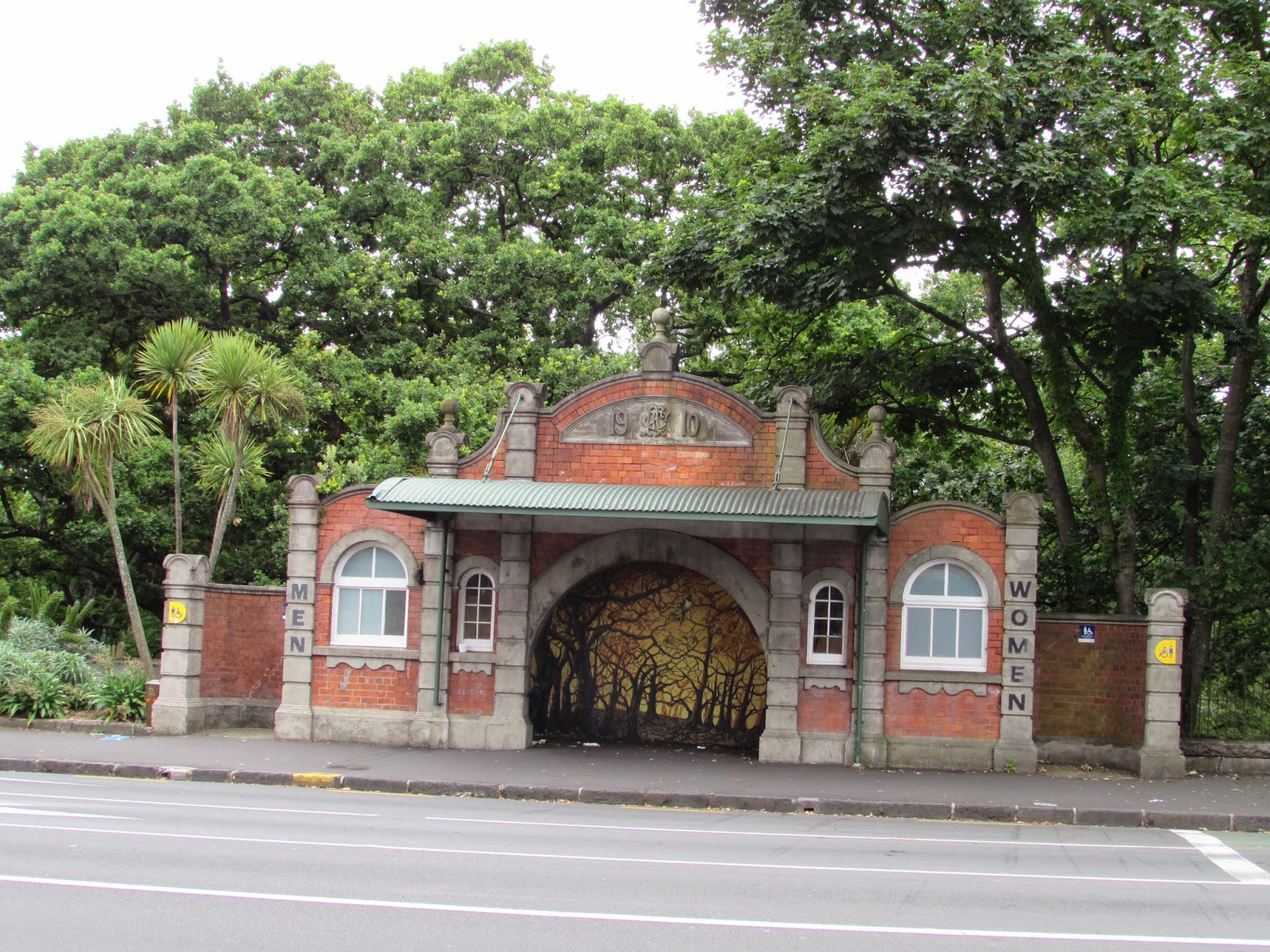
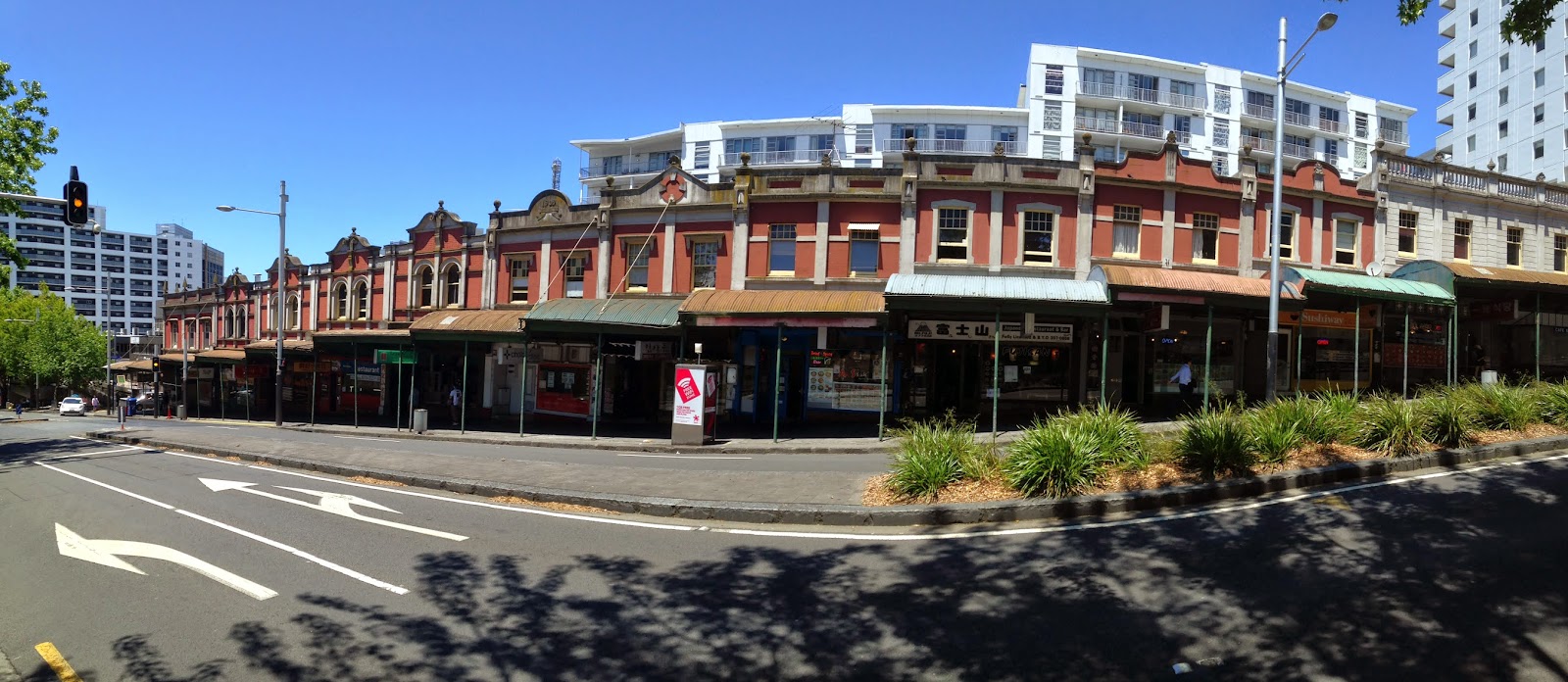
In my previous post, I alluded to the interesting buildings and architecture around Auckland. On my walking explorations of the city I found several examples that demonstrate my contention. Perched on the top of a challenging hill for walkers, Karangahape Road, locally known as K’ Road, has several architecturally significant buildings. The road’s name, translated from Maori, means “a winding ridge of human activity.” I walked the length of the road and explored some of the adjacent areas. Here are some of my favorite examples:


An old tram shelter along K’ Road, built in 1910, still stands although the tram were discontinued more than fifty years ago. 

Also along K’ Road, the intriguing St. Kevin’s shopping arcade was built as an entrance to Myers Park. The park is a gully that runs between two hills and was set aside in 1915 to benefit the citizens of the city. Today, there are a number of eclectic shops and restaurant in the arcade. 

The sixteen terraced shops along Queen Street were built between 1908 and 1912. Currently, restaurants occupy most of the shops. 

The Grey Lynn suburb has a number of shops and businesses. It is not the most prosperous area of Auckland; however, it is vibrant and varied. The seafood shop, with its faded colors, is a great subject for a novice photographer. 


Friday, December 19, 2014

Exploring Auckland

The first time I seriously considered Auckland was in college. I remember reading a brief story, in our local newspaper, about a guy who got on plane heading for Oakland, but ended up in Auckland. The man, Michael Lewis,  said that he was having trouble understanding the accent and thought he was going Oakland, but then grew concerned when the flight was taking him to Tahiti first. At the time, I was dubious about his story thinking that it was a clever scam to get a free trip to an exotic and costly destination; however, upon tracking down a few articles the story does seem to make more sense. 

My story is different: I intended to fly to Auckland, or more specifically to New Zealand. I once read that New Zealand looks like England did fifty years ago. I was not in England fifty years ago; however, judging from my, thus far, limited sojourns in Auckland, I am not sure that the observation is true. Auckland, which is not only the largest city in New Zealand but in the entire South Pacific, is different from many major cities. The city is a place of interesting architecture, where remnants of the the colonial past are still visible. 

A Pukeko in Western Springs, Lakeside Park 
The idea that a country of islands, half a world away, could come, occupy and colonize another chain of islands in the South Pacific is fascinating. Even today, with modern technology and transportation, New Zealand is isolated and exotic. As John Chambers points out, the interchange of cultures between the staid English and the sexually adventurous Polynesians makes the story of colonization improbably intriguing, with the potential for misunderstanding mores. Yet, the remoteness of the sizable islands of New Zealand gives it an other worldly draw. It took time for nature to colonize these remote islands. With no natural predators, some birds abandoned the use of flight. Trees and vegetation did not have the same development patterns as other areas.

The remoteness and mixing of identities, together with more recent arrivals, produces different kind of country. It does cause a tension between what New Zealand is and what it wants to be. Upon entry into the country, the traveller has a number of procedures he/she encounters. The arriving aircraft is sprayed with an aerosol in an attempt to prevent foreign insects from entering the ecosystem. A customs form, which all people arriving must fill out, uses draconian language in an attempt to enforce compliance with laws designed to protect native plants and animals. [Despite the ominous language, I found all the officials courtesy and helpful.] These measures are, no doubt, necessary to protect what remains of the fragile ecosystem. 

Whitcoulls in Central Auckland
Yet, things seem strangely familiar. The most common small bird I have seen while walking around Auckland is the sparrow. There are plenty of familiar stores and fast food restaurants.  Even Christmas is celebrated with a similar enthusiasm and tradition as in the Northern Hemisphere. During the holiday season, which is summer in the Southern Hemisphere, many of the decorations, carols and traditions appear to be centered around the notion that it is supposed to be cold. I was sitting in a café, having a coffee, while blaring over the speakers were two, back-to-back, versions of “White Christmas.” Santa and his reindeers adorn what was once Farmer’s Trading Company, a major department store in New Zealand now a huge bookshop, and snowmen dot the city. Yet, there are subtle differences. A restaurant I had dinner in one evening announced the following day (20 December) that is would be closing until mid-January for the holidays, a tradition that dates back to when shops in New Zealand closed at 6PM everyday. There are rather large flightless birds wondering around the numerous city parks.  And, after all, there are quite a few people wearing shorts and sandals wandering the city. 


\