Sunday, August 16, 2015

A Short Road and Rail Trip

A short road trip found Spence and myself spending a night in Lock Haven, Pennsylvania. After spending the day roaming rural Pennsylvania, checking out the Pennsylvania Grand Canyon and the Wellsboro Diner, we headed for an evening of baseball and adventure. In our brief time in the area, we found good food, conversation and interesting things to think about.
A home for the night
Sometimes the adventure of travelling is not limited to where one visits, but often where one lays their head. This trip had us staying in a caboose, constructed by the Pennsylvania Railroad in 1941. It is now owned and operated as B&B (without the breakfast) by the Clinton County Historical Society. The caboose rests at the old railroad station in Castanea, a small village just across Bald Eagle Creek from Lock Haven. It had the amenities of a nice self-service hotel room, with a dining area, refrigerator and microwave, plus the added bonus of great nostalgia. Although trains no longer pass through the small village, and most of the tracks have long since disappeared, as you wake up one can still hear a constant stream of train whistles in the distance, punctuating the quiet early morning. At one point I thought to myself, is this what it would be like to ride the rails? 
A minor problem with staying in the caboose was that I did not bring a towel, something not provided by the historical society. Thinking I might like to have a shower the next morning, we stopped by a dollar store to purchase a lime green towel ($2.50) and matching washcloth (.50). The next morning, after taking a shower, it seemed that the towel had left a great deal of itself on the floor of the shower. The rest of the day I felt like I was picking lime green lint out of my hair and off my clothes.
A bed for the night
My travelling partner has a propensity to sleep late, so I took the opportunity to have a short walk to explore Castanea. After a night of rain, clouds hung low over the mountains as I walked. The town has become a bedroom community of working-class people, with older homes and very few businesses. There was one house, at the corner of Logan and Brown, which has been abandoned for some time that made me think of the old mansion in the film, It’s A Wonderful Life. Not that the house necessarily resembled the abandoned film mansion; however, the broken windows and the two stories made me wonder if local people might believe the house was haunted. The streets in the town resemble the lattice-work of a pie top, nestled between Bald Eagle Mountain and Bald Eagle Creek. A small, fast-flowing stream, Harvey’s Run, bisects the town from the mountain to the creek. It was running quite heavy after a night of rain.

After my perambulation I find myself at the Train Station Restaurant, a thriving enterprise. The restaurant occupies what once was a house. Two women ran the breakfast without pretense. The food was simple but good and informal. An egg, toast and a cup of coffee cost me less than $4.00, meanwhile I was privy to many of the conversations between locals. The waitress kindly laughed at my joke that I might be back for a second breakfast when Spencer woke up. Sure enough, about 45 minutes later, we returned to the restaurant and I had yet another cup of coffee and toast while Spence had a hearty breakfast of waffle and bacon.


Saturday, August 15, 2015

Boston (Indiana)

The small hamlet of Boston, Indiana is an example of trends found across the United States. Although the population of the country continues to grow, most of that growth occurs in urban and suburban areas. As people have increasingly moved away from rural areas, they have left the remnants of houses, buildings, businesses and institutions behind, often to decay in inglorious fashion. The population of Boston was never substantial, topping out at 257 people according to the 1950 census. Nevertheless, the town was prosperous enough to have an elementary school, a high school and a bank along state road 122, all of which are defunct. Sixty years later the population of Boston was nearly half of what it was in 1950.

The elementary school in Boston, Indiana
The elementary and high school, built in 1932 in a wonderful art deco design, sit empty with broken windows. A rusted, empty flagpole still stands in the front lawn between the two schools and vines have obscured much of the buildings. I wonder if there are still people who long to explore the hallways and classes of their youth. In my own curiosity, there was a temptation to sneak in and have a look at the interior of the building. As we pulled up to in front of the schools, I jokingly asked my travel companion if he was interested in having a look. He flatly declined. Nevertheless, I endeavored to change his mind because the sign carved in stone on the front of the high school read: “Entry ye to learn.”  


Monday, August 3, 2015

Proper, Dignified and Classic Shopping

This summer two major department stores closed in the centers of two cities separated by 3,400 miles. Both stores have had long histories, were cultural and geographic landmarks, and treated the customer to a fine shopping experience in buildings that used marble and brass, rather than concrete and fluorescent lights.
Kaufmann’s was a Pittsburgh institution. Originally founded in 1871 by German immigrants, its flagship store, at the corner of 5th Avenue and Smithfield Street, opened its doors in 1887. The department store evolved into a regional chain that had stores in five states. Eventually, the chain was bought by Federated Department Stores and in 2006 the flagship store’s name was changed to Macy’s.
In the summer of 2015, Macy’s announced that it would be closing its downtown location and the Kaufmann Building would be converted into offices and apartments. Although I had been in the store from time to time. The announcement prompted me to explore the store before its final closing. 
One of the historical aspects to the building is that Frank Lloyd Wright was hired to design the executive offices on the top floor as well as him masterpiece, Falling Water, on the company’s retreat south of Pittsburgh near Mill Run, Pennsylvania. In the late 1920s, the store was substantially redesigned with an art deco interior. While much of the interior has since been remodeled; features have been hidden or abandoned, but the elevators still retain the art deco design. My trip to the eleventh floor felt like snooping, as the only thing open on the level was the salon. I explored some of the empty corridors that had no signs forbidding entry, but clearly had not been used for quite some time. Behind a glass wall one could still see Edgar’s Restaurant, a mid-level eatery; Michael’s Restaurant, a high-end establishment; and, the Forbes Room, a nice meeting room that probably had catered meals as well. Just down the hall, an open door revealed the massive kitchen that served all three establishments. Towards the end of the building’s tenure as a department store, the only remaining restaurant was the Tic Toc Restaurant on the first floor. The Tic Toc opened in 1959 and, in later years, served many of the dishes made famous on the eleventh floor.
Earlier in the summer the classic department store in Dublin, Cleary’s located on O’Connell Street, closed its doors without warning. After years of financial difficulties, aggravated by the global financial crisis, the receivership company announced the store’s immediate closing and liquidation in June. Much like Kaufmann’s, and other department stores in North America and Europe, Cleary’s was a local shopping destination, where one could take time out for a meal or afternoon tea. I once heard a Dubliner tell a group of American students that if they wanted to buy something nice for their mothers, they could do so in Cleary’s. 
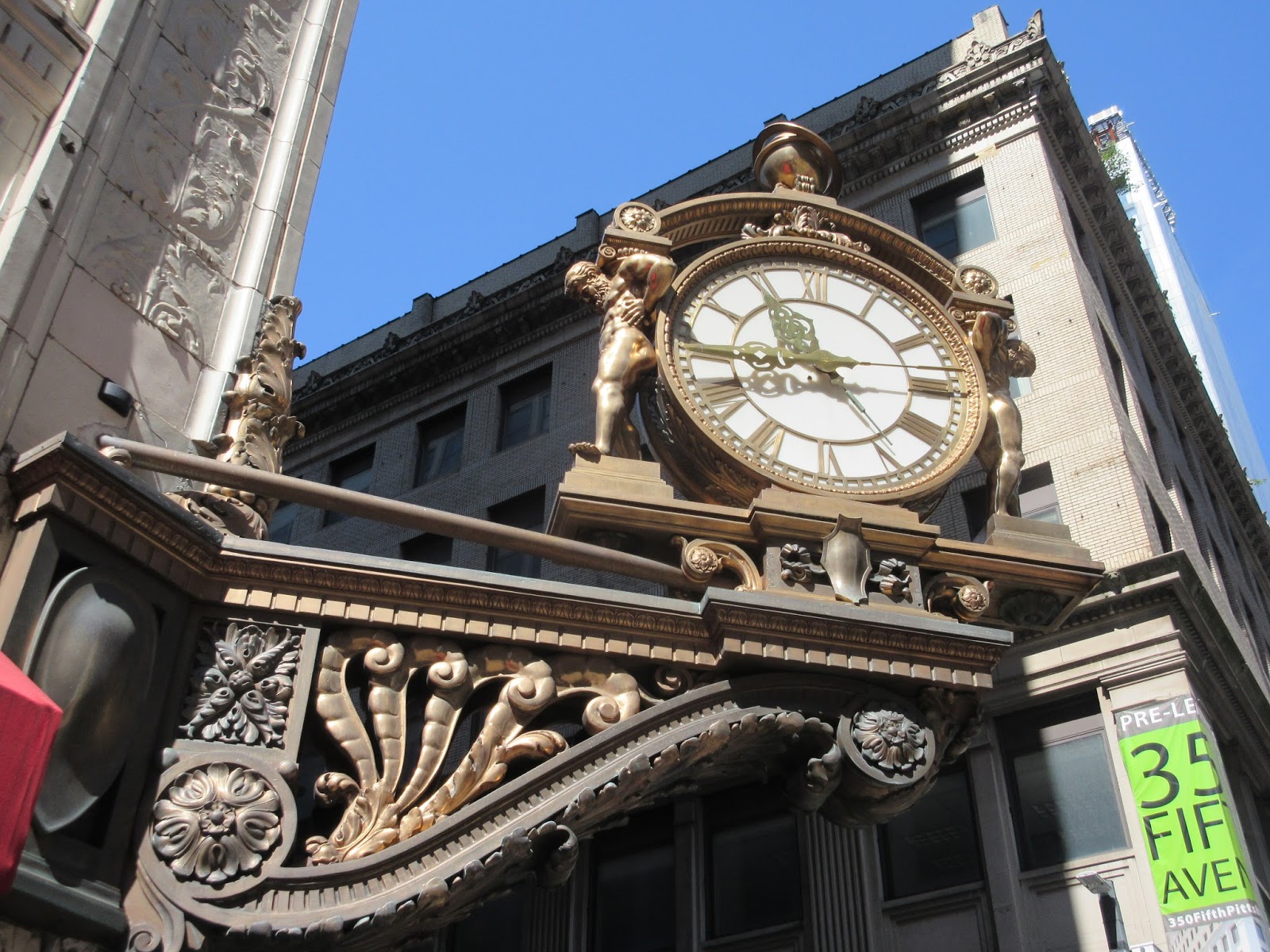
In addition to the many other parallels between the two stores something that Kaufmann’s and Cleary’s had in common was the ornate clocks that graced the outside of the buildings. Because of the central location of these stores, and the recognizable landmarks the stores represented, residents in both cities, in an era before mobile phones and texting, would make plans to meet “beneath the clock at…” Given the ornate clock at the old Marshall and Fields building in Chicago, it was probably the case there as well.

So why mourn, or memorialize, these old department stores? In the days before nondescript malls and fluorescent lighting, grand department stores, with their fabulous architecture and decorative fixtures, ennobled the shopper and provided a memorable experience. These beautiful and elaborate buildings were a sign that the merchant took pride in their work and made the customer feel welcome. 


Tuesday, July 28, 2015

East Broad Top Railroad

Narrow-gauge track in Three Springs
The East Broad Top Railroad line, a defunct, narrow gauge line, is still observable in Three Springs, Pennsylvania. At its peak the company, which built the mainline from Mount Union to Orbisonia between 1872 and 1874, owned 60 miles of line. Its primary function was to remove coal from the Broad Top Mountain plateau. From the late 19th century until the 1950s, the line hauled coal. With the precipitous fall in coal prices and the switch to oil and gas, the railroad switch to tourist excursions from 1961 to 2011. Although there is a preservation society, it appears that excursions have not ran for the last four years.

Squirt Soda advertisement
On a trip through Three Springs, I took the opportunity to photograph the line and a railroad building with a (seeming) vintage advertisement for the soda Squirt.


Saturday, July 25, 2015

Recipe: Thai Basil Chicken

This recipe was inspired by a dish I had at a Thai restaurant in Rotorua, New Zealand. It was probably the best version of the dish I have ever had in a restaurant, so I wrote down the ingredients and began to experiment with the sauces and seasoning when I got home. This is what I came up with:

Ingredients: 1 pound of chicken breast (or tenders), 3 teaspoons of chopped garlic, crushed red pepper to taste, diced carrots (about 1 cup), chopped, bite size broccoli (about 2/3 cup), diced zucchini  (about 1.5 cups), 2 tablespoons of oyster sauce, 1 tablespoon of soy sauce, 10-12 large leaves of fresh basil, and cooking oil.

Preparation:
Sprinkle chicken breasts with Thai seasoning. Baked in an over at 375° for about 15-18 minutes. Remove from the oven and allow to cool. Chop into bite size pieces. If the chicken is not quite cook all the way through, it is fine. The chicken will cook further during the stir-fry phase.

Stir Fry:
1.      In a wok, heat a little oil. Sautee chopped garlic and crushed red peppers for about 90 seconds
2.      Add chicken and stir fry for about three minutes
3.      Add carrots, zucchini, broccoli and stir fry for about three minutes
4.      Add oyster sauce and soy sauce, coat vegetables well, cook for about 2  minutes

5.      Finish by adding basil, cook 30 sec to one minute. Serve immediately over cooked rice (basmati or jasmine is the best). 

Saturday, July 11, 2015

Road Trip: U.S. Route 6 (Providence to Hartford)

It was a beautiful summer day in New England; perfectly blue sky, warm but not too hot. The scenic route from the capitol of Rhode Island to the capitol of Connecticut leads through the heart of southern New England and interesting terrain. The trip, which is about 77 miles, could be done much faster, of course. Yet, time and weather beckoned for a contemplative examination of the route and scenery.
Soon after exiting the freeway onto Route 6 proper, in the outskirts of Providence, more local businesses are noticed. Mom and Pop hotels, such as the Bel-Air Motel and the Stone House Motor Inn, which are in varying states of repair can be found along the road. Dairy bars, as well as pizza shops, dot the little towns and villages along the way. Of course this is New England, so there is a requisite Dunkin Donut in every hamlet and neighborhood; however, there are not a great many chains in the rural areas.
A recent visitor from Britain said that he was surprised how much of the northeast was forested. One of the reasons I love Alfred Hitchcock’s film, The Trouble with Harry, is how beautifully the forests of Vermont in the autumn are filmed. People tend to focus on the shoreline of Maine and Cape Cod, or of the major metropolitan areas, when they consider New England. And, I often forget about the abundance of wetlands in the region. Yet the rural areas of New England are enticing.
The total length of Route 6 in Rhode Island is only 26.5 miles. Thus once you leave the metropolitan Providence area there is not much of the road left in the state. Crossing into Connecticut the road becomes much more typical of the rural U.S. routes that lattice the United States.
Unitarian Church, Brooklyn, CT
Unlike its more famous counterpart further south, Brooklyn, Connecticut is a small and rural crossroad village that is prototypical of New England. The village is picturesque, with the Unitarian Church, sitting on the commons, built in 1771 anchoring the center of Brooklyn. The plain and evocative architecture of the town, usually painted white, is so appealing that even local enterprises that are no longer in business, such as the local service station, are still visually appealing.
Service Station in the center of Brooklyn
After leaving Brooklyn, I stopped for lunch at the Aero Diner in North Windham, a restored 1958 diner originally constructed by the Bramsom Engineering Company of Union Bay, NY. The diner began life as the Boulevard Diner of East Hartford, but was restored and moved to its current location in 2005. Although it was a rather late lunch, the diner hosted a typical Saturday afternoon clientele. Several people lingered over their food and desserts chatting about various things. A young man and woman in their twenties, who went to school together, talk about their new houses and families at the counter. A group of four men in their seventies, with four empty stainless steel milkshake cups in the center of the table talked intently when I sat down to order my lunch. The four men were still there, chatting away, when I left.
Back on the road again, I saw my first sign that indicated the distance to Hartford: 32 miles. It was a reminder to me at how there were not a lot of signs to spoil the view.
Aero Diner, North Windham, CT
I stopped for a short walk on the Hop River State Park Trail in Andover. The railroad track has been replaced by a walking and bike path. I noticed the trail from my car because a relatively new bridge on the trail crosses route 316 within a few hundred feet of route 6. Also at the intersection of Route 6 and 316 once stood the Andover Creamery Company. The creamery utilized the nearby railroad so that local farmers in the late nineteenth and early twentieth century could sell their butter to distant customers across the region.

After my walk, I returned to the car and started west. Soon, U.S. Routes 6 and 44 join together and travel together through Manchester, before joining I-84 into Hartford.


Sunday, July 5, 2015

More Dogs…

Champion Patrick of Ifold
(1923-1931)
I continue to be fascinated by the Anglo-American penchant for memorializing our canine friends in interesting and strange ways. I was touring the Ulster Museum, the national museum of Northern Ireland, when I happened upon Patrick, a massive taxidermy dog that stood about the height of my chest. Pattack was an Irish wolfhound, bred at Ifold Kennels in West Sussex and born on St. Patrick’s Day 1923. Reportedly, he was very famous in his day, accumulated national championships and sired many champion offspring. He died in 1931.

Former magazine model in her retirement years
As I have begun to notice and inventory dog monuments, I have mentally noted that there are not an equal number of places dedicated to cats. It seems that since the Ancient Egyptian civilization, cats have been maligned by poor publicity. Even Hollywood would prefer dogs over cats. However, when you think of the poses struck by dogs, as opposed to cats, one can see how dogs like Patrick, Bobby, or Station Jim might be more majestic that our feline friends.