Showing posts with label Dublin. Show all posts

Saturday, June 25, 2016

Finding the Dublin we might not know

To know a city, one must walk the city. All too often while traveling, we tend to stick to the main thoroughfares that are frequented by tourists. This is true even while walking.  There are interesting sites, restaurants and pubs out of the way, hidden in neighborhoods and side streets. It is true that there are no magnificent structures in these area; if there were, then people would be flocking there. Nevertheless, if you are interested in how people live, take the unfamiliar street or alley.  
I began to explore the Ringsend section of Dublin; an area I have neglected on previous visits. It has long been an area that was out of fashion. It was a warm Saturday afternoon in June. People were enjoying the weather the weather out of doors. Most people I spoke to expressed it as uncommonly good. There were several people sunbathing in Ringsend Park. As the evening wore on, people began to fill up the outdoor seating areas of pubs and restaurants to dine and drink alfresco. I was well outside the tourist area of Dublin and there was an air of ease that surrounded the chatter and laughter.
Demolition of the Boland Flour Mills
Currently, Ringsend is undergoing a transformation from industrial dockyards to a more gentrified area with waterside apartments and office space. Most of the old Boland Flour Mills factory is being demolished and redeveloped. The front portion of the factory appears to salvaged as part of a new condominium front.
While there is a great deal of revitalization, old row-houses, showing the hallmarks of working class lives, can still be easily found adjacent to Ringsend Park. Despite the ongoing gentrification, it was clear it has not affected many side streets and buildings. There is still an uneasy edge to the Ringsend area. Poverty and jobless people are easy to spot. Despite the numerous “ban the poo” signs that dot the area, the sidewalks are a veritable land mine of dog feces. Some roads, especially away from the new and refurbished buildings, are in need of repair. When two cyclists were making their way around the dock, the male commented to his female companion, “The ramps (speed bumps) are smoother than the road.”
As I was walking along the River Dodder, I watched nine or ten boys playing in a small patch of grass near a housing estate. It was not unlike some of the games in which I participated growing up. One vociferous boy got the others organized. By the time I could see and understand what was going on, it was all too familiar. The boys had placed nerf guns into a pile and formed a circle, at varying paces back, around the toy armaments. The lead boy gave a countdown from ten. When he reached zero, the boys all rushed forward to grab a gun. In the ensuing scrum, there was lighthearted wrestling and each emerged with a weapon and had a minute to secure a defensive position for the impending battle. I did not stay for the outcome, but I feel sure that the lead boy would have fared well.
The Grotto on Margaret Place
At the end of Margaret Place, a small cul-de-sac in near the Aviva Arena, there is a small grotto. I found the message at the base a sweet message of neighborly fealty. The grotto is dedicated to Kathleen Crowe who had tended Mary for many decades until her death in 2009. Someone in neighborhood has been continuing in the care of the Grotto. 


Monday, August 3, 2015

Proper, Dignified and Classic Shopping

This summer two major department stores closed in the centers of two cities separated by 3,400 miles. Both stores have had long histories, were cultural and geographic landmarks, and treated the customer to a fine shopping experience in buildings that used marble and brass, rather than concrete and fluorescent lights.
Kaufmann’s was a Pittsburgh institution. Originally founded in 1871 by German immigrants, its flagship store, at the corner of 5th Avenue and Smithfield Street, opened its doors in 1887. The department store evolved into a regional chain that had stores in five states. Eventually, the chain was bought by Federated Department Stores and in 2006 the flagship store’s name was changed to Macy’s.
In the summer of 2015, Macy’s announced that it would be closing its downtown location and the Kaufmann Building would be converted into offices and apartments. Although I had been in the store from time to time. The announcement prompted me to explore the store before its final closing. 
One of the historical aspects to the building is that Frank Lloyd Wright was hired to design the executive offices on the top floor as well as him masterpiece, Falling Water, on the company’s retreat south of Pittsburgh near Mill Run, Pennsylvania. In the late 1920s, the store was substantially redesigned with an art deco interior. While much of the interior has since been remodeled; features have been hidden or abandoned, but the elevators still retain the art deco design. My trip to the eleventh floor felt like snooping, as the only thing open on the level was the salon. I explored some of the empty corridors that had no signs forbidding entry, but clearly had not been used for quite some time. Behind a glass wall one could still see Edgar’s Restaurant, a mid-level eatery; Michael’s Restaurant, a high-end establishment; and, the Forbes Room, a nice meeting room that probably had catered meals as well. Just down the hall, an open door revealed the massive kitchen that served all three establishments. Towards the end of the building’s tenure as a department store, the only remaining restaurant was the Tic Toc Restaurant on the first floor. The Tic Toc opened in 1959 and, in later years, served many of the dishes made famous on the eleventh floor.
Earlier in the summer the classic department store in Dublin, Cleary’s located on O’Connell Street, closed its doors without warning. After years of financial difficulties, aggravated by the global financial crisis, the receivership company announced the store’s immediate closing and liquidation in June. Much like Kaufmann’s, and other department stores in North America and Europe, Cleary’s was a local shopping destination, where one could take time out for a meal or afternoon tea. I once heard a Dubliner tell a group of American students that if they wanted to buy something nice for their mothers, they could do so in Cleary’s. 
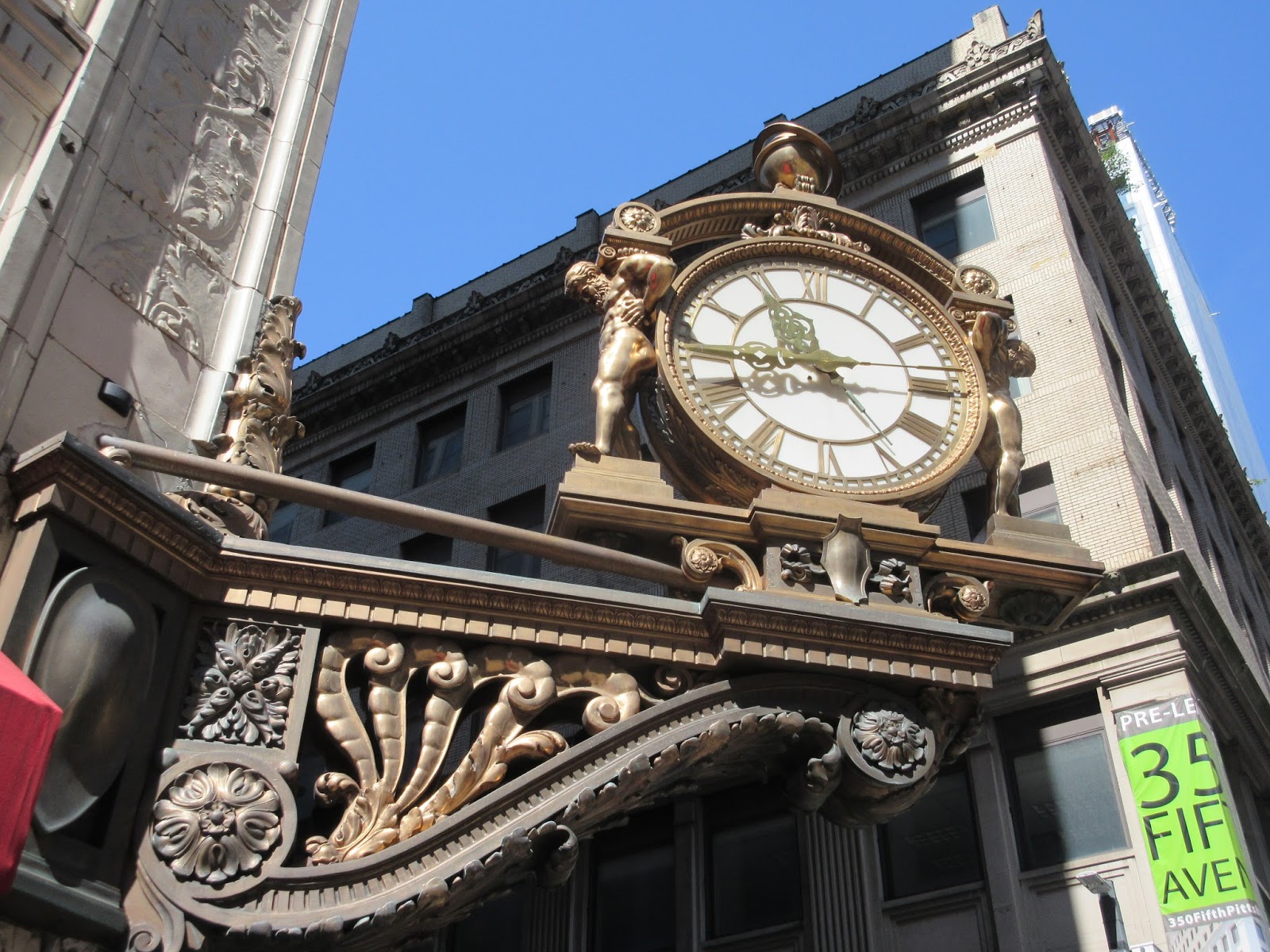
In addition to the many other parallels between the two stores something that Kaufmann’s and Cleary’s had in common was the ornate clocks that graced the outside of the buildings. Because of the central location of these stores, and the recognizable landmarks the stores represented, residents in both cities, in an era before mobile phones and texting, would make plans to meet “beneath the clock at…” Given the ornate clock at the old Marshall and Fields building in Chicago, it was probably the case there as well.

So why mourn, or memorialize, these old department stores? In the days before nondescript malls and fluorescent lighting, grand department stores, with their fabulous architecture and decorative fixtures, ennobled the shopper and provided a memorable experience. These beautiful and elaborate buildings were a sign that the merchant took pride in their work and made the customer feel welcome. 


Saturday, June 15, 2013

Endangered Species

They are still around, but one has to wonder for how much longer. In an era of mobile phones, emails and social media, how long will public telephones and post (mail) boxes continue to exist? Both of these symbols of Britain, usually painted red, are recognizable to citizens and travelers alike. Increasingly though I have noticed that many telephone boxes are empty shells, devoid of telephones. In Britain some telephone boxes might be around for a long time simply because they are iconic and tourist love to take pictures. But what of the long term? Will public telephones be confined to museums?

This trend raises a question: How many public pay telephones are used around the world these days? And, who exactly are using these phones? (I cannot tell you the last time I used a pay phone or how much a telephone call might cost…in any country.)
Since I have been in Scotland during this trip, the telephone boxes do remind me of the great Scottish film, Local Hero (1983). In the film an oil executive desperately wants to maintain connections with his life back in Houston while he is on a business trip to Scotland. He uses the payphone in a small Scottish town to keep himself “connected” to his friends, only to find that he has a real connection with local townsfolk. The film was popular enough that many people actually traveled to the town of Pennan just to see the phone booth from the film. We might suppose that the mobile phone makes us feel more connected; however, as with the spirit of the film, I have my doubts.
Post boxes, perhaps, have a longer life ahead of them. I find it paradoxical that the older hardware (post boxes) will likely survive the “newer” technology (but I digress). It seems that there has been a drop in “snail mail” but I reckon that there will continue to be a need to physically send materials for the foreseeable future. Post boxes in Britain (and Ireland) carry historical references on their sides. The old style receptors have the initials of the reigning monarch on the side. In Ireland, which was a part of the British Empire until 1922, there are still a number of old post boxes that carry the initials of late nineteenth or early twenty century monarchs. The difference is that the Irish boxes got a coat of green paint rather than the traditional red.

Irish Post Box from the George VI era
Post Box from the Victoria Era

Perhaps all of this is nostalgia, but it does make me think of the changing aspects of travel, communications and the world. 

Friday, June 14, 2013

Ireland’s Neutrality and the North Shore Bombings

I was having difficulty finding my destination for the morning. I walked into the offices of Marino College. I could tell that the man in the security/reception booth had sized me up and determined I did not belong there. I asked if he could direct me to the bombing memorial. There was an instant flash of recognition on his face and he understood why I was there. He gently smiled and said, “You’re at the wrong Marino College.” He asked if I was on foot (which I was). He gave me very good directions to get to the memorial, which I had passed along the way. “You will begin to feel a slight rise underneath your feet. When you reach the top of the hill, the garden will be down just a little, on the left side of the road,” he said. 
My goal on this cool drizzly morning was to find the memorial to those who died in the German bombing of North Dublin in May 1941. There is some question as to whether it was inadvertent or not. During the Second World War the government of Éamon de Valera had a foreign policy position of absolute neutrality; however, Republic of Ireland fire brigades had been assisting in Belfast. The outbreak of the war came just seventeen years after Irish independence and two years after the new constitution established a Republic. The new Republic forced Britain to relinquish its naval bases on its territory. Several authors have argued that Ireland’s policy was, in part, based upon the personal animosity between de Valera and British Prime Minister Winston Churchill.  
Several stray bombs had fallen on the Republic of Ireland prior to the North Shore incident. It is worth remembering that the six counties of Northern Ireland (part of the United Kingdom) were heavily involved in the war. In the early morning hours of 31 May 1941, a number of bombs from German airplanes fell on houses in northern Dublin, specifically in and around the North Shore Road area. As a result twenty-eight people were killed and ninety were injured; many more people were left homeless as well. Compared to what was happening across the continent, it may appear that this was a minor incident; however, for those who were the victims it had to be a traumatic event. Ireland was not at war; there was no warning or protection. Average Irish citizens experienced for a few terrifying hours what the Irish Independent referred to as “this horrendous war.”
As was the case elsewhere, tales of what happened in the aftermath are interesting. The Irish Independent related two short stories that offered tantalizingly specific information:

At 8:45 a.m., on Saturday, Miss Behan and Miss Hoey, who resided in 157 North Strand Rd., were rescued alive having been trapped in their home for just seven hours. Before their rescue stimulants were administered to them by Dr. Pringle. (Irish Independent, 2 June 1941)

In another vignette, the newspaper offered a little levity about the tragedy:

It was nearly two hours before the man trapped in the N.C.R. house was dug out. He was exhausted, and his first request was for a cigarette before he was taken to the hospital. (Irish Independent, 2 June 1941)

All the contemporary newspaper accounts (that I have read thus far) offered glowing praise for public officials and rescue services that responded to the bombing. The Irish Press did note the work of private citizens as well in rescuing and helping one another.

In the ruins of one of the houses rescue workers formed a human chain to extricate four people from under the fallen masonry, lifting them from hand to hand to the roadway, while demolition squads worked on the threateningly dangerous walls of shattered buildings beside them. (Irish Press, 31 May 1941)

Ireland’s relationship with the Second World War has been difficult because of its neutrality. Although the North Shore Road bombing was out of the ordinary for the Irish, its memory has been obscured and overshadowed. The memorial was not erected until 1991; the monument was refurbished in 2011 (which is when I learned of its existence). It has been on this trip that I learned of the only Irish-born Jew to have been killed in the Holocaust, Ettie Steinberg; there were a handful of Irish sailors who suffered in German prison camps. Ireland’s stance during the war meant that it did not join the United Nations until 1955. Some Irish citizens did fight for Britain against Germany during the war. But those who did often face prejudice and discrimination after the war. It was just this past month that the government of Taoiseach Edna Kennedy issued a pardon on behalf of the country to those who fought against National Socialism. It is not often that memorials from the World War II era are found in Ireland and Dublin; however, the process of coming to terms with the aftereffects of the war has begun.


Thursday, June 13, 2013

Remembering Poverty: Public Art in Dublin

Quite by accident, while on an exploration near Christ Church Cathedral, I stumbled upon a piece of public art that was brilliant in its simplicity. The exhibit, by Chris Reid, is located in and around Nicholas Street and consists of twenty bronze plaques. Each plaque, without explanation, gives a short snippet of an interview conducted by the artist with Dublin residents who lived near the block of buildings on Nicholas Street. The installation coincided with the refurbishment of the housing blocks. (Reid also published Heirlooms and Hand-me-downs as a part of the project as well.) 

While many of the plaques are interesting and moving, the first one I came across (which is photographed here) was so fascinating and compelling it prompted me to learn more. Without any immediate explanation, the stories drew me to read more and eventually find the explanation. Some of the plaques recall bleaker times and generally urge vigilance, through actions and attitude, to prevent a return to those times.