Showing posts with label Pittsburgh. Show all posts

Tuesday, January 10, 2023

Pittsburgh vs. Vancouver (10 January 2023)


First game at PPG Arena in Pittsburgh in 2023

Pittsburgh vs. Vancouver (10 January 2023)

In my first hockey game of 2023, and my first Penguins game of the season, it looked at first like the two-and-a-half-hour drive to Pittsburgh was going to be frustrating. By the first TV timeout, the Penguins were down by two goals, and coming out of the commercial break they would give up another.  Down by three goals, the Penguins replaced starting goalie Casey DeSmith and even the score by the end of the first period in a dramatic and exciting game. Coming in for relief and making his Penguins debut, was Dustin Tokarski called up after the injury to Tristan Jarry. 

The game had a fascinating backstory. Ending a 6-game losing streak against Arizona in Tempe two nights before, the Penguins remained without the services of Kris Letang who had a nightmarish season thus far. He suffered a stroke on 28 November, only to return to play against Buffalo on 10 December. After suffering an injury in the last game of 2022, he traveled to Boston for the team’s outdoor game in the Winter Classic in Boston. While there, he found out that his father died. The team voted to travel to Montreal to attend the wake in a show of support for Letang.


Dustin Tokarski entering the game, in his Penguins debut, during the first period 

Score


1

2

3

F


Vancouver

3

0

1

4


Pittsburgh

3

2

0

5


Goals

Scorer

Assists

Time


Conor Garland (7)

Hughes

Schenn

4:46 / 1st

Van 1, Pit 0


Brock Boeser (8)

Horvat

Mikheyev

6:40 / 1st

Van 2, Pit 0


Quinn Hughes (2)

Schenn

Petterson

7:05 / 1st

Van 3. Pit 0


Evgeni Malkin (13)

Smith[1]

Rust

8:57 / 1st

Van 3. Pit 1

PPG


Sidney Crosby (21)

Dumoulin

Rust

14:25 / 1st

Van 3, Pit 2


Jason Zucker (10)

Malkin

16:30 / 1st

Van 3, Pit 3


Evgeni Malkin (14)

Zucker

7:58 / 2nd

Van 3, Pit 4


Rickard Rakell (14)

Malkin

Smith

14:31 / 2nd

Van 3. Pit 5

PPG


Travis Dermott (1)

Ekman-Larssson

Boeser

12:52 / 3rd

Van 4, Pit 5


Game Notes:

·         Crosby’s goal 1457 points tying him with Teemu Selanne  for 17th most career points in NHL history.


[1] Ty Smith: First point as a Penguin.

Sunday, February 20, 2022

Penguins vs. Carolina 20 February 2022


Pregame ceremony honoring Sidney Crosby's 500th NHL goal before the game

Andrew and I cautiously resumed our attendance at hockey games. It was our first game together since 8 March 2020, the last game the Penguins played prior to the initial Covid pause. That game, also against the Carolina Hurricanes, was the last time the two teams had played, a gap of nearly two years. The teams entered play each with 70 points, tied for the lead in the division, but the Hurricanes had played fewer games.

Prior to the game, a ceremony to acknowledge Crosby’s 500th NHL goal occurred. The feat happened at the previous home game on 15 February against Philadelphia. Assistant captains Kris Letang and Evgeni Malkin presented him with a golden hockey stick and a framed memento.


Saturday, March 28, 2020

Walking on the Great Allegheny Passage


While my focus continues to be on completing the C&O Towpath, it is intriguing to think about other long walks. The Great Allegheny Passage takes the up where the C&O leaves off in Cumberland, Maryland and completes a 150-mile, non-motorized trail, to Pittsburgh. Walking in the trail in the Pittsburgh area is a step back in time, mixing the beauty of the Monongahela River with the remnants of the city’s industrial history.
Homestead Grays Bridge
Approximately seven miles upriver from downtown Pittsburgh, Homestead was once a vibrant working class and immigrant hub. Today, some of the riverfront has been revitalized into commercial ventures but just a few blocks away the poverty of post-industrial blight remains. Walking from the Waterfront, a shopping and entertainment complex built on the site of steel mills and railroad terminals, the walker is at first confronted with the hurly-burly of shoppers and traffic. The Monongahela is tranquil, but the evidence of a turbulent past is all around. The foundations and rusting structures visible evidence of the steel mills that dotted the riverfront; the moorings of docks, rusting and overgrown, no doubt dangerous, are fenced off from those who walk, jog or bike passed.
Birds thrive along the river and many can be seen along the path, even on a late winter day. Frenetic robins have begun their spring mating rituals a little early this year. Mallards and Canada geese gently swim or mosey away if you approach too closely. Songbirds gleefully tweet but use the undergrowth, shorn of foliage, still provide ample cover from potential predators.
Between mile markers 139 and 140, the Pump House was a part of the U.S. Steel Homestead Steel Works and is now an interpretive center for the 1892 Homestead Strike Memorial. The strike was a defining clash between steelworkers and industrial management, pitting the Amalgamated Association of Iron and Steel Workers (AA) against the Carnegie Steel Company with its local operator, Henry Clay Frick. Company under Frick sought to break the union in Homestead, introducing non-union clauses into the workers contract, leading to a confrontation when the existing collective bargaining contract expired. On 1 July 1892, Frick locked out workers who moved to keep the plant closed through surveillance and picket lines, attempting to deny the company an opportunity to employ replacement workers. The standoff resulted in a pitched battle between the union and Pinkerton agents on 6 July, when Pinkerton agents attempted to land a boat on the grounds of the plant from the Monongahela. Shots erupted and a ten-minute gunfight ensued. The governor of Pennsylvania sent the state militia to restore order. The strike melted away as workers, primary East European immigrants, crossed the picket line. The incident broke the AA; by 1900 not a singled steel plant in Pennsylvania would remain unionized.
One of the interesting things about Pittsburgh is the proliferation of ethnic clubs in the area. In Homestead, the Hungarian Social Club is visible from the trail, but appears to be closed.
Upriver from the commercial sector, the path turns away from the river slightly to circumnavigate businesses that still have property adjacent to the Monongahela. I walk around struggling steel plants and abandoned outbuildings, on East 8th Avenue. The trail leans back to the river where it squeezes between the Monongahela and lightly used railroad tracks. Walking through this area, seemingly a forgotten section of the concrete and trash, there is a temptation to feel vulnerable. A chain link fence ostensibly denies access to the Carrie Furnace Hot Metal Bridge; however, the sizable hole and graffiti on the bridge suggest that it does not do a good job. Constructed in 1900, the bridge has not seen railroad traffic in quite some time.
Rails leading to the Carrie Furnace Hot Metal Bridge


Saturday, December 22, 2018

Eating in Pittsburgh

Ham and Cheese Sandwich, fries included, at Primanti

Travelling to Pittsburgh usually means either hockey or a Dickens Fellowship meeting, sometimes both. After a hockey game, a late-night meal usually constitutes one of a handful of local eateries but most frequently Primanti Bros., where sandwiches come with grilled meat, cheese, vinegar coleslaw, tomatoes, and fries between the slices of bread. Legend has it that the sandwich was invented for steel workers in the Strip District of Pittsburgh, so they could be easily purchased and consumed during a short lunch break.

Sunday morning is an iconic time to have breakfast. It is often a time when families and friends gather and share a morning meal as a celebration of the weekend and a day of leisure and distraction. Conversations at Eggs N’at in Moon Township revolved around the Steelers, their late afternoon game against New England, and the indeterminate prospects for the playoffs. Andrew and I waited for about twenty minutes for a table in the small restaurant that crammed seven tables and a counter that seats eight people into a confined space. Nonetheless, no one seemed to mind the wait. Album covers from the 1970s and 1980s, such Duran Duran’s Seven and the ragged Tiger and U2’s War, decorate the walls. Culinary delights such as rum raisin French toast, breakfast pizzas, and specialty pancakes, tempt even the most fatigued diner.
Eggs N'at on a Sunday morning 
There is an easy conversation between the staff and patrons at Eggs N’at. In typical Pittsburgh fashion, we are greeted with, “Yinz want some coffee?” I observed the other patrons as we wait for our food; most were wearing black and gold, several were consulting their phone for updates of one kind or another. The general din of conversation was interrupted when one of the servers hung up her phone and began complaining about the caller on the other line. He started the conversation, she said, with “Hey, Lady, what kind of pancakes you got?” A story repeated for emphasis, which elicited bemusement both times.


Thursday, March 8, 2018

Saint John Chrysostom Church, Pittsburgh


Built between 1932 and 1935, the evocative Byzantine Church, Saint John Chrysostom, is located on a remote residential street in the Greenfield section of the city. It is a distinct landmark, with onion domes adorned with Slavic style crosses, visible just east of the Squirrel Hill Tunnel from Interstate-376. Often, while driving in Pittsburgh, I tried to deduce how one got to the church. Several times, I scanned the highway for an exit that would allow easy access to the church. It turns out that it located in an isolated part of the city, entombed by surrounding tunnels, highways, hills and waterways. 

We were unable to explore the interior of the church, but murals on the exterior of the building are both beautiful and compelling. As an Eastern Russian Greek Rite congregation, the church has served immigrant families of the community. Buildings such as Saint John Chrysostom serve as a testament to those who settled and worked the dangerous and dirty industrial jobs of Pittsburgh and the religious diversity these families brought to the United States. 

Without a doubt, the most famous parishioner was Andy Warhol, who was baptized in the church as a child.

Tuesday, March 7, 2017

Translating English (Part 3)

Each region of the United States has its own dialect, idioms, and colorful phrases. Pittsburgh, and Western Pennsylvania, is no exception. Perhaps most famous in the Pittsburghese lexicography is the use of the word, “Yinz,” or you ones. It is used frequently in Western Pennsylvania to make informal inquiries or observations, as in “Yinz going to the Steelers game?”
Kennywood is an iconic amusement park, dating from the late-19th century, in the metropolitan Pittsburgh area. It is famous among locals and natives as a place of great rides, school outings and summertime fun. Yet, if you ask or tell a male in Pittsburgh “Kennywood’s open,” it has a profound effect. You are indicating that the person’s pants zipper is down. It is widely known and employed, in fact a local restaurant chain has the phrase on the men’s room door to remind patrons to check their wardrobe before exiting.


My grandmother, a long-term resident of Louisville, Kentucky, was fond of saying criticizing people by saying something was, “Lit up like Levy’s.” The reference was to Levy’s Brothers Department Store, in downtown Louisville, which had a large and bright Christmas display each year. If there were too many lights on in the house, which usually meant she considered it a waste of electricity, they she would utter the phrase. 

Sunday, February 19, 2017

Abandoned Churches in Pittsburgh (Part 2)

About three years ago, I began an exploration of abandoned churches in Pittsburgh. Since that time, I have read quite a lot about the phenomenon of urban abandonment and have become very interested in photography as a way of preserving that which is in danger of being lost. The decline in the number of people who regularly go to church, the loss of congregations to more contemporary services, and the trend of megachurches has fueled the disappearance of late nineteenth and early twentieth century religious edifices in the United States.
Albright United Methodist Church (Pittsburgh)
In the Bloomfield neighborhood of Pittsburgh, the Albright United Methodist Church stands on the edge of oblivion. The structure, built in 1905, was slated for demolition in 2015. Its land was to be redeveloped as space for retail buildings, no doubt using modern building methods that are less permanent. Seemingly, at least for now, there appears to be a reprieve. These great stone buildings, both religious and secular, give the neighborhood a unique feel. It makes the area an attractive destination for urban dwellers. Yet, the demand for modern shopping and conveniences undermine the essential quality of the neighborhood. It is an ironic situation: the aesthetic character of Bloomfield, East Liberty, and Shadeyside that attract modern urban dwellers create an impetus to destroy the things that make the area attractive.
St. Peter and Paul Roman Catholic Church
(Pittsburgh) 
I revisited St. Peter and Paul Roman Catholic Church. Over the past three years nothing in the status of the building has really changed, except that more decay has occurred. In what is ostensibly a “bad area,” people are friendly many times offering a greeting. In my mind, I suspect they are curious about the guy photographing abandoned buildings but local people, nonetheless, usually offer a reticent “hello,” and are more forthcoming when I return the greeting. Nevertheless, just in case I am challenged as to why I am in the neighborhood, I have a cover story ready. It is along the lines of a great aunt who attended the church in the 1970s and I am reflecting in the past. The great aunt part is not true, but every time I run across a church like this I think about the numerous parishioners who once offered their time and effort, their meager financial support, to the particular institution. What they have worked so hard for in their lifetimes stands upon a precipice of existence. It is difficult to think about buildings such as these and not consider the importance of them to generations of the past. 


Saturday, February 20, 2016

Selling Flowers in Pittsburgh

On a Friday afternoon in downtown Pittsburgh, a vendor selling bouquets of flowers from white plastic buckets that I associate with industrial foods is advertising to cars on the way home. As I approach on foot, the man, who is facing away from me, is practicing his martial arts moves, punching and kicking objects and people that only exist in his imagination. I thought to myself that his practice session was, perhaps, not conducive to selling his products. Flowers are usually the purview of the marital arts, not the martial arts.  He suddenly turned my way and was seemingly surprised by my presences. He looked at me sheepishly and asked, “Flowers, sir?” 

Saturday, January 30, 2016

Vignettes of Shadeyside

"Mother's pure Egg Noodles"
The Shadeyside neighborhood  was originally a small village that was later incorporated into the city of Pittsburgh in the mid-19th century. Today there are several businesses, and remnants of establishments, that attest to the vitality of the area. A sign painted on a brick wall, visible from Pearl Street, touts Boehm Company’s Egg Noodles. Dan Cercone’s Barbershop, in operation since 1931, continues to serve local patrons with old-fashion barber services. It is an area that is alive and vibrant, but not reconstructed in a faux gentrification style that is prevalent today. 
A well-dressed woman, with a black coat and matching beret emerged from a row house on Taylor Street. Behind her she dragged a small piece of rolling luggage. The front window of her house had the curtains drawn, but between the window and the curtain was a tortoise-shell cat studiously watching her human disappear down the sidewalk. No doubt, in the cat’s mind, the well-coiffed woman was off on a hunt to gather food for her feline baby. It struck me, as I walked away, neither the cat nor I would ever know the truth.

Dan Cercone's Barbershop after hours
I had breakfast at Rocky’s, where the topic of conversation among the patrons was the current fortunes of Pittsburgh sports team. Pittsburgh is a city where the community is built upon loyalty to, and support for, the local sport teams. More so than any other American city I know, Pittsburghers are more apt to wear clothing supporting the Steelers, Pirates and Penguins, all of which have some form of black and gold in their jersey. It was a January Sunday morning as I sat in Rocky’s and the Steelers' playoff game conflicted with a Penguins games. The conversation focused on the improbability of a Steelers win, while also debating the general malaise that surrounded the Penguins. While one older gentleman hoped for a miracle win for the Steelers, propelling them into the Super Bowl, the more knowledgeable in the diner that morning were resigned to an inevitable outcome. 


Monday, August 3, 2015

Proper, Dignified and Classic Shopping

This summer two major department stores closed in the centers of two cities separated by 3,400 miles. Both stores have had long histories, were cultural and geographic landmarks, and treated the customer to a fine shopping experience in buildings that used marble and brass, rather than concrete and fluorescent lights.
Kaufmann’s was a Pittsburgh institution. Originally founded in 1871 by German immigrants, its flagship store, at the corner of 5th Avenue and Smithfield Street, opened its doors in 1887. The department store evolved into a regional chain that had stores in five states. Eventually, the chain was bought by Federated Department Stores and in 2006 the flagship store’s name was changed to Macy’s.
In the summer of 2015, Macy’s announced that it would be closing its downtown location and the Kaufmann Building would be converted into offices and apartments. Although I had been in the store from time to time. The announcement prompted me to explore the store before its final closing. 
One of the historical aspects to the building is that Frank Lloyd Wright was hired to design the executive offices on the top floor as well as him masterpiece, Falling Water, on the company’s retreat south of Pittsburgh near Mill Run, Pennsylvania. In the late 1920s, the store was substantially redesigned with an art deco interior. While much of the interior has since been remodeled; features have been hidden or abandoned, but the elevators still retain the art deco design. My trip to the eleventh floor felt like snooping, as the only thing open on the level was the salon. I explored some of the empty corridors that had no signs forbidding entry, but clearly had not been used for quite some time. Behind a glass wall one could still see Edgar’s Restaurant, a mid-level eatery; Michael’s Restaurant, a high-end establishment; and, the Forbes Room, a nice meeting room that probably had catered meals as well. Just down the hall, an open door revealed the massive kitchen that served all three establishments. Towards the end of the building’s tenure as a department store, the only remaining restaurant was the Tic Toc Restaurant on the first floor. The Tic Toc opened in 1959 and, in later years, served many of the dishes made famous on the eleventh floor.
Earlier in the summer the classic department store in Dublin, Cleary’s located on O’Connell Street, closed its doors without warning. After years of financial difficulties, aggravated by the global financial crisis, the receivership company announced the store’s immediate closing and liquidation in June. Much like Kaufmann’s, and other department stores in North America and Europe, Cleary’s was a local shopping destination, where one could take time out for a meal or afternoon tea. I once heard a Dubliner tell a group of American students that if they wanted to buy something nice for their mothers, they could do so in Cleary’s. 
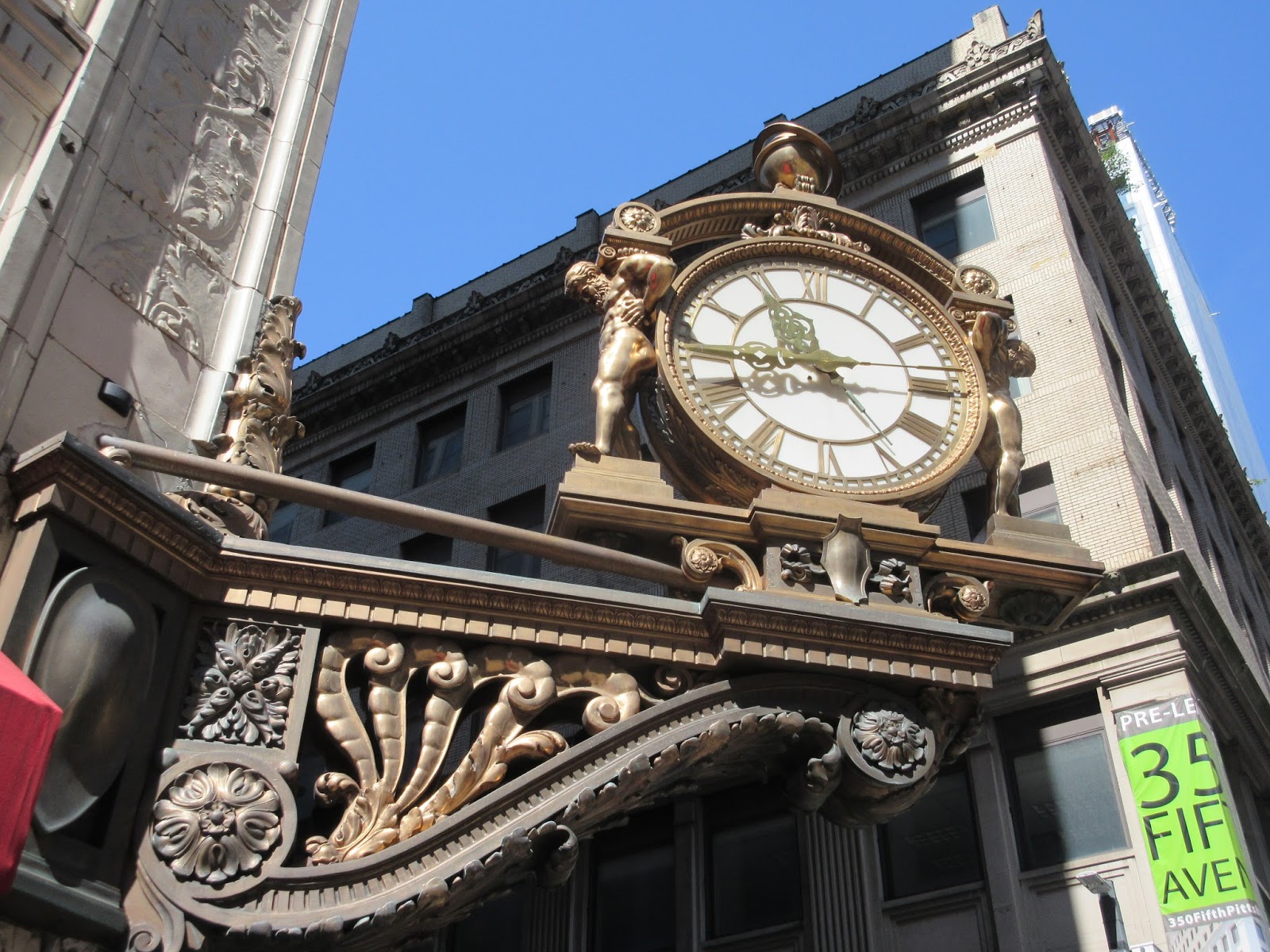
In addition to the many other parallels between the two stores something that Kaufmann’s and Cleary’s had in common was the ornate clocks that graced the outside of the buildings. Because of the central location of these stores, and the recognizable landmarks the stores represented, residents in both cities, in an era before mobile phones and texting, would make plans to meet “beneath the clock at…” Given the ornate clock at the old Marshall and Fields building in Chicago, it was probably the case there as well.

So why mourn, or memorialize, these old department stores? In the days before nondescript malls and fluorescent lighting, grand department stores, with their fabulous architecture and decorative fixtures, ennobled the shopper and provided a memorable experience. These beautiful and elaborate buildings were a sign that the merchant took pride in their work and made the customer feel welcome. 


Friday, August 1, 2014

Baseball: July 2014

Bowman Field in Williamsport, PA
This month I attended a game in my 48th minor league stadium, Susquehanna Bank Park at Historical Bowman Field in Williamsport, Pennsylvania. The stadium was built in 1926 and is currently the home of the Williamsport Crosscutters. Originally the field was named Memorial Field but was renamed in 1929 to honor J. Warren Bowman.
The outfield wall of Forbes Field
Bowman Field hosted its first game on 27 April 1926, which was the first of a two game series between the Williamsport Grays and the Harrisburg Giants of the Negro National League. The Grays played as a member of the New York-Pennsylvania League in 1926, but opened against the Giants as a warm-up exhibition. The Giants, a much more experienced team, won both games easily.

Homeplate from the final game at Forbes Field, 28 June 1970
On my way to see two games at PNC Park in Pittsburgh, I stopped by to recce the remains of old Forbes Field. The former home of the Pittsburgh Pirates, from 1909 to 1971, was the site of some historic players and games, including Roberto Clements and Honus Wagner. The stadium saw Bill Mazeroski’s World Series winning homerun as well as the final three homeruns of the Babe Ruth’s career. Today, all that remains of the great stadium are the outfield wall and home plate, which is situated inside Posvar Hall (University of Pittsburgh).

PNC Park (July 2014)
Statue of Satchel Paige at PNC Park 


Saturday, March 22, 2014

PNC Statues

As George Harrison wrote, “It’s been a long, cold, lonely winter.” But late March means that our attention turns to warmer weather and baseball. Staying close to PNC meant that morning walks could be in and around the park and riverfront area. Although it is one of the newer major league venues (opened in 2001), the baseball history of Pittsburgh is woven into the surround area. The four statues that line the outside of the stadium represent the great legacy of the team.
Roberto Clemente
Honus Wagner


On the corner of General Robinson and Bill Mazeroski Way, stands the statue of Honus Wagner onetime member of the Louisville Colonels (1897-1899) and later, when the team moved, the Pittsburgh Pirates (1900-1917).  The “Flying Dutchman” had a career batting average of .327 and was selected as a member of the first class of the Baseball Hall of Fame. The statue was originally erected in Schenley Park, but moved to Three Rivers Stadium in 1972 when that stadium was opened. In turn, it was moved to its current location when PNC was opened.

On the opposite end of the park, down the left field line at the foot of the bridge that now bears his name, stands the statue of Roberto Clemente.  Clemente hit his 3,000, and final, hit on the last day of the season in 1972. During a relief mission to Nicaragua, in the aftermath of an earthquake, Clemente died in an airplane crash on 31 December 1972. Among his posthumous honors was election to the Hall of Fame. The former Sixth Street Bridge, built in 1927-28, was renamed the Roberto Clemente Bridge.

Saturday, February 8, 2014

The Great Allegheny Passage (Feb 2014)

The Great Allegheny Passage Tail is a 149-mile walking path that begins in Cumberland, Maryland and winds its way up to Pittsburgh, ending at Point State Park where the confluence of the Allegheny and Monongahela Rivers form the Ohio River in downtown Pittsburgh.
Railroad tower near MM144
On the weekend in which January turned to February I walked on a small portion of the trail from an abandoned railroad observation tower in Baldwin Borough (near mile marker 144) to the Birmingham Bridge just prior to mile marker 146. I used the old observation tower as a reference marker for the southern terminus of this trip. The tower was marked with graffiti and is derelict. A large electrical outlet box on the side had its door standing ajar and it seems that birds had worked around the ends of big cables to make nests. Nearby a pair of downy woodpeckers searched the snow-laden trees for food. After two weeks of extremely cold weather, the Monongahela River was filled with ice and sections of the path were covered with well packed snow. As I walked on some of the more secluded parts of this section, I watched towboats with barges navigate and push through the ice that clogged with the river.
Pittsburgh skyline from the Hot Metal Bridge
Birmingham Bridge
Walking north the path crosses 29th Street on Pittsburgh’s Southside, adjacent to the Hot Metal Bridge. The trail in the Pittsburgh area is interesting because it takes you through many of the remnants of the city as a steel town, a sort of modern archaeological excursion. There are several places and markers denoting where steel plants once stood. A pile of railroad ties slowly disintegrating seems to point out that the decline of the industry was rapid and somewhat unexpected. 

As I walked underneath the Birmingham Bridge on Groundhog Day, people were gathering for an event known as the “Drowned Hogs.” Given Punxsutawney Phil predicted six more weeks of this harsh winter, the event probably accurately captured many people’s mood.


Sunday, August 4, 2013

Abandoned Churches in Pittsburgh

My recent sojourn to Pittsburgh was primarily a baseball trip; however, I took a few hours to investigate some of my ongoing interests. Future blog posts will feature some of these investigations. This post, while substantial, still feels incomplete and I will more than likely return to the theme in the coming months.
The recent bankruptcy of Detroit has directed the public’s attention on the plight of urban areas, especially after the decline of an industrial sector. Detroit has experienced decay, depopulation and disassembling. Citizens have become demoralized and have pondered how to escape the seemingly inevitable downward spiral of decline and decay. What is notable is that Detroit is not the only city to have experienced this phenomenon. Other cities, such as Youngstown, Ohio and Camden, New Jersey, have experienced significant decline as well.
Recently, I have been reading Alice Mah’s Industrial Ruination, which is an examination of the artifacts, or “waste,” left behind from industrial societies. As Mah points out the ruins are not static – the empty and abandoned buildings are one state and will be repaired or demolished and rebuilt. Yet, for the residents of that city or town, the artifacts are often nostalgic reminders of what once was. In my explorations of Pittsburgh, I have found an interesting phenomenon that appears to be outside Mah’s analysis. Pittsburgh has had its setbacks and, although they are optimistic signs of its revitalization, a number churches in the city and surrounding areas have been left abandoned and derelict. Yet, many of the churches in Pittsburgh, architecturally, reflect a pre-industrial impulse. Given that many who worked in Pittsburgh’s factories were immigrants, the churches more than likely reflect memories of their homeland and pre-migration lives. What to do with these abandoned churches is a confusing and difficult problem for the city. Because they are architecturally different, and religiously significant, should the city and the community work harder to preserve them? My sentiment is to save these structures. Yet, how many can be?
St. Mary Magdalene Church in Homestead (July 2013)
St. Mary Magdalene Church – Standing across Amity Street from Frick Park, St. Mary Magdalene towers above the working class houses and other churches in Homestead. It was built in 1895-96 and served the working class families who moved to the area to work in local steel mills. After a fire in 1932, the church was substantially destroyed; it was rebuilt and re-opened in 1936. (There was yet another fire in 1977.) The decline of the steel industry in Homestead and Munhall resulted in a depopulation in both boroughs. In 1992, the Diocese of Pittsburgh decided to merge the parishes of Homestead and Munhall, including St. Mary Magdalene. Although originally slated to close, local residents petitioned to have St Mary Magdalene remain open as the new St. Maximilian Kolbe parish; however, the church was forced to close the building in 2009 as a result of financial pressures. The church is currently for sale.
The former St. Peter and Paul Roman Catholic Church
St. Peter and Paul Church – Situated in the East Liberty neighborhood of Pittsburgh, St. Peter and Paul Church was built in 1890. The church suffered a lighting strike and major fire in 1909 and was subsequently rebuilt. In 1992, the parish was merged with five other parishes and closed. In 1999, the church was featured in the Kevin Smith film, Dogma, starring Matt Damon and Ben Affleck. Exploring the neighborhood, the church and rectory, on Larimer Avenue, still dominates the area and from a distance it stills looks impressive. The visual is helped because there are several empty blocks, presumably where houses have been demolished, in the vicinity of the vacant church. But up close, the church tells a different story. In recent months the church and rectory has been broken into, presumably by the homeless, and fires have been started in an effort to keep warm.
The front door to St. Peter and Paul in April 2013
While both of these churches currently stand empty, another former Catholic church has been reincarnated into one Pittsburgh’s most successful dining destinations. The former St. John the Baptist Church is now the Church Brew Work, an award winning microbrewery in the Lawrenceville section of Pittsburgh at 36th and Liberty. The cornerstone of the church was laid in 1902; however, because of the reorganization of the Catholic Church in the early 1990s, John the Baptist was closed in 1993. In 1996, after a renovation, the building was reopened as the microbrewery. The restaurant and brewpub has saved the beautiful interior of the church making it a unique dining experience. Whether Mary Magdalene is repurposed in a way that saves its architectural legacy remains to be seen; however, time is running out on St. Peter and Paul. If someone does not do something with the church in East Liberty soon, there may be nothing left to salvage.