Tuesday, July 12, 2016

Translating English (part 2)

It is easy to have a little fun with funny English translations in China. The so-called Chinglish is a source of amusement for many, including a couple of websites. But one does have to admit that if it was Americans translating English into Chinese, the results would be horrendous. Nevertheless, some translations are minor simple minor mistakes, perhaps even typographical errors. For example, on a tourist map of Beijing near Tian’anmen Square that told the observer: “You Are Her.”
Some translations made me scratch my head in confusion. My favorite was at the Quanfu Temple, which is constructed of wood and has incense regularly burning. A sign reminds the visitor: “Careless is a big fear to fire protection.” Fair enough.

On the highway to Huangzhou, the toll plazas are manned by young people. I read the sign below and then noticed that the attendant was looking slightly upward, off into space, with his hand raised in a wave at a 90-degree angle, with a bizarre (and somewhat creepy) smile. The sign over the tollbooth read: “The Youth Civilization Serve You With Smiling.” 

Monday, July 11, 2016

A discussion on the virtues of cats

Having a cup of coffee at Carson’s Store, the Noark, Connecticut diner that has been a general store and local institution since 1907, I listened as two elderly people, speaking very loudly to one another, have a wide-ranging conversation that ended with this point:
Female: “He does have his good points…he leaves me mice in my bed.”
Male: “Yes. That probably is his best point.” 

Sunday, July 10, 2016

Clomacnoise

When I first visited Ireland in 2001, Clonmacnoise was one of the first places I visited. It is a place that captivated me. I remember reading about the ancient monastery in a travel book and was mesmerized. In planning my trip, I thought that it would intrigue me. It did.  To this day I remain fascinated by the site. It appeals to my sense of history, the quest for knowledge and understanding our place in the world.
This monastery and religious site in County Offlay was founded by St. Ciarán in 547 AD along the banks of the River Shannon with the assistance of Prince Diarmaid. Ciarán never saw the fulfillment of the center for learning and teaching; about seven months after the founding of Clonmacnoise, he died of the plague with his dying word reportedly relaying, “He who perseveres till the end will be saved.” According to legend, he was buried beneath the small church known as Temple Ciarán, a small tenth century structure within the confines that replaced an earlier wooden church. A shrine of Ciarán’s hands was kept at the church but was last seen in 1684. An old Irish legend suggests that a handful of dirt from Clonmacnoie in each corner of a field will insure its prosperity.
The site would grow in religious and scholarly importance during the middle ages but its importance would not protect it. It seems to me that it is a great irony that the site, dedicated to peace, knowledge and contemplation, was attacked no less than forty times over its history by the Irish, the Vikings and the English. Most of the time for plunder, and had devastating results. The vulnerable monastery would survive and rebuild until its final sacking by English forces, dispatched from Athlone in 1552. According to the Annals of the Four Masters, during the attack, “not a bell, large or small, or an image, or an altar, or a book, or a gem, or even glass in a window, was left which was not carried away. Lamentable was this deed, the plundering of the city of Ciarán, the holy patron.”
In Temple Coghlan, a chapel whose walls date from the 10th and the 15th centuries, several gravestones adorn the floor that is largely constructed of grass and gravel. It is exciting, at first, to think about observing centuries old stones and memorials, but a cursory glance leads to disappointment because the grave markers or monuments primarily date from the late 19th and early 20th centuries. It as if the people of just a couple of generations ago viewed the religious and historical importance of Clonmacnoise and sought to appropriate it for themselves.

Clonmacnoise represents a place of learning and study that I find appealing. The knowledge that was lost (the history, art and philosophy) each time the site was raided is a tragedy. I speak neither Latin or Irish sufficiently well enough to understand the manuscript in any meaningful way. Yet, I would relish the opportunity to see what was lost. 

Tuesday, June 28, 2016

Lennon Wall

For fans of Beatles music, especially that of John Lennon, the Lennon Wall in Prague is a source of inspiration and community. During the communist period, it was a blank wall across a small square from the French Embassy. After his assassination in 1980, the residents of Prague turned the wall into a makeshift memorial for John Lennon. It honored his life, music and ideas with graffiti that depicted his image and lyrics. Oftentimes, people would write messages about their hopes for peace, tranquility and fulfillment. The music of the Beatles was officially banned in Czechoslovakia. The authorities would whitewash the wall in an attempt to keep a lid on a celebration of Western music and ideas, only to have residents to reestablish the memorial again.
The Lennon Wall in May 2016
Since the collapse of communism in Eastern Europe in 1989, the wall has remained largely unmolested by the government. It has become a gathering place that attracts more and more tourists and travelers each year. The wall has featured images of the Beatles, references to lyrics, but more importantly implores peace, love and internationalism. People leave messages, identify where they are from and celebrate their love of music. It is not uncommon to fund musicians encouraging visitors to sing alone. Because there are new messages and images every day, the wall is constantly changing.
I have been visiting the wall for several years. The increase in the number of people has meant that the Lennon Wall is no longer a secret shared among a few people. Once, I could bring a dozen students to the wall and we would constitute a majority of people. It is sad to see that more nationalist images have begun to crop up. Two large Czech flags adorned the wall this year. Nevertheless, there remains a feeling of goodwill and comradeship. It is common for people to join in song and greet one another while visiting.
I was talking to a student who was in the military, standing at the edge of the square watching the visitors. He was clearly moved by the experience of being at the wall and interacting with others. He noted that it was nice to see people speaking different languages, from different parts of the world, singing together rather than trying to kill each other. I am willing to bet that John Lennon would have been happy. 

Saturday, June 25, 2016

Finding the Dublin we might not know

To know a city, one must walk the city. All too often while traveling, we tend to stick to the main thoroughfares that are frequented by tourists. This is true even while walking.  There are interesting sites, restaurants and pubs out of the way, hidden in neighborhoods and side streets. It is true that there are no magnificent structures in these area; if there were, then people would be flocking there. Nevertheless, if you are interested in how people live, take the unfamiliar street or alley.  
I began to explore the Ringsend section of Dublin; an area I have neglected on previous visits. It has long been an area that was out of fashion. It was a warm Saturday afternoon in June. People were enjoying the weather the weather out of doors. Most people I spoke to expressed it as uncommonly good. There were several people sunbathing in Ringsend Park. As the evening wore on, people began to fill up the outdoor seating areas of pubs and restaurants to dine and drink alfresco. I was well outside the tourist area of Dublin and there was an air of ease that surrounded the chatter and laughter.
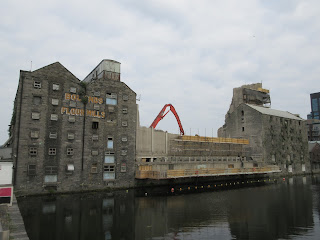
Demolition of the Boland Flour Mills
Currently, Ringsend is undergoing a transformation from industrial dockyards to a more gentrified area with waterside apartments and office space. Most of the old Boland Flour Mills factory is being demolished and redeveloped. The front portion of the factory appears to salvaged as part of a new condominium front.
While there is a great deal of revitalization, old row-houses, showing the hallmarks of working class lives, can still be easily found adjacent to Ringsend Park. Despite the ongoing gentrification, it was clear it has not affected many side streets and buildings. There is still an uneasy edge to the Ringsend area. Poverty and jobless people are easy to spot. Despite the numerous “ban the poo” signs that dot the area, the sidewalks are a veritable land mine of dog feces. Some roads, especially away from the new and refurbished buildings, are in need of repair. When two cyclists were making their way around the dock, the male commented to his female companion, “The ramps (speed bumps) are smoother than the road.”
As I was walking along the River Dodder, I watched nine or ten boys playing in a small patch of grass near a housing estate. It was not unlike some of the games in which I participated growing up. One vociferous boy got the others organized. By the time I could see and understand what was going on, it was all too familiar. The boys had placed nerf guns into a pile and formed a circle, at varying paces back, around the toy armaments. The lead boy gave a countdown from ten. When he reached zero, the boys all rushed forward to grab a gun. In the ensuing scrum, there was lighthearted wrestling and each emerged with a weapon and had a minute to secure a defensive position for the impending battle. I did not stay for the outcome, but I feel sure that the lead boy would have fared well.
The Grotto on Margaret Place
At the end of Margaret Place, a small cul-de-sac in near the Aviva Arena, there is a small grotto. I found the message at the base a sweet message of neighborly fealty. The grotto is dedicated to Kathleen Crowe who had tended Mary for many decades until her death in 2009. Someone in neighborhood has been continuing in the care of the Grotto. 


Tuesday, June 7, 2016

The imbiss at Olivaerplatz

It is a simple snack, or a quick lunch for me while in Berlin: roast bratwurst on a hard roll (Rostbratwurst im brot). It is good, easy and relatively inexpensive. The bratwurst served in Berlin is much longer and not quite as thick as those served in America. Both sides of the sausage hang temptingly out both sides of the fist-sized bun. It is almost if it demands that you eat both ends before you have any of the bread.
Curry uwe
Curry uwe imbiss is an unassuming place at the edge of Olivaerplatz, a square that commemorates the Treaty of Oliva of 1660 ending the Northern War (1655-60). It is small, about the size of a food truck but looks as if it has been there for decades. Eating there means that one must stand at one of the three tables precariously covered by a tent-awning, or in the elements at one of the two small tables in the back. The two tables in back are usually frequented by older people who appear to be regulars. Whoever is working at the imbiss, when not busy, can be found having a smoke and/or chat with those sitting at the table. The conversation is usually convivial.

Plaque commemorating the Peace of Oliva
On days when it is nice I usually take my bratwurst, with a good helping of mustard (senf), further into the square. Olivaerplatz today is a park that has flower gardens and park benches. On a cool afternoon in May I sat at a bench quite some distance from the imbiss and began to eat. Almost immediately a small sparrow appeared at my feet begging for food. I took another bite and was startled when my new acquaintance tried to land on my knee. I wanted to see if the sparrow would land on my knee, but I did not want my entire bratwurst sandwich to become the sparrow’s lunch. I broke off a small piece of bread and threw it to the ground. The sparrow hopped to it right away, struggled with it and then flew off. I was hoping to entice my friend to land on my knee with a second piece of bread, but alas the one piece of bread was enough of a meal.


Friday, June 3, 2016

The Good Dog of Moate

In Moate, I was walking the path that runs alongside the abandoned railway tracks on the north edge of town. It is a great place to relax and see birds up close. A man with an African accent, and his daughter, were walking just a few yards ahead. Meanwhile a woman walking her dog were approaching from the opposite direction. Quite by accident, the five of us (four humans and a dog) converged in the same area simultaneously. The little girl (about five-years old) was singularly focused on the dog, who was older, docile and had a meandering gait. She asked her father worryingly, “Is that dog going to lick me?” The owner, who overheard as she approached, assured the girl that it was a friendly canine and would not pay her any attention. The girl’s father reassured her as well, noting that it was a good dog and would not lick her.
As I approached I offered my hand to the dog to smell as a distraction and a greeting – sure enough, he did not lick. As we all departed our common meeting spot, me walking faster than the father and daughter, the woman and dog walk away, the little girl continued to voice concern, “I did not want that dog to lick me.”

Her father replied
in a reassuring tone, “No. That was a very nice dog…he would not bother you.”