Showing posts with label books. Show all posts

Thursday, March 10, 2022

Powell’s Books City of Books


Powell's: The literature section where Dickens is located

Bookstores are where our mental journeys begin. There is a symbiotic connection between books and travel – they feed one another. We read about where we are going, or where we cannot go, take books along when we travel, then journal and write while we are away.

It is an iconic bookstore, a quasi-religious shrine for booklovers. Powell’s is a must-see experience when in Portland. In graduate school, Powell’s was an online resource for hard to find, out of print texts that fueled one’s imagination. Part of that search was premised on the idea that there was that one book that would solve the research problem, it would be the answer we were looking for. Perhaps I have become jaded, or less naïve, but I am not looking for that one single book.

Watching other people in Powell’s looking for that book might be as fun as shopping for ourselves. I overheard a conversation between a middle-aged woman and her father, who had an armful of books, “Dad, would you like to have a coffee?” “I am not quite done yet.” “That’s okay. We can have a coffee with everyone, then afterwards we will let them go, and you can look some more.” In the cooking section, I observed a twenty-something couple studiously transfixed by the books, located in a locked bookshelf with glass doors that constituted the cooking with marijuana section. In the sci-fi and fantasy section, the clothes worn by patrons were even better than the books.

Powell’s is so large that it is difficult to know how to tackle it. I was not even sure what I was looking for when I went in. At first there was a temptation to add to my Dickens collection, although there was nothing in the section that was unique enough or unavailable elsewhere. I wandered through the hiking and nature section, but it was primarily focused on the Pacific Northwest. Eventually, I was entranced with the travel section. I leafed through a couple of books and guides to El Camino de San Sebastian, because we have friends who will hike it this summer. But it was the travel writing that was beckoning. I walked out with two books about Ireland, probably not a surprise to anyone.

Wednesday, July 28, 2021

The Book Barn (Niantic, CT)


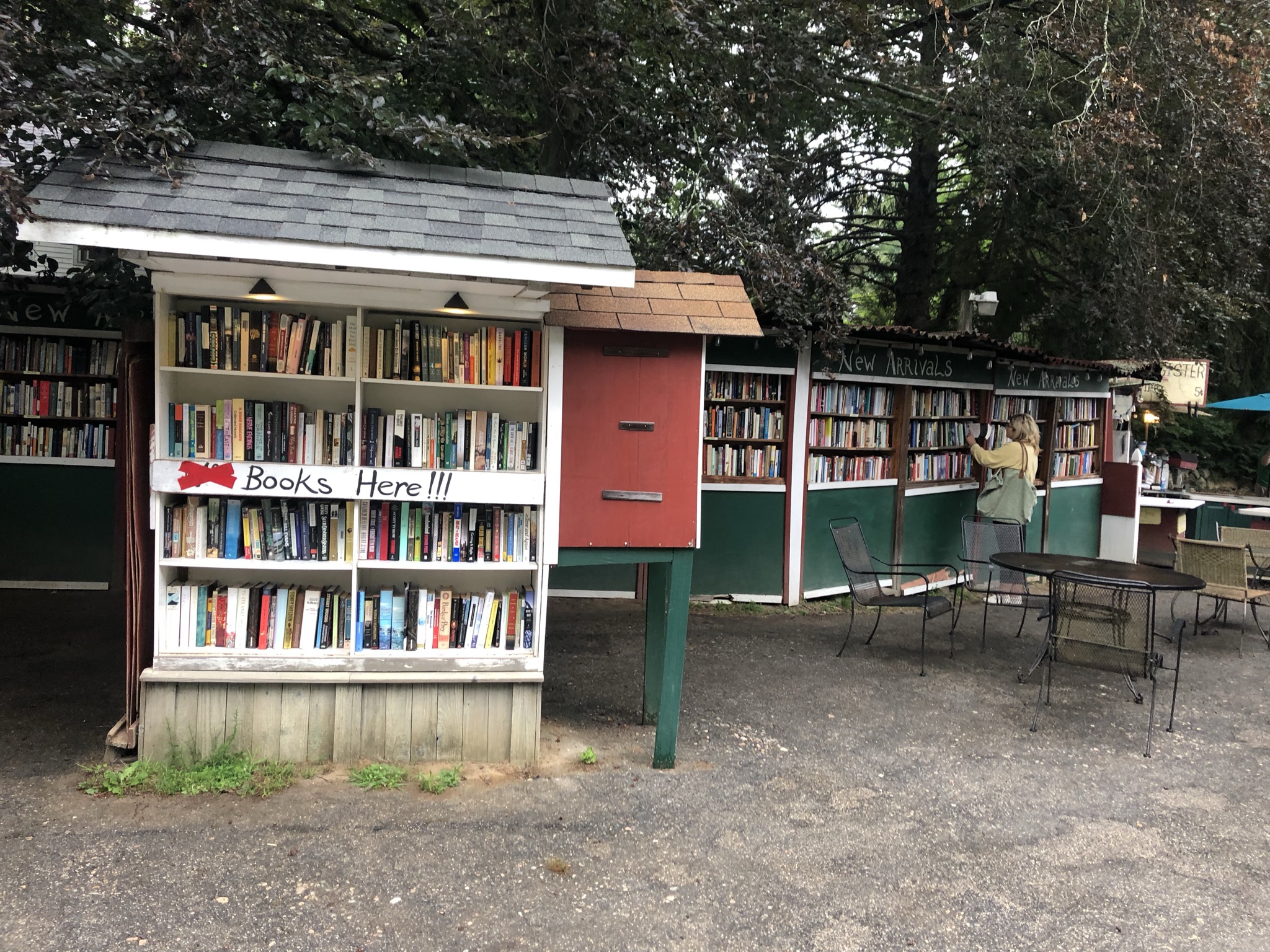
A happy discovery. While exploring the Connecticut shoreline, with all its geographic and travel permutations because of the rivers flowing into Long Island Sound. Niantic, and the surrounding area, looked intriguing. Our goal was to find a small town to walk, wander, and eat. Some place that would be engaging and entertaining on a Sunday afternoon. I set the destination on my GPS for a place, The Book Barn, more because it was on the far side of town. The intriguing name provided a mystery to be discovered. Making our way through town, scouting locations, I aimed to turn around at the destination. But upon arrival, we decided that The Book Barn may should have been our destination in the first place.

Inside the main barn

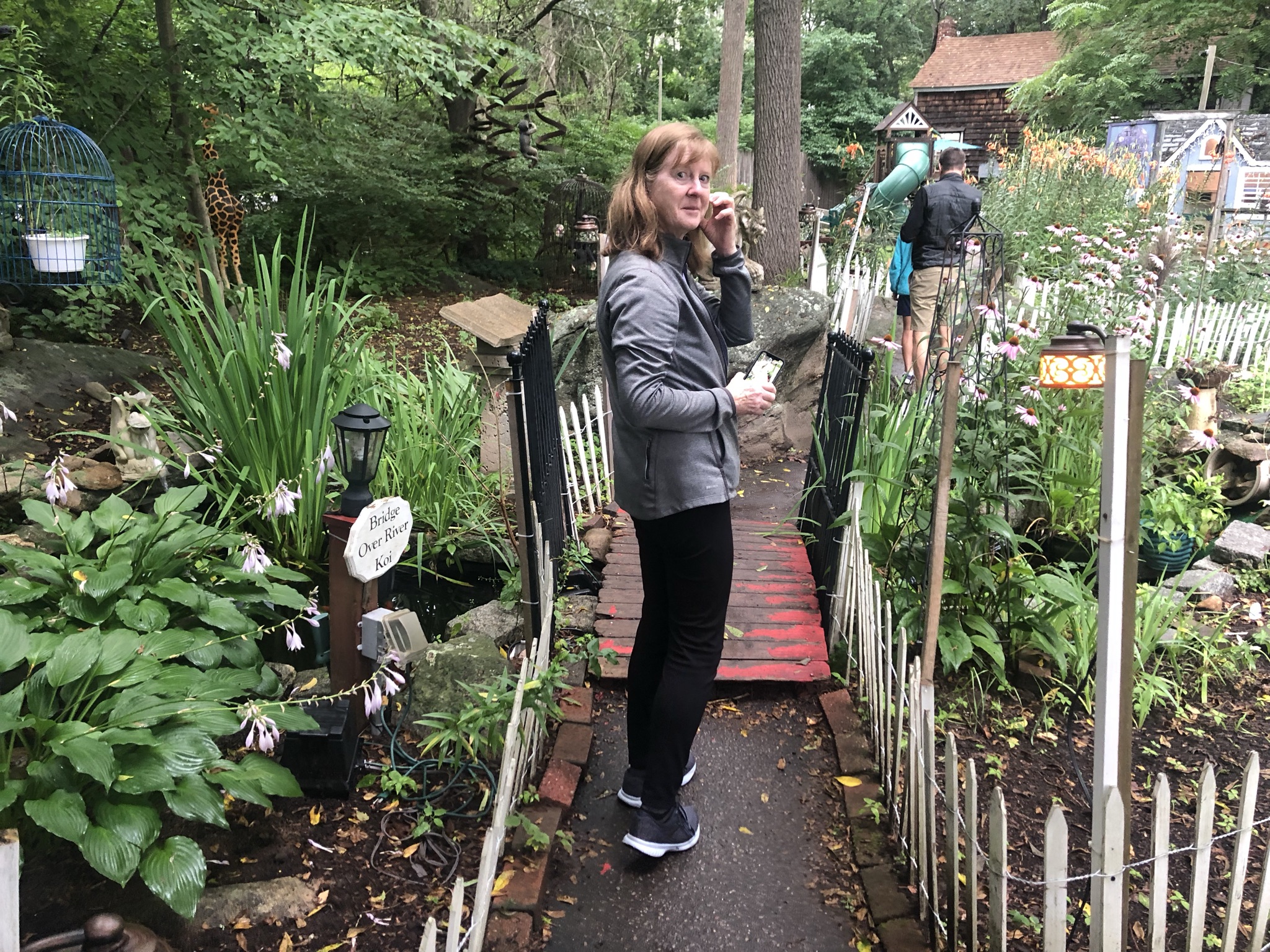
A used bookstore that combines a love of gardening and animals with the pleasures of reading, The Book Barn is a hub of activity for bibliophiles and treasure seekers. It has outgrown the barn that originally contained the business into many outbuildings and stalls around the property. I told Angie, who was worried about some of the books getting wet, that some of the stalls approximated ones that line the Seine in Paris. People wander from building to building, looking for treasures. Signs, prints, and jokes (e.g., The Bridge over the River Koi) entertain and distract browsers. Today, the bookstore has spilled over into two other locations in Niantic, one just a tenth of a mile away and another in downtown Niantic.

Overwhelmed Shopper

On some level shopping was a bit overwhelming: Too many choices, and an assault on the senses. It was difficult to get my head organized because, not knowing that I was going to a used bookstore, I had not thought about what I would hunt for. By the end of the day, after visits to all three locations, I had purchased two books: A Penguin edition of Dickens’s American Notes for General Circulation and a juvenile book called Frank on a Gunboat by Harry Castleman, published in 1892, at $4 apiece.

Inattentive Assistant


Sunday, June 28, 2020

June on the C&O Canal Towpath

The return to the towpath, after three months of staying close to home because of the pandemic, was a difficult decision. But because I was in the most remote area of the C&O Canal, and I would minimize the interaction with other people, I decided to have some exploration during this COVID summer. What I did not realize was that the trail was so remote that it proved difficult to access. 

Exiting I-68, I had difficulty believing my GPS, which said that Bonds Landing was twelve miles away, but it would take 42 minutes to arrive. I was sure it could not be that long, and that it would correct itself as I got closer. If anything, the GPS was optimistic. What I did not realize was traveling though Green Ridge State Forest would be on narrow gravel roads, fording three steams on Carroll and Kasecamp roads, and dodging potholes that were capable of swallowing small cars. As nerve wracking as it was to drive, it was a fascinating journey with an old cemetery, stunning vistas, deer, and mosquitoes. 

The towpath was lush, and the undergrowth full. Within five minutes of beginning my walk I nearly stepped on an eastern ratsnake sunning itself. It is a reminder, early on, that I have not been on the trail in three months. This is not the same as walking in the neighborhood. Whenever I see a ratsnake, at first glance, I think it is a tree branch that has fallen across the path. But the curvature is a giveaway. It is the largest and most common snake in Maryland. Although it is nonpoisonous, its bite can be quite painful. 

I have been reading Peter Wohlleben’s seminal book, The Hidden Livers of Trees, in which he argues that our concept of life, communication, and cooperation is so deeply rooted in our own experience, it is difficult to conceive how other living things might experience the same things. We cannot adequately communicate with trees to determine if they contemplate experiences and relationships, thus we do not know if they have experiences like animals. But his description of how communities of trees share resources, help one another, and have knowledge to heal themselves certainly forces me consider trees differently. Walking along the edge of the canal, one becomes conscience of the number of trees that have succumbed. Often, you can find dead trees leaning against neighbors. It is almost as if the neighbors are cradling their dead neighbors in their comrade's repose. Looking at the remains of one tree resting against two neighbors, I was reminded of the Pennsylvania Railroad War Memorial at 30th Street Station in Philadelphia. The bronze statue, which honors those railroad workers who died during the Second World War, depicts the Archangel St. Michael supporting a lifeless body is a moving tribute. Perhaps trees do not grieve, but a long examination of nature can remind us of how we are part of something larger than ourselves. 

As I finished the month, there is a sense of excitement because I am less than twenty miles from the upstream terminus of the towpath at Cumberland, Maryland. Yet, it is sad that this portion of the journey is coming to an end. During the four trips to the towpath this month, I have encountered few other walkers, except for some near the aqueducts. It makes walking during the pandemic more socially responsible. But like many other things during a pandemic, it is an experience with minimal human interaction. This lack of interaction is not good for our mental health. It is tiring, but the regenerative powers of nature are still present. 


Cody meeting me as I neared the end of my 9.5 mile walk

Roby Cemetery 


Yellow-billed Cuckoo

Paw Paw Tunnel


Town Creek Aqueduct 

Orchard Oriole

Lock 68

Least Flycatcher


Oldtown Toll Bridge

Saturday, May 4, 2019

Reading on Mud Level


Fulfilling my nearly quotidian trip to the CVRT, I drove past the school for Plain Children on Mud Level Road. Seven children, sitting on a two-by-four railing that marked the boundary between the parking lot and the playground, had their heads dutifully bent reading books while sitting in the sun. Each child was dressed in overalls and/or the floral patterns of homemade clothes that I associate with Mennonite women. Small uniformed gaps divided each child from his/her companion. Driving past at 35-miles-per-hour, I caught only a fleeting glance. But there were no distractions; just the pleasure of reading in the sun on a spring day.

Thursday, December 21, 2017

Dickens, Cambridge (OH), and Christmas

The works of Charles Dickens elicit strong responses. There are those who take great umbrage about the place in Dickens occupies in literary canons. His contemporaries often found that his work was wordy and tedious; some modern critics find him too didactic and overly committed to idealized characters rather than real-life people.[1] Yet, many of his works are considered classics, stories that continue to be read in high schools and inspire films, plays, musicals and other works. More so than any other, Dickens has become synonymous with the proper way to celebrate Christmas. The emphasis on traditional meals, caroling, and gift-giving can be traced to A Christmas Carol, even if most people are unfamiliar with the underlying social and political commentary that accompanies the novella.
In Cambridge, Ohio during the holiday season, I found evidence of this connection between the public imagination and Charles Dicken. Each year, along Wheeling Avenue, this small town erects nearly one hundred displays as a part of the annual “Dicken’s Victorian Village,” recreating London Victorian Christmases of the 1850s.  Up and down the sidewalks, in shop windows, and even upon some second stories, mannequins display scenes from a holiday season from our collective imagination. The displays attempt to balance the idealized Christmas with the poverty and deprivation Dickens wrote about. For example, a female mannequin is seated, exhausted, because she has no days off during the holiday season and is expected to be constantly available to provide her service. Another display shows an elderly woman begging from an upper-class man. The accompanying sign from this display notes that there were few respectable remunerative opportunities for females in the London of the 1850s. Yet, most others describe decorating trees, depict Tiny Tim and Bob Cratchit, and details of Dickens the man and his family. These are scenes that prompt nostalgia for days gone by; an imagined simpler time. But juxtaposed are the signs and symbols of the holiday season of the present, with more prosaic advertisements. For example, a used car lot, not too far from Wheeling Avenue, beckons potential customers with a sign that reads: “Naughty or Nice / Get a new car for your wife.”
It is interesting to speculate how Dickens might feel about the linkage between him and Christmas today. I am sure that he would be flattered to think that his works, specifically A Christmas Carol, nearly 175-years old, continues to be relevant and beloved. But in one of his lesser known works, The Chimes, written a year after A Christmas Carol, Dickens is particularly suspicious of nostalgia and believing that there were “good old days.” The primary protagonist in this novella is Toby Veck, who opens the story with a prayer, muttered to himself, “I don’t know what we poor people are coming to. Lord send we may be coming to something better in the New Year nigh upon us!” Although it is frequently pointed out that Dickens was concerned about the plight of the poor, the collective remembrance of A Christmas Carol tends to focus on the spirit of Christmas and holiday traditions. But Dickens was also concerned about how recounting the “good old times,” as he called it in The Chimes, served to discount the lives of the poor. In remembering the “good old times,” no one ever talks about poverty and deprivation. Toby comes to believe, because of the persistent nostalgia for an undefined previous romanticized era, that the poor must accept sole blame for their plight and are “born bad.” This relieves the intelligentsia and upper-classes from any responsibility for the system, the alleviation of poverty, or supporting the public tools, such as education, to help the poor escape the situation. Surely, a lesson for the modern world as well.


[1] In an editorial written in the Wall Street Journal, playwright David Mamet wrote that the author’s work made him “vomit.” Mamet admits, however, that A Tale of Two Cities and A Christmas Carol are classics of English language literature. David Mamet, “Charles Dickens Makes Me Want to Throw Up,” Wall Street Journal, 22 July 2017. 

Saturday, December 24, 2016

Reading A Christmas Carol in the Twenty-First Century

The mirror, in the Parker House Hotel, Boston, 
where Dickens practiced A Christmas Carol
before giving public readings
Although published nearly 175 years ago, A Christmas Carol remains essential reading. While it may not immediately seem to be a book about travel, Charles Dickens, a prodigious traveler himself, has his protagonist travel through time and space to review the consequences of his action. Because the Christmas season is both a time of charity and reflection, Dickens takes this opportunity to remind his reader about the necessity of both. The book is a critique of Victorian England, but the genius of the book is how it transcends time and place to think about our lives and others.
The opening paragraph of the novella set the scene: There is a broad discussion of how mean and cruel Scrooge is to his fellow man. His general disposition is so unkind that even the blind man’s dog finds no favor with him. When confronted by his nephew with his unpleasant nature, especially given it is the Christmas season, Scrooge asks how can he not be? He considers himself surrounded by fools and people who do not understand the driving force of the economy. The holiday season marks a time at which people spend lavishly money they do not have; engage in celebration, while they have nothing to celebrate. In short, they foolishly spend their money to make others happy. His nephew retorts, on the contrary, the season is one in which people open their hearts and treat their neighbors charitably. He implores Scrooge to think of people, those less fortunate, as “fellow-passengers to the grave;” we all share the same mortality and the existential plight of this reality. We may not have profited from those less fortunate, but the Christmas spirit instructs us to treat them charitably nonetheless.
A few pages later, Scrooge is visited by two men who are seeking subscriptions for the poor: “Many thousands are in want of common necessaries; hundreds of thousands are in want of common comforts, sir.” His reply is telling: he queries about whether prisons and workhouses still exist. When he is told how horrible the places are, that many would prefer to die than be sent to those institutions, his response that those unfortunates should die, it would have the benefit of reducing the surplus population. The words written by Dicken, throughout his career, helped to highlight the plight of the poor, the tragedy of child labor, and the degradation of poor houses. It would be easy to tell ourselves that this was in the past, part of nineteenth century Dickensian Britain; however, these problems continue still shape our world, economies and lives.
Scrooge claims not to know of the dismal nature of the poorhouses. It is a willful neglect. It was not his business to concern himself with such things; his business kept him occupied to the extent that he could not, nor did he want to, take a concern in the plight of the poor. When his dead former business partner, Marley, appears to him, Scrooge doubts the apparition, instead choosing to believe the facts (as relayed by his senses) cannot be trusted. It might be a case of indigestion caused by mustard, cheese, or an undercooked piece of potato. His rationalization of what it could be, rather than what the facts lead us is all too familiar with the current fascination of fake news. All too often we choose to believe what fits our heuristic of how the world works and reject out of hand data contrary to our beliefs.
Scrooge compliments his former partner on his business acumen; however, the ghost of Marley counters that his actual business should have been the welfare of humans, benevolence, and charity. Instead he, and Scrooge, chose to focus on the trade by which they accumulated wealth. Yet, “The dealings of my trade were but a drop of water in the comprehensive ocean of my business,” Marley laments. It is a recurring theme in the works of Dickens, telling his readers repeatedly that a person’s worth is not predicated on their ability to make money. When confronted with the probable death of Tiny Tim, the Ghost of Christmas Present reminds Scrooge of his comment that such deaths would reduce the “surplus population.” It is a funny thing that, in modern society, we place rhetorical emphasis on those who forego remuneration in order to help other humans or the world in general. Yet, we privilege and celebrate those who make a great deal of money as being wise or insightful. Where is our concern for those less fortunate?
The pursuit of money, while forgetting the humanity around him, leads to the end of Scrooge’s morals, kindness, and happiness. We can even see this as an enlightened self-interest: karma, or what goes around, comes around. It is a point not lost on the traveler either: a generosity of spirit yields an abundance in return. In the opening chapter (stave), Scrooge is clearly unhappy: he offers no charity and receives none in return. Dickens points to his avarice as the source of his difficulties. His pursuit of money means that he loses his chance at love. The Ghost of Christmas Past shows him how a young woman, Belle, puts an end to their relationship because he places more emphasis on the idol money than her. She Admonishes him, “I have seen your nobler aspirations fall off one by one, until the master-passion, Gain, engrosses you. Have I not?” Clearly disturbed by this vision of the past, Scrooge is forced to endure the vision of her as a grown woman, basking in the love of her daughter and the adoration of her husband. The path not traveled, martial contentment with Belle, is the price Scrooge pays for his avarice.
Dickens uses the voice of the Ghost of Christmas Present to remind is readers of the hypocrisy of Victorian England. There was a bill introduced in parliament to close bakeries and other entertainment venues on Christmas and Sundays, which would have deprived poor people of a hot roast and a day of leisure. Proposed by Sir Andrew Agnew, the Sunday Observance Bill was designed to enforce a certain amount of piety for religious holidays; however, the burden would have fallen particularly hard on the working class. Since bakeries were forbidden to use their ovens to bake bread on Sundays, many allowed their ovens to be used to cook roasts for those who did not have the means to so in their own homes. Sundays were the only day off for most of the working poor, thus the law would deprive them of their recreation opportunities. Scrooge asks the apparition if these moves were not done in the name of Christmas spirit. But the ghost explains that those who were attempting to do so were using bigotry and hatred in the name of piety to further their interests and do not speak for the spirit of the holiday itself. Dickens was particularly keen to advocate on behalf of the working class and their leisure time. In a tract against the Sunday Observance Bill, he wrote: “The idea of making a man truly moral through the ministry of constables and sincerely religious under the influence of penalties, is worthy of the mind which could form such a mass of monstrous absurdity.” Dickens goes on to argue that the minister who buys sports equipment for children was doing more to make people happy, religious and moral than any legislation could ever hope to achieve.
The use of Christmas as a setting implies a certain religious dogma. But to think that the lessons from Dickens applies solely to Christians would be a mistake. The lessons of kindness and charity, of treating others well, of being patience and kind, transcends a single religion and a specific holiday. The traveler knows that acts of kindness while on a journey is repaid several times over.


Sunday, July 10, 2016

Clomacnoise

When I first visited Ireland in 2001, Clonmacnoise was one of the first places I visited. It is a place that captivated me. I remember reading about the ancient monastery in a travel book and was mesmerized. In planning my trip, I thought that it would intrigue me. It did.  To this day I remain fascinated by the site. It appeals to my sense of history, the quest for knowledge and understanding our place in the world.
This monastery and religious site in County Offlay was founded by St. Ciarán in 547 AD along the banks of the River Shannon with the assistance of Prince Diarmaid. Ciarán never saw the fulfillment of the center for learning and teaching; about seven months after the founding of Clonmacnoise, he died of the plague with his dying word reportedly relaying, “He who perseveres till the end will be saved.” According to legend, he was buried beneath the small church known as Temple Ciarán, a small tenth century structure within the confines that replaced an earlier wooden church. A shrine of Ciarán’s hands was kept at the church but was last seen in 1684. An old Irish legend suggests that a handful of dirt from Clonmacnoie in each corner of a field will insure its prosperity.
The site would grow in religious and scholarly importance during the middle ages but its importance would not protect it. It seems to me that it is a great irony that the site, dedicated to peace, knowledge and contemplation, was attacked no less than forty times over its history by the Irish, the Vikings and the English. Most of the time for plunder, and had devastating results. The vulnerable monastery would survive and rebuild until its final sacking by English forces, dispatched from Athlone in 1552. According to the Annals of the Four Masters, during the attack, “not a bell, large or small, or an image, or an altar, or a book, or a gem, or even glass in a window, was left which was not carried away. Lamentable was this deed, the plundering of the city of Ciarán, the holy patron.”
In Temple Coghlan, a chapel whose walls date from the 10th and the 15th centuries, several gravestones adorn the floor that is largely constructed of grass and gravel. It is exciting, at first, to think about observing centuries old stones and memorials, but a cursory glance leads to disappointment because the grave markers or monuments primarily date from the late 19th and early 20th centuries. It as if the people of just a couple of generations ago viewed the religious and historical importance of Clonmacnoise and sought to appropriate it for themselves.

Clonmacnoise represents a place of learning and study that I find appealing. The knowledge that was lost (the history, art and philosophy) each time the site was raided is a tragedy. I speak neither Latin or Irish sufficiently well enough to understand the manuscript in any meaningful way. Yet, I would relish the opportunity to see what was lost. 

Monday, June 15, 2015

On Books, Bookshops and Libraries


One of my great pleasures of traveling is visiting one of two places: a library or a bookstore, preferably used. I recently read two pieces that helped give form to some of my thoughts on why I find libraries and bookstores so valuable and why I seek them out while travelling.
Nick Bilton’s piece chronicles the love he shared with his mother for books and reading. Their shared fondness was interrupted by an argument over the utility of e-books. It seriously damaged his relationship with his mother and led to deep reflection about the importance of books. Like him, I occasionally use an e-reader while traveling. Yet most of the time, I prefer the tactile pleasure of a physical book. I am a person who needs physical reading materials when I need to concentrate. The temptation to become distracted while on a computer or e-reader is just too great.
Bilton’s disagreement with his mother is further complicated after he moves to the United States and it becomes apparent that his mother’s cancer is terminal. After her death, his sister who is sorting through their mother’s belongings, sends him a text message asking if he wants her iPad. It is a devastating question. He does not want it; he wants her library – the books she held, felt, wrote in, spilled things on. The iPad is a piece of electronic gadgetry that will someday become obsolete and ceased to work. The beauty of the book is that it is a technology that can always be used and does not require a “reader,” other than the person holding it.
Treasures from used books: A "Hullabaloo" 
For me, part of the thrill of finding books is to see the name, date or inscription written inside. It is a great treasure to find a little note or newspaper clipping left between the pages of a book. While in Edinburgh I shopped a charity used book sale at a church and purchased a copy of Historical Streets of London, written in 1923. It has an inscription that reads, “To John and Nancy for friendship + hospitality, March 1979.”  Used books connect us with other people, from around the world, sometimes who died before we were born. As with Bilton and the messages to and from his mother, the personal notes left for others are a gift. The gift of a book is not simply a gift of hours of pleasures, but a lasting epigram of messages and meaning. Perhaps the messages left for me are less literary, but they are every bit as meaningful.  Even without an inscription, the gift a book carries meaning. Books are collections of stories or ideas that the owner thinks is sufficiently important that he/she is willing to keep it among their personal possessions. Giving a book as a gift is sharing these ideas and messages. It is a reminder to ourselves (and others) of who we are and what we think is important. In the corner of a messy closet I have a small collection of my father’s books. There are no great editions, nothing of substantive value – just his books. The move to digital media makes me wonder what will become of my own library when I am gone.
Forsythe’s essay is more upbeat and amusing; however, the message is still serious. His central thesis is that bookshops are essential for an educated life. The problem with knowledge is that we don’t know what we don’t know. Hence, the joy of book shopping, especially in a physical bookstore, is that we browse, search and discover. It is a journey of the mind. The book can be held and taken for a test drive. We get a preview: Does it hold our attention? Do we like the way it looks?
I make the same claims about libraries. The library is a repository of knowledge and information that is limitless. Even the smallest library contains unknown useful and/or interesting information. A public library is a place where the citizen can education oneself. Yet, we overlook libraries and take them for granted. Often libraries suffer from neglect. People only pay attention when there is a controversy. Yet, the loss of a library is a serious blow to a society.

Many would argue that the internet make books, traditional libraries and bookshops obsolete. Yet, these kinds of arguments do not take into account the usefulness of adjacent information. In the book lover’s parlance, the law of the good neighbor suggests that often the information want is not in the book you are looking for, but in the book next to it on the shelf. The bigger the collection, the larger the size our fields of information becomes. At the end of the day, while books, bookstores and libraries might seemed to be institutions of the past, we live in a world where high-level knowledge still requires each.

Nick Bilton, “In a Mother’s Library, Bound in Spirit and in Print,” New York Times, 14 May 2015, page D2.

Mark Forsyth, The Unknown Unknown: Bookshops and the Delights of Not Getting What You Wanted (Icon Books, 2014). 

Monday, May 25, 2015

Some thoughts on Leigh Fermor’s A Time For Gifts

One of the great travel writers of the twentieth century, Patric Leigh Fermor provides an elegant and intoxicating view of Europe during the 1930s. In December 1933, just months after Hitler became chancellor of Germany, the 18-year old Leigh Fermor sets out to walk across Europe from Holland to Istanbul. Forty years later he revisits his journals, the treasured mementos of any traveler, and begins to construct a planned three-volume remembrance of that fateful journey. A Time for Gifts is the first of those three volumes and it takes us to a world lost because of time, war and practice. Each time I picked up the book, a respite in my busy schedule, I found that a smile crept across my face.
Rather than an interesting time-capsule approach to the subject, Leigh Fermor relies on his journals and memories, he contextualizes what he thought, saw and experienced. The book does so without the heavy foreshadowing one might expect. Obviously, the reader knows what is coming. Yet, there are no overburdening allusions to the tragedies or events that are about to come;  we know that bad things are going to happen to some of the people he encounters and we are free to speculate without the author telling us what happened. 
In an introductory letter to his friend Xan Fielding, Leigh Fermor sets the context for his journey. He notes, writing decades later, that the impulses and desires of youth works to keep us unfocused and in trouble. Leigh Fermor gives perspectives and can better explain some of his actions. His tendency to engage in social activities, his attention to connections with women, and the temptation of constant parties, all conspire to allow his talents to go to waste. He decides to take a radical step, to break out of a life set to be wasted.
One of the primary interests of the author in A Time for Gifts is an earlier history of Europe that most of us are aware of today. While not specifically mentioned, the gathering clouds of the First World War casts long shadows over the book. Leigh Fermor concentrates on the bloodletting that surrounded the Thirty Years’ War, but conveniently neglects the more recent devastation that was World War I. Perhaps it is all too fresh and raw. The continent convulsed during the war and the monuments, even a hundred years later, are ubiquitous; every small town has a monument or cairn commemorating those who fell during the Great War. Since the journey takes place in the interwar years, his trip, the countries he visits and the politics of the time are all shaped by the aftermath of the First World War and the impending gloom of the coming Second World War.
Nevertheless, from the perspective of the reader, there is a sense of uneasiness and concern about the fate of the people the author meets on his journey. Toward the end of one chapter I had a sense of foreboding about Baron Pips that he did not survive the war (as he was Jewish). But by the final paragraph of the chapter, we are relieved to find that Pips survives and thrives. The book does an excellent job of building tension and creating empathy for the people he meets. But the story does highlight what is lost: six million Jews, as well as several million others, die. Sure, Baron Pips is unique, but who is not?
At one point the young Briton is confronted, chastise and ridiculed by a supporter of Hitler in a beer hall; however, many other people come to his defense. It is an example of how fanatic supporters often hold individuals accountable for the actions of their group or government. It is also an example of how some people internalize the messages of their leaders or governments, while others overcome their cognitive dissonance to come to his aid. Leigh Fermor finds a tremendous amount of kindness throughout his trip. In another example, in Heidelberg, after he is taken in by an elderly couple during the middle of a snowstorm. He quite rightly asks if a German traveler would be treated the same in England. It is a question that haunts many of the students who travel to Europe with me.
The simple gift of a five-year old daughter of a German innkeeper in Bingen early on Christmas morning was very touching. I was sympathetic to his inability to think of a gift with which to reciprocate. Leigh Fermor’s description of beautiful faces of the innkeeper’s daughters, aged 5 to 15, led me to immediately consider what will happen to these young girls ten years down the road. Germany will is be pummeled by Allied planes; deprivation and devastation will be widespread. I am sure it was on Leigh Fermor’s mind as he edited his notes years later. What happened to that sweet five-year old, who would have been about seventeen, when the war ended? Her sweet and kind gesture was unlikely saved her from the deprivations suffered a dozen years later. 
Other encounters offer interesting travel insights and observations. Leigh Fermor ruminates on the importance of eggs. There one point in which he describes the delight in carefully removing the egg from the shell with a spoon and having it with buttered bread. Another incident has him riding in the back of a lorry with a fifteen-year old girl who gives him a birthday gift of a dozen eggs. For those of us who are drawn to travel by foot, Leigh Fermor offers quotable passages to explain our passion to others. When he is tempted to take a ride to go further down the Danube, he reminds himself that “all horsepower corrupts.” I have often noted that to walk provides an opportunity to observe. Walking at three miles an hour, as opposed to traveling by auto at sixty-plus or by train at 120-mph, allows for a study rather than a glance. If you see something of interest, walking affords the chance to study rather than a fleeting glimpse. Leigh Fermor concurs noting that while walking it is impossible to be out of touch.
A Time for Gifts is a difficult book to describe, yet at the end of the day it is a book about the joys of travel, walking and meeting people. I smiled knowingly when Leigh Fermor writes that he would wander the city and kept repeating to himself, “I’m in Vienna.” There are so many times when I have found myself in exotic or remote locations and have had to remind myself to take time to remember where I am – to enjoy the experience or to embrace my travel achievement. Leigh Fermor offers sage advice and valuable insight. He is a polymath who is both steeped in literature and enjoys a Laurel and Hardy film at the same time. For those of us who are interested in travel, history and thinking, A Time for Gifts is essential reading.

Patric Leigh Fermor, A Time for Gifts: On Foot to Constantinople: From the Hook of Holland to the Middle Danube (New York Review Books, 2005; originally published, London: J. Murray, 1977).


Monday, October 13, 2014

Rain, Books and Lewes

Biblion Used Book & Rare Fins in Lewes, Delaware
A rainy weekend at the Delaware shore brought me once again to Biblion Used Books & Rare Finds in Lewes. This cozy and comfortable shop offers an eclectic selection of books, journal and note cards. When the weather is nice, the sign in the front of the store usually has a good literary quote.

It was by chance that I made my periodic visit to Biblion on the same day I read an article in the Guardian about the “weird and wonderful bookshops” around the world. The article reminds me of some of the great stores I have visited and the treasures I have procured. 

Monday, March 17, 2014

Rizzoli Books

A newspaper article in January noted that the famous Rizzoli Bookstore of New York might have to move again because the building it occupies is set for demolition. Originally the bookstore opened on Fifth Avenue in 1964. It moved around the corner to 57th Street when its nineteenth century building was demolished in favor of a new office tower. Almost three decades later the bookstore is faced with a similar problem.
Interior of Rizzoli Bookstore (March 2014)
After reading the article I went to Rizzoli’s website and read through the blog. A number of famous people have shopped at the store and it has hosted its share of parties. One of my favorite stories was the day David Bowie made some purchases and presented his credit card, which used his actual name: David Jones. The clerk looked at the card and asked: “Hey, weren’t you in The Monkees?”

I decided to pay my respects to the venerable place in March, realizing that I probably would not be in the city again before it closed. Scaffolding already surrounded the outside of the building and inside people were measuring bookshelves and stacking oversized manuscripts onto trolleys. It was a signal that no stay of execution was likely. The three stories of the building were stocked with interesting books, foreign magazines, and individual alcoves were dedicated to Italian, French and Spanish-language books. A number of interesting literary and travel posters dotted the walls. Perhaps the most striking feature of the store are the chandeliers that produce a soft light in a space that is darker than most modern retail outlets.
Can a chain bookstore offer me less expensive books? Yes. Can they offer a cup of (overpriced) coffee while considering my purchases? Sure. Can I come across titles, authors and ideas I have not considered in a chain store? Of course. Why, then, would I consider the loss of a bookstore like Rizzoli important?
I suppose that there are a number of answers to that question. Nostalgia is certainly important, but the “law of the good neighbor” is top most in my mind. Because independent bookstores have a wider range of interesting (not necessarily marketable) titles, it is far more likely that an interesting discovery could happen. The law of the good neighbor suggests that, typically, the information you seek is not in the book you are looking for, but instead in the book right next to it. I would argue that explorations in an independent bookstore are more organic than in a chain; however, I would not deny that discoveries happen in all bookstores. (I worry that our discoveries might be extremely limited if all of our book purchases were online.)

More importantly, however, is the unique space where the books live prior to finding a new home. There is something more ennobling in a store that is not flooded by fluorescent light. Intimate spaces like Rizzoli invite us to make real connections with books and ideas. As we search for discoveries, we are not limited to literary treasures. The odd corner or alcove is packed with precious gems that await our adventurous exploration. 

Sunday, December 22, 2013

Walking in Fredericksburg

Making new friends in Fredericksburg
Mid-December found us enjoying good food and shopping in Fredericksburg, Virginia. In addition to unique restaurants, there are also a couple of good bookstores for bibliophiles. The town as has been the site for many important historical events, some of which will be explored in future posts. But this time it was a limited visit, I took a long walk around the town and observed some interesting building.
The exploration of Fredericksburg reminded me of an important maxim I share with students: If you want to know a city, you must walk the city. Walking south on Caroline Street, I was surprised at the number of extant eighteenth century homes remained in Fredericksburg.
Walk signal on Caroline Street
The downtown section of the city retains a small-town Americana feel. The pedestrian indicators retain the green “walk” sign that was prevalent when I was a kid.  Old drugstores and businesses with lunch counters are still operating in the center of town as well.
Old Power Station between Caroline Street and
Rappahonnock River
Looking through the power station to the River
A fascinating derelict building on the banks of the Rappahannock River is an abandoned power station for the Virginia Electric and Power Company. The station, which is at the intersection of Ford and Caroline Streets, looks to have been abandoned several years ago.


Saturday, October 19, 2013

Whither the Book?

Angie turned to me and said, “Anyone who thinks the book is dead should come here.” The here to which she was referring is Strand Books in New York. We were visiting the famed bookstore on a Saturday afternoon in late September. The store, which is very big, was so crowded it was often difficult to browse for books because people were moving in and out between shelves. The line at the checkout counter stretched 20-25 people, long enough that I could overhear conversations about twenty-something dating rituals as we waited to complete our purchases.
There are other famous bookstores that engender such passion as well. Located at the corner of Pender and Richards streets in Vancouver, MacLeod’s Books is one of those used book stores where one can lose yourself for hours. It is a small space; however, there are so many books stuffed into the store that it makes shopping a treasure hunt for unknown goods.
MacLeod's Books
Featured in Macleans two years before my visit, I spent almost two hours searching through stacks of books. There are so many books that line the aisles that it leaves little room to walk, and this did not include the books that are on the shelves and perched on top of bookcases. While I was browsing the multitude of books, contorting myself to read spines that were not in an orderly fashion, I thought to myself that I was searching for books I did not know I wanted.

As I was browsing I could overhear a number of conversations between customers and the staff. The staff was knowledgeable and friendly, but not in an artificial manner that one finds in chain stores. The man and woman who worked the store while I was there figured out queries with minimum information. Among the customers was a woman from Germany, who purchased a couple of books and said that she had read about the store online. 

Friday, July 26, 2013

E. B. White’s Here is New York

It has been sixty-five summers since the essayist E.B. While walked the streets of New York, and holed up in a hotel room, in preparation for his ode to the city, Here is New York. The book was reissued in paperback in 1999, for the fiftieth anniversary of its original release, and new copies are readily available around bookstores in the city; however, my copy is from the original publication year (1949) and it the “Book of the Month Club” edition. Somehow, in my affectations, this makes it more authentic.
White’s general theme, in what is essentially a long essay, is that the city is both ever-changing and never-changing. The streets and familiar landmarks give one a sense of stability and permanence. Yet, at the same time, old buildings are torn down and replaced with amazing frequency. What I find interesting in the book is how prescient White’s observations are. He notes that people have an edge and arguments occur far more frequently, prefiguring the stereotype of rude New Yorkers. He is concerned about the over-commercialization of society, noting that to him Grand Central Station was the most inspiring interior until ruined by advertising. He laments the intrusion of television into public spaces, arguing that men go to bars to gaze at television rather than having “long thoughts.”

It is the final observation of the book that is the most interesting and far-sighted. White is very much a man of his era; writing in 1948 he is concerned about the specter of nuclear warfare. But his prose eerily foreshadows the September 11 attacks, even though the airplanes he fears are carrying atomic weapons instead of being themselves the weapons of terror. He notes, as well, what makes the city stronger in the aftermath: “The city at last perfectly illustrates both the universal dilemma, and the general solution, this riddle in steel and stone is at one the perfect target and the perfect demonstration of nonviolence…” (53). White returns to the argument that the city’s diversity makes it stronger, specifically that the number of different nationalities and groups meant that people had to be tolerant of one another (43). It is this allure of the city, which White argues bestows the gifts of loneliness and privacy, that allows people to be who they want. Because people migrate to the city to find freedom and anonymity, and they recognize fellow travelers, it creates the essence of urban tolerance. It is also the source of disdain for many outside urban areas, for they fear those who are different. Reading White sixty-five years after his observations, I was struck by his foreshadowing of current trends. Cities are big, often illogical, collections of neighborhoods and people that look like utter chaos; however, as Katz and Bradley have more recently argued, perhaps it is cities that will lead the future.