Monday, September 30, 2013

Nostalgia in Massillon

Massillon, Ohio, alternatively known as Tiger Town and City of Champions, is one of those towns that has fallen on hard times, but the history, architecture and charms continues to shine. Although not born here, silent film star Lillian Gish spent a great deal of her childhood in the city and is claimed by the city. I fear that my reason for coming to Massillon is at an end. (Just as I was getting comfortable spelling the name of the city.)
One of the nice things about walking through town is examining the old buildings and connecting it with local history. The remnants of a local confectionery are still visible. The Sugar Bowl, which was established in 1902 and was a tradition in the city, is no more. The entrance reveals a vacant storefront; however, this painted wall, which faces Diamond Court, is a reminder of a business that lasted nearly a century in Massillon. It was a place where local people gather after games and dances, for dates, and when being social with one another. An even older business is the Liebermann Bakery, opened in 1882, and still making delicious treats and breads today. Although I tried to avoid such delights as a rule, I stopped in for a Boston cream doughnut and a cup of coffee while in town. It was nice to stand in a small shop where you could see the people working, making bread and cakes, and local people were there for a weekend ritual. It is difficult to say why the tactile pleasure of warm baked goods and hot coffee, the experience of walking into a bakery and selecting from a multitude of choices, smelling fresh bread and speaking to those responsible for these delights is so satisfying. I walked by later in the day and the smells of baked good wafted onto the street, which only served to enhance my feelings for Liebermann. All I know is that this is not an experience one has at a megastores.

Of course many more buildings stand without the original tenants. Many buildings in the center of Massillon remain empty or under-utilized. One of the first buildings that stood out for me was the Bloomfield building on South Erie. It was the home of Bloomfield’s Furniture and its showroom was located in the building during the 1930s. During the post-World War II period it had moved to Lincoln Way (old US 30).

Saturday, September 28, 2013

Outside Salem, Ohio

It is not easy to explain what compels me to stop while driving along back road. I am not always sure what I am seeing, but in this case the building just looked fascinating. Along the side of the road, near Salem, Ohio, the front plate of this brick building caught my eye. The inscription reads: “1908 / Dist No 4 / Green TP.” My best guess is that it is a former school house, but it has been difficult to track down any information so far.  

Monday, September 23, 2013

NYPL

For some of us of a certain predilection, the most important site in New York is the New York Public Library. Restaurants, theaters, shops, monuments and stadiums all beckon, but do not represent the repertoire of knowledge and culture collected within the walls of the exquisite building at 42nd and Fifth Avenue. Even if it is just a quick pass through the gift shop, a trip to the library is always rewarding.
The ceiling of the reading room surreptitiously
taken with my iPad
A few hours reading books in the main reading room, where no tourists are allowed to take photographs, is ennobling. Unlike many other libraries these days, the time-honored traditional of quiet reflection is largely observed. Often the only noises, which are magnified because of unusual silence is the frequent sound of the wooden chairs legs dragged across the tile floor and the infrequent coughs of patrons. It is a quiet oasis in the midst of a great bustling city. 

The best quality of a research library is that there are books and material that is available very few places, or nowhere else in the world. In fact, the New York Public Library system is a treasure trove of unique items. It is one of the things that makes the library so special and why so many fight to keep much of the collection on-site to continue to make it a working research library.
While the collection makes the library particularly useful, the building inspires us to greatness. At the entrance to the main reading rooms is a quote from John Milton that reminds us of the immortality of literature, words and books: “A good Booke is the precious life-blood of a master spirit, imbalm’d and treasur’d up on purpose to a life beyond life.” There are also corners of the library that reminds of us days passed; my favorite is the bank of public telephones in the basement that are, today, rarely used. 
Public telephones at the NYPL


I was reading a fairly obscure book by a British author (only 52 libraries around the world reported having a copy) from the early post-World War II era. I had expected to find the book distasteful and vehemently disagree with the ideas presented; however, I was struck by the thoughtful exploration of the issue in question. While I disagree with the overall premise, it did strike me as an interesting understanding of issues from a bygone day. The author had written five other books, which made me wonder if the library held copies. More broadly, what ideas, thoughts, stories, narratives and collections must be contained in the volumes within the stacks of the library? These are the types of books that are not on any type of electronic device and likely never will be. When was the last time someone read the book I read on that beautiful fall afternoon? Are there books that have not been read in decades that would be discovered by a patron later today? Next week? Or next year?  

Thursday, September 5, 2013

Vintage South Loop Chicago

A number of item caught my eyes on a recent trip to Chicago and the following are three that are interesting but I do not have anything particular to write about.   
Blue Star Auto Parts sign – 2001 South State Street 

Universal Pluming – 1815 South State Street 

Yellow Cab sign painted on the side of a building as seen from South Wabash 
between Cermak Road and East 21st Street 

Friday, August 23, 2013

Exploring Coudersport, PA

Potter County Courthouse
Nestled among the tree-laden hills of Potter County, Coudersport is a quaint town that makes you feel as if it is twenty years ago. There is no megastores and there are very few national chain retailers, other than the ubiquitous McDonalds that permeates small town America.  The town survives in spite of the economic downturn and the mechanization of the lumber industry. While there we had dinner at a small, locally owned, restaurant where the menu was limited but the food was simple and good. It was a place where locals went for a dinner out, but the dinner selection was like going to a friend’s house: you ate what they had.
North Main Street
The buildings in town are neat and well kept. Most of the buildings date from the 1880s and 1890s, the boom days of the lumber industry. The Masonic Building on North Main Street still has the remnants of advertising for a local confectionery on its side. Inside the post office, built during the Great Depression, there is a frieze dedicated to the lumber industry that hangs next to a display containing the first letter mailed from the new post office in 1938. 
The Allegheny River, which makes its way through town, has its headwaters approximately ten miles from Coudersport (near Cobb Hill). The river briefly goes north, into New York, before joining the Monongalia in Pittsburgh to form the Ohio River.
Cherry Springs State Park is located approximately 15 miles away. The park is designated a dark sky area, which means that the park is protected from ambient light sources. With the reduction of light pollution, observing the night sky (stars, constellations, planets and the Milky Way) much better. People travel from across the eastern half of the United States to stargaze at Cherry Springs because it is considered to be the best location on the East Coast.
Cherry Hill State Park at Sunset
Although the night we were there was not optimal observation conditions, there were high clouds and a very bright moon, one still got a sense about what most of us miss on a nightly basis. An extremely bright meteor, that streak seemingly half way across the sky, was the highlight of the evening. As the sun sank into the west, and the orange glow faded to black, those who were there competed in hushed tones to point out each new star as it appeared in the sky. The observation area is very user friendly with comfortable benches whose basks are reclined at a sixty degree angles to facilitate looking up. The benches are pointed toward the east to aid in adjusting the viewers’ eyes to the dark as the sun sets.
The light clouds and the bright moon adumbrated the Milky Way. Enough so that once again I contemplated in the dark what these faint points of light meant. It has been several years since I took and astronomy class, and even longer since I was first mesmerized by Carl Sagan’s Cosmos. We live in a time and a society that emphasizes us as individuals. Our lives, replete with electronics and artificial light, prevent us from seeing the stars. Many of us engage in solipsistic habits that emphasize our own importance. There are billions and billions of stars, as Sagan would say, in the sky. Each of those stars represents a sun, potentially encircled by planets, at distances so vast it is difficult to contemplate. Many of the stars we see in the sky are so far away that it took scores, hundreds, even thousands of years for the light to reach earth. In the face of such overwhelming number and distances, sitting in the dark, quietly, it is difficult not to feel insignificant.

I was reminded of a prayer I read while in Dublin at the Church of Adam and Eve. At the Shrine to St. Clare of Assisi (1193-1253) a reflection begins, “Place your mind before the mirror of eternity!” 

Thursday, August 22, 2013

Vintage Advertisement (Moravia, NY)

A vintage advertisement appears on the side of the building at 148 North Main Street in Moravia. The Gold Medal Flour sign is in very good shape, but because of its location it is difficult to photograph. There is a gap between the building and the one to the immediate left where one can walk between and get a good look at the sign; however, it is not conducive to photographs.

Wednesday, August 14, 2013

Vintage Advertisements (McAdoo, PA)

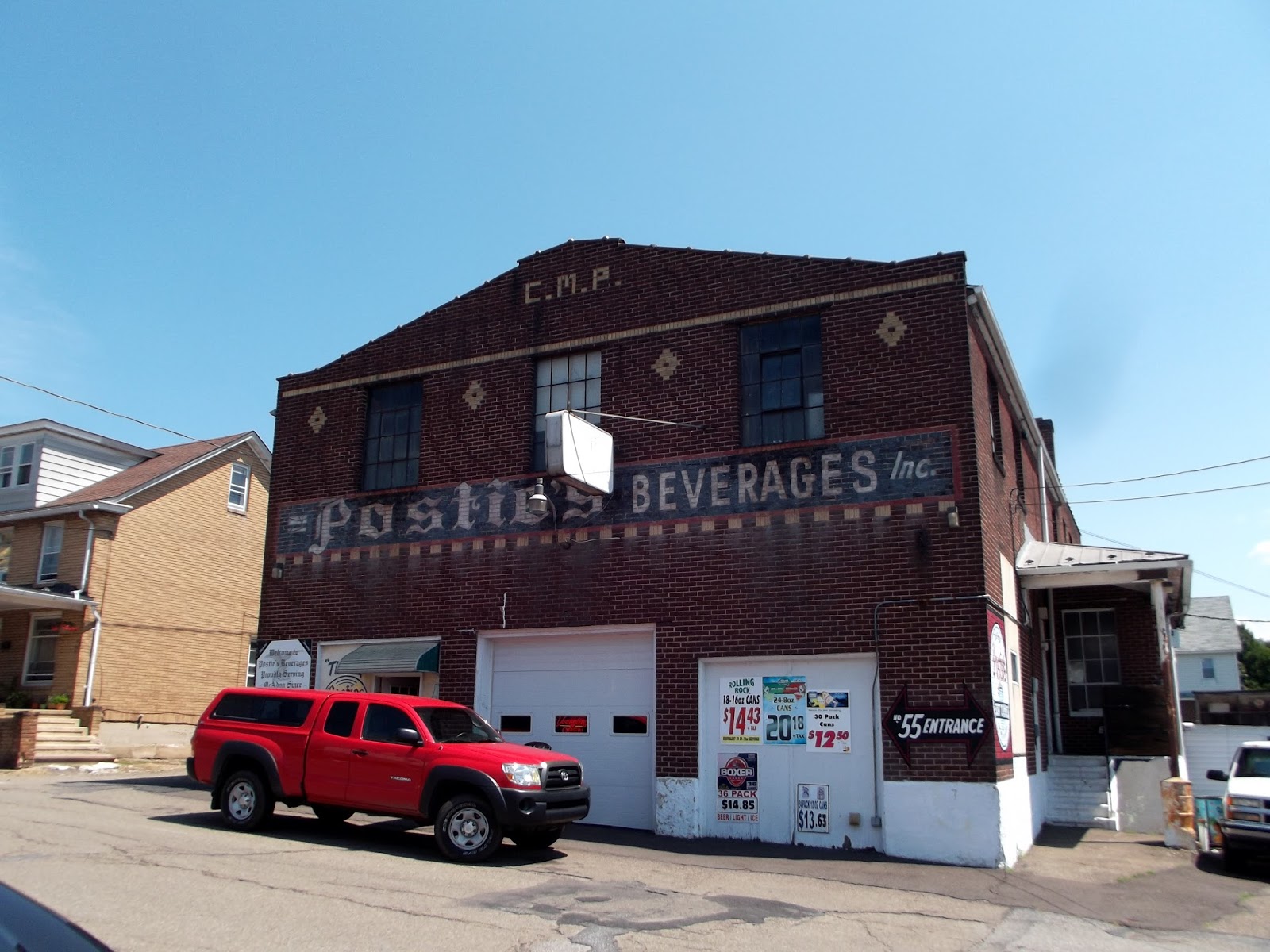
Postie’s Beverages – 55 South Manning Street, McAdoo, PA.
It appears that Postie’s was once a local soft drink maker and distributor that have evolved into just a distributor today. I did find some examples of old bottles for sale online, but relatively little other information.

As I was finishing my photography of the building an older man stuck his head out the door and yelled at me, “What the hell are you looking at?” I explained that I was a traveler, interested in old buildings, and just taking a few photographs. He replied, “A traveler, uh?” I went on to apologize if I were disturbing him in any way. He looked around, still not sure of me, “I thought you might be the bank, looking to repossess me.” I assured him I was not, which seemed to placate him. The encounter made me disinclined to enter the store. Although the next time I am passing through I will, more than likely, stop in.