On the hotel shuttle bus to
Dublin Airport there are trips that are beginning and others that are ending.
Mine was ending; however, across the aisle from me, sat an Irish family whose
trip was just beginning. The father was preoccupied with the latest news on his
phone. The mother, even though claiming fatigue, was engaged in a lively
conversation with her two daughters, aged five and two. When the mother asked,
the five-year-old claimed that she wanted to ride a train when they arrived in Portugal
and buy earrings. The mother reminded her that she had ridden a rain before to
Croke Park. The daughter then told her to pull up her blouse because, apparently,
she was revealing too much. There was an exasperation of a teenager from the
mother, who glanced over at her husband still solely focused on his phone. Mom
then asked if there was something wrong with her lip and the daughter indicated
that she had a loose tooth. "Ah," she replied with an Irish lilt,
"does the tooth fairy come to Portugal?" The father did not respond.
She gave her daughter a wink, "I will text the tooth fairy the address in
Portugal...My goodness ten euros, I don't think so."
Saturday, June 16, 2018

Thursday, June 14, 2018
Penguins in Mullingar
It was a blustery day in
Mullingar and I stepped back inside the hotel to retrieve my trusted Penguins
walking hat. It was the kind of day where the wind was blowing and there was just
enough rain to be a nuisance, but not really to create any puddles. Walking near
the center of town on Austin Friars Street, the primary east-west axis, I was
not paying attention to anyone, just lost in my own thoughts. Because I know no
one in town, I try to blend into the background and observe. Out of the corner
of my eye, I saw a young man, perhaps in his twenties, walking hand-in-hand
with a young woman. As he passed, I heard him say, “ooh…cool hat.” His comment
did not immediately register, because I do not expect anyone to talk to me. But
after a few seconds, I realized he was talking about my Penguins hat because no
one else around was wearing a hat.
Tuesday, June 12, 2018
Belfast 2018
 |
| A vibrant art scene in central Belfast |
After deindustrialization, and
“The Troubles,” the buildings and businesses of central Belfast bear witness to
the recent difficult times. Yet there are signs of revitalization and vitality.
The area around the St. Ann’s Cathedral is bustling with inviting restaurants
and traditional pubs. Live music emanates from several venues, and I have
decided it is a requirement that every street performer must have a version of
“Brown Eyed Girl” in their repertoire. As with every city that is recovering,
there is an edginess to Belfast. Although the Good Friday Peace Accords were
more than two decades ago, signaling an end to the violence between the Catholic
and Protestant communities in Belfast and Northern Ireland, some areas of the
city exude a mistrust concerning their neighbors.
It is odd to reflect upon how
many maps of cities I have in my head. Sometimes I might forget how to get from
point A to point B before I return to a city. But when I arrive, I usually
figure it out. The pathway and connection between landmarks and streets comes
back to me almost instantly. Perhaps most odd is my still emerging knowledge of
Belfast. To have an intimate knowledge and understanding of Falls Road and
Shankill Road in West Belfast is disorienting. I was in high school during some
of the most egregious violence of the Troubles, and while I did not understand
the circumstances or implications then, my view of Belfast was that it was a
city of violence and danger. In my mind, I saw Belfast and Northern Ireland as
a war-torn region, akin to places like Beirut during its civil war.
 |
| The gate on Northumberland that each night closes |
I have a sense of unease when I
walk the streets of Belfast. While visiting other places, like Babelplatz and
Potsdammerplatz in Berlin, I understand the horrific atrocities and loss of
life that occurred there. But what happened in Belfast was in my near-adult
lifetime. The news photographs and footage, I can recall vividly. I remember
sitting at the kitchen table, eating breakfast before school, hearing about the
death of Bobby Sands during the hunger strike. I would soon be off to college,
pursuing a degree in political science, and news was a dissonance about how
Western Europe was supposed to operate. Those memories still persist today as I
wander the streets of Belfast.
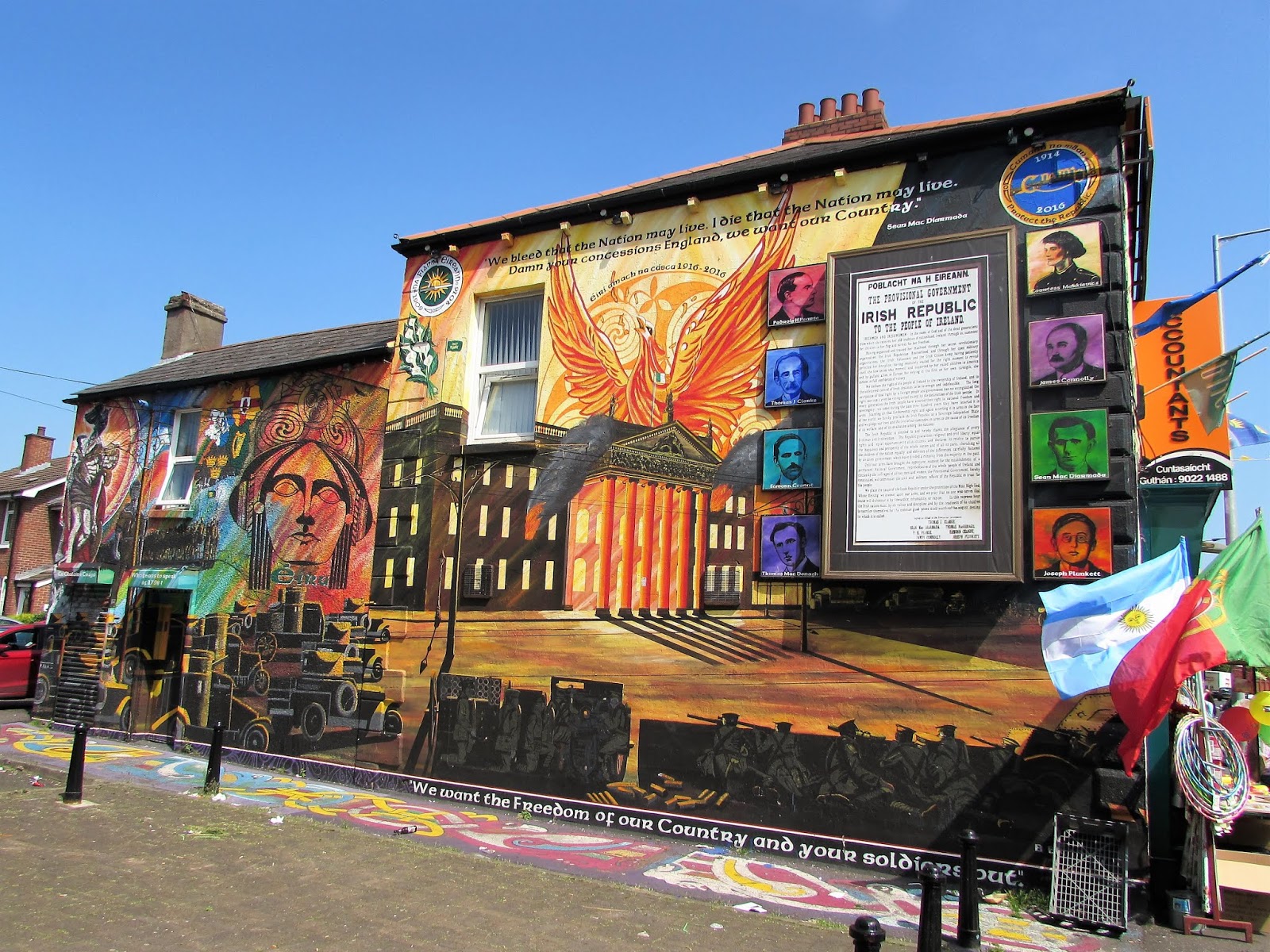 |
| Mural on the Falls Road (Republican) |
 |
| Mural on the Shankill Road (Loyalist) |
Despite the peace between the
communities, West Belfast in many respects remains divided, both literally and
figuratively. Murals in the Republican and Loyalist sections, along the Falls
Road and the Shankill Road, tell two different stories. It is almost as if
there is a belief that the peace is a respite; the old animosities still exist
and once again the argument will be had again. The gates on Lanark Way and
Northumberland Street still close every night to separate the communities.
Houses next to the wall that divides the communities still employ fences to
prevent bricks from coming through their windows. Even neighborhood libraries,
those bastions of knowledge, understanding and contemplation feel different.
There is less than half a mile between Falls Road and Shankill Road branches,
but the displays, book suggestions and art reflect the two different
communities. One wonders how the communities move on from a lack of violence to
real integration of neighborhoods.
Sunday, June 10, 2018
Walking the Royal Canal (Part 1)
 |
| Yellow Irises along the Royal Canal |
The Royal Canal is a
146-kilometer long canal, constructed between 1790 and 1817, running from
Longford to Dublin. Built as competition for the Grand Canal, it was never
particularly profitable and largely made redundant with the invention of
locomotive transportation in the middle of the nineteenth century. Today, it is
a greenway and popular walking and biking trail through the midlands of
Ireland. I spent a bank holiday weekend in Mullingar, ostensibly to walk the
Old Westmeath Rail Trail; however, after discovering the canal path I became
enchanted and abandoned my original plans for an exploration of the canal. Life
is often more interesting when you deviate from your plan to find something
more interesting.
On Saturday afternoon, I walked
through town, on Pearse Street and Austin Friars Street to the Dublin Bridge
that crosses the canal. Travelling east from Mullingar, the canal enters an
area where there are not many houses but plenty of people on a warm late
Saturday afternoon. I passed a group of five teenagers surreptitiously smoking
cigarettes near Piper’s Boreen, a narrow country road. Several young fathers
were walking children, many in strollers. A grandfatherly looking gentleman was
pushing a little boy in a stroller, who from fifty yards away began to wave at
me. I think he want to make sure I saw him and waved back.
Transportation on the canal was
officially terminated in 1961; however, restorations, first private groups,
then by the government, have allowed for the canal to be used for water
recreation. Over the course of the weekend, I saw a handful of fishermen but no
boats of any kind. A boat along the far side of the canal looks as if it has
not been used in quite a while and given the growth of vegetation in and around
the water, nor does it appear that the canal has been transverse recently
either.
 Although I have walked many
trails and canal paths, each one is different. This is especially true on the
Royal Canal: There is a sense of adventure when one is visiting for the first
time. In Ireland, the birdsongs and flowers are unfamiliar. Iridescent
dragonflies are nearly impossible to photograph and, therefore, to identify. An
unseen horse neigh in the fields behind the trees; little did I know that there
were fields there. On the distant shore, behind some trees, I heard two men
talking to each other. The one man, who I had trouble understanding, asked a
question to the other to which the reply was, “Huh?” He asked the same question
again. This time the reply was, “Aye.” This sequence was repeated, asking two
more questions twice, each respectively eliciting the same answer.
 Mullingar, a small city of about
20,000 people, is an old market that still thrives today. Walking through town on a
weekend evening, the smell of fried fish permeates the town. Nevertheless, I
had dinner at a pub where the evening roast was turkey and ham, served over
mashed potatoes, and a good helping of broccoli and carrots. Plain and
uncomplicated, the dinner was a hearty anecdote to several days of travel and a
long walk on the canal. The sun was still shining and most people in town had
congregated at a pub outside just down the road. My chosen pub was largely
empty, save two other tables: A nearby table with a French-speaking couple and
their young adult daughter who thoroughly enjoyed an American-style brownie
with ice cream for dessert; and, two drunk Irishmen, whose difference in age suggested
that they could be father and son, but given the conversation were probably are
not. At one point, the older of the two men, who I judged to be in his
seventies, perhaps younger but the tolls of a hard live were showing, got up to
pay for another pint and use the facilities. As he walked by my table, he
listed and almost fell face-first into my table before recovering his
equilibrium. I glanced over to the younger man who jumped up to offer
assistance, yelling, “Are you alright there?” I glanced over to the French
couple to see if they had a reaction to the display, but they were oblivious,
enjoying their dessert. Soon after, a quarrelsome couple from British Columbia
came to bar requesting meals that were not hamburgers and not vegetarian.
 |
| East of Mullingar |
The next day was a beautiful
June Sunday morning on a bank holiday weekend bringing many people out on the
canal path; however, the further I got from Mullingar, the fewer people I saw.
Early on, a man walking two small dogs acknowledged what a beautiful morning it
was. Indeed, it was. Later, a man said to me that it was “a lovely day.” I
replied that is was beautiful. As we continued to walk past each other, he
recounted that it was 23 degrees (73°F). I thought to myself that his comment
was a little specific, but I have come to realize that the Irish have a keen
sense about the weather.
It is difficult to judge whether
one should acknowledge their fellow wayfarers on the trails of Ireland. In the
United States it is common, almost expected, to acknowledge someone when
meeting on a walking path. The rules in Europe are somewhat different. On the
continent, one should all but ignore fellow walkers. In seems that in Ireland
that the older the traveler, the more one should acknowledge the person. Thus,
the elderly walker should be spoken to first; do not even bothering looking at
teenagers. Children are a crapshoot: There reactions will tell if you should
offer a greeting.
Likewise, it is difficult to
know which side of the path one should walk on and, specifically, how to decide
how to pass an oncoming walker. Since Americans drive on the right-hand side of
the road, typically when they walk they also inhabit the right side of the
path. It would seem to make sense for those places that drive on the left-hand
side of the road to do the same thing in reverse. I have come to notice,
however, that things get muddled. Perhaps because there are so many travelers
from the United States and the continent, Irish people have become used to the
confusion. After observing people walking for many years, I have concluded that
there is no single answer to which side of the path one should walk. When
walking, people tend to spy each other from as far as a hundred yards apart and
begin to discern and signal which side of the path they will be using, often
without eye contact.

On the western outskirts of
Mullingar, there is a small cross commemorating the life of Mary Walker, a
32-year old woman who died in 1909. Mary, an employee at the local post office,
had been on an afternoon walk along the canal, a popular pastime even in the
early twentieth century. She was the victim of a sensational and violent
murder. The story
gripped Mullingar and Ireland for several months and even made national
headlines. A local man was later tried and executed for her murder.
Approximately 100 meters east
from the Kilpatrick bridge, I spied a wooden cross located inside a stone wall
on the opposite side of the canal. There was no immediate indication why this
site was marked. I went to the bridge and crossed over to the other side.
Walking back, at first, I did not see anything to suggest the meaning of the
cross. I was getting ready to move on when at the last second, I saw a carved
some sign set in the middle of the wall facing the canal. Plans, flowers and
weeds had largely obscured it rendering it almost invisible from the path. The
difficulty was that there was a substantial ravine between the path, perhaps four
feet deep and two feet wide. A couple of the weeds had thorns on. Nevertheless,
my curiosity compelled me to brave the ravine and have a look. Even at that it
was difficult to hold my camera and simultaneously pull the plants back far
enough to read the inscription. Finally, I worked out that the cross marked a
cemetery where several victims of a cholera epidemic were buried. A minor discovery
perhaps, but interesting. Then, I was confronted with the prospect of climbing
out of the ravine to once again rejoin my walk. I struggled to crawl back up to
the path just as a middle-aged woman on a white bike was passing. She slowed
down and inquired, "Are you alright?" I thought to myself if I was
not I am not sure she could have really helped me. Nevertheless, I cheerfully
answered, "I am, thank you very much."
 |
| Harbour Bridge in Mullingar |
The canal west of Mullingar
contains a series of bridges, which give a wayfarer an opportunity for
beautiful photographs. While it requires cyclists to dismount, the reflection
of the bridges in the water, backed with the blue sky and greenery are
beautiful sites that encourages me to keep walking. At Bellmount Bridge, I
stopped to greet a West Highland Terrier whose owner seemed embarrassed that he
had interrupted both of our walks.
I ended my outward bound western
journey from Mullingar in the small village of Ballinea, which is not much more
than a few houses and a local grocery along the side of the road. I went in to purchase
a couple of biscuits (cookies) and a cup of coffee. The cashier told me that
there was a table at the side of the shop “to take a load off” my feet for a
while. I shared the picnic table with a
couple of cyclists, who looked to be in their mid-to-late thirties and were
having a coffee and snacks as well. After a few minutes, we started chatting.
They asked if I had walked out from Mullingar, which they estimated to be “a
good walk.” They were postmen from Mullingar, one of them had a bike jersey
from An Post, the Irish postal
service, and had decided to have a ride that morning. I inquired about how far
they intended to go that day. “Ah,” said the guy not wearing the An Post gear, “This is it.” Which meant,
like me, they had traveled five kilometers (about 3.2 miles) out and were going
back after their coffee. They had a good laugh and said, “Sometimes we just put
on the gear and drive out, so we can have a cup of coffee.”
Saturday, June 9, 2018
The Room of Names
There is no escaping the primary
memorial for the victims of the Holocaust in central Berlin: The
Memorial for the Murdered Jews in Europe. It is direct and to the point.
The Jews of Europe did not die as a result of war but were murdered. What
happened was a deliberate act.
In a darkened room in the
memorial, there are projectors illuminating the names, and when it is known the
birth and death dates, of individual victims of National Socialism on the four
walls. A commentator, in hushed tones, reads a short biography of the person
named, first in German, then in English. There are six benches situated in the
room where visitors can sit and contemplate on the lives of victims, and their
own, while listening to these short biographies. Based on testimonies, many of
the biographies are heartbreaking, short and incomplete; sometimes indicating
that a person was probably present at a massacre and was never heard from
again. It is difficult to imagine that about half the victims of the Holocaust
have not, or unlikely ever to be, identified. At first glance this may seem to
be odd or unexplainable; however, I consider what if I were among the 200 or so
survivors of my current domicile of roughly 10,000. What it must be like to
overcome the trauma, and guilt, of such a cataclysmic event and then be
burdened with the responsibility of remembering as many people as I could;
piecing together details of their lives and recording their names and lives for
posterity. It is little wonder that many of the victims are remain unknown.
Wednesday, June 6, 2018
Shopping in Dundee?
Navigating the pedestrian
traffic in Edinburgh during rush hour can be challenging. Walking on North
Bridge early one evening, I found myself behind two elderly women, each wearing
rain coats, knee-length skirts, and scarves to protect their white hair, coiffed
by an old-style permanent. I was enjoying the banter between the two about the
best bus to take to Dundee, apparently there is good shopping there, when one
of the women noticed me and apologized for being so slow. Although I indicated
that I was in no hurry, she moved and stopped to let me pass. Meanwhile, her
companion continued on blithely about buses and shopping, until she glanced to
see that her companion was no longer beside her and then turned to see me. She
soon joined the chorus of apologies. I was quite happy to walk behind, and ease
drop on the conversation, but felt obliged to pass.
Tuesday, May 29, 2018
Platz des 9. November 1989
 |
| Platz des 9. November 1989 |
Bösebrücke, on Bonholmerstrasße,
was the bridge that served as a border crossing between East and West Berlin
during the Cold War. Situated outside the central district of Berlin, it
crosses only railroad tracks rather than water, and is one of the last places
you can still see the Berlin Wall in its original form. The crossing
facilitated a passage from the Soviet into the French occupation sector and was
the first place where the wall was opened on 9 November 1989. After the
premature announcement from the East German government that private travel
would be allowed to the West, people began to clamor at Bösebrücke to make
their first foray into West Berlin. At 9:20 PM, to relieve the pressure of
people crowding the gate seeking exit from East Berlin, a few people were
allowed to cross into West Berlin. Their passports were stamped invalid. Three
hours later, the East German border guards reported that 20,000 people had
crossed the border.
 |
| Barbed wire still attached to the wall |
It has been nearly thirty years
since the fall of the Berlin Wall. I watch a group of school kids participating
in a school exercise, taking notes listening to a woman, about my age, discussing
the events that led to the fall of the Berlin Wall and the subsequent collapse
of East Germany. The kids were unimpressed, teasing each other just out of the
sight of the teacher, giving each other piggyback rides, and generally more
interested in the traffic that transited the bridge than in the remains of the
wall. The fall of the Berlin Wall was a seminal event in my life, both
personally and academically; yet for these kids it is ancient history. When I
was about their age, the Second World War had been over for about thirty years.
The end of World War II, the death of Hitler and the dropping of atomic bombs
on Japan, seemed far removed from my life. It still does. It is only natural
for these students to have the same feeling.
Subscribe to:
Posts (Atom)