Wednesday, November 20, 2013

The Adventure of the Lost iPhone

I was on my early morning walk, a ritual when I travel to major cities by myself. It was a cold November morning in Philadelphia but my walk was pleasant because I was out before most commuters were in downtown. The previous night I was listening to the Christmas-themed Sherlock Holmes story, “The Blue Carbuncle” as I drifted to sleep. I did not get very far into the story before I drifted off to sleep, but little did I realize that my experiences a few hour later would approximate Sherlock’s adventure of a previous century. In the story, Holmes is presented with a man’s hat and a Christmas goose, using the existing evidence he tried find the owner of the items. While seemingly mundane, the story takes a dramatic turn when a precious jewel is found in the crop of the goose. My story does not have such a fantastic ending.  
About halfway through my walk, I crossed 13th Street at Arch. As I approached the other side of the street, I spied what appeared to be a smart phone laying in the ramp from the street to the sidewalk. Initially, I walked by. I continued almost to 12th Street, thinking about the phone, who lost it, and how they would find it. I stopped in my tracks when I realized that a person or cyclist would crush the phone if it was unobserved.  I turned around to look, there was no one between me and the phone. It was still very early. I took it upon myself to retrieve the phone.
Despite walking nearly a block in downtown Philadelphia, there was no one on my side of the street. Surely, I thought, someone would see the phone before I did. Alas, no one did. As I approached I considered my alternatives: look in the phone book for a spouse or parent, see if there were any identifying marks, check and see if there were an email address? I tried to channel Holmes and deduce how to find the owner. I picked up the phone. It was a nice iPhone with a black case. I noted the Verizon service and saw that they was an email feed from a gmail account on the homepage. Yet, the phone was locked with a passcode. Despite several attempted maneuvers, I determined that using the phone to find the owner would be impossible.
There were no business immediately around, and even if there were it was too early for any to be open. I put the phone in my jacket pocket and experienced a twinge of guilt. Did someone see me and think I was pilfering a smart phone?
Now that I had a lost smart phone in my jacket– what was I to do with it? There was a feature to bypass the code to make an emergency call, but this did not seem like a situation that warranted a 911 call. I decided to continue my walk and consider my options; perhaps there would be a police officer to whom I could give the phone. A few blocks down I met a traffic officer and tried to pass the burden of the cellphone to him. He said he was not a police officer and could not accept the phone. He suggested that I continue my walk and if I came across a police office and give it to him (or her). Not finding a police officer until I reached my hotel near the corner of Market and Juniper Streets, standing outside a Dunkin Donuts was a police officer. He stood, staring at me dispassionately, as I explained by dilemma. He barely made a sound as I relayed my story. When I turned on the phone to demonstrate the phone was locked, a message popped up: “This phone is lost. Please call xxx-xxx-xxxx.” I looked up, the police officer continued to stare at me, even as he casually glanced down at the phone. I looked at the phone, then at him, and said: “Never mind.”
I returned to my hotel room to retrieve my own cellphone. I called the number, a man with a slight accent answered. I said that I had found his cellphone. After some preliminaries, including that I did not live in Philadelphia and the iPhone was his wife’s, we made arrangements to relieve me of the lost phone. He asked my name and the nearest coffee shop, which was the Dunkin Donuts where I encountered the disinterested police officer. He said is wife Anna would meet me there. I asked how soon and he replied, “Shortly.” I told him I would wait outside. After I hung up the phone I debated calling him back and say, “I am wearing a green jacket…or a hat.” I did not.
I waited outside the iconic donut franchise on Juniper Street for about ten minutes, watching people pass by. The policeman who I had spoken to earlier had moved on. As I watched people I tried to discern who might be Anna. I noticed a young woman in a green sweater walked by and made eye contact. She walked into the shop and I can continued to scan the people walking by. After a few minutes, the woman in the green sweater reemerged and asked, “Are you...?”
“Anna?” I replied. She affirmed my question with a nod.
I pulled the iPhone from my jacket pocket and Anna seemed relieved to finally see the phone. Her accent and appearance provided an indication that she was an immigrant from Eastern Europe; however, her accent was slight and were it not from speaking to her husband I might not have detected it. She explained that that she had fallen that morning and her phone had dropped, undetected, out of her pocket. She said with earnestness, “I would like to give you fifty dollars…” I cut her off and replied, “Absolutely not…it was my pleasure.” With little left to be said, we exchanged pleasantries and went our separate ways.
Philadelphia, which in Greek means brotherly love, does not always live up to its moniker. I am sure Holmes would have some profound statement at this point. I do not, except: It is these little vignettes that allow us to connect to people, and give us travel stories to remember.


Sunday, October 27, 2013

Short Observations of Vancouver

Sometimes when we travel we see what we want or expect. In a travel guide published in 1927, J.E. Ray wrote:
“One of the charms of Vancouver, to an Englishman, lies in its suggestiveness of the homeland. The climate is something like that of England. Whilst the gardens and the flowers therein might easily have been transported in their entirety from Devon or Cornwall.”
Some eighty-six years later it is difficult to discern much of what Ray saw. While some things may be reminiscent of Britain (such as the additional U in words such as labour and neighbour), in many respects, Vancouver is distinctly Canadian and emblematic of the Pacific Rim and a global city. Where else, but Canada, could you wake up to a morning newspaper where the front page has a picture of Sidney Crosby and Nathan MacKinnon, the two first round picks from Cole Harbour, Nova Scotia (2005 and 2013, respectively) playing against each other for the first time in the NHL? (The Globe and Mail, 22 October 2013)
Much like neighboring American cities to the south, the weather is dictated by the patterns of the Pacific Northwest. Although the forecast might call for sunny skies, this does not rule out the possibility of fog, which was persistent throughout my visit. Perhaps as a result, much like Seattle and Portland, there are a plethora of coffee shops. Although there are a few Starbucks, Blenz is far more ubiquitous (not to mention Tim Hortons).
Looking down at the sidewalks in Vancouver, one will find the outline of leaves imprinted onto the concrete. There is no pattern that is discernible, just decoration that is a nicety. Also on Burrard Street, between Alberni and Georgia, there are two sidewalk markers that denote the locations of Oscar’s Restaurant (1943-1962) and the Palomar Nightclub (1937-1952).  It is a happier commemoration than looking down at the sidewalks in central Europe.
Ray does mention the Asian population of Vancouver in his account; however, he uses some unfortunate terms what is considered insensitive today. In his description of Chinese, Japanese and Indians he assigns certain jobs to each populations. The Museum of Vancouver has a very interesting exhibit on the history of the city, which includes artifacts and stories about Asian migrants. Chinese immigrants, who referred to Vancouver as “Saltwater City,” have been a significant segment of the population since the 1860s. Beginning in the 1880s the government of Canada tried to limit the number of Chinese immigrants through a series of taxes, and later exclusions that prevented anyone from China immigrating to the country.
Nelson Park is a neighborhood park in the middle of the west end of the city. I expected to find a statue of Admiral Nelson somewhere in the park; however, there was none that I am aware of. Instead, the park is a green space in the middle of a mixed neighborhood of single-family houses and stylish apartment buildings. There is a large dog park and a farmers market on Saturdays during the summer months.

Near the cenotaph at Victory Square, there is a small plaque that recalls the reading of the Riot Act in 1935. Protesters at a work relief camp in the city held a demonstration over conditions, treatment and food that escalated into a riot at the Hudson Bay department store on Georgia Street. A reminder that the effects of the Great Depression were felt worldwide. 

Thursday, October 24, 2013

Powell Street and Asahi Baseball

What once was the area of the city where Japanese immigrants in Vancouver lived, today evidence of the Japanese community that once flourished along Powell Street is difficult to find. There is a small historical marker on the building at 314 Powell Street indicates that the building was once Fuji Chop Suey Restaurant, the most popular establishment in the neighborhood. The marker states that the restaurant served “Japanese-style Chinese cuisine” and was a fashionable venue for banquets and wedding.
Powell Grounds at Oppenheimer Park, Vancouver 
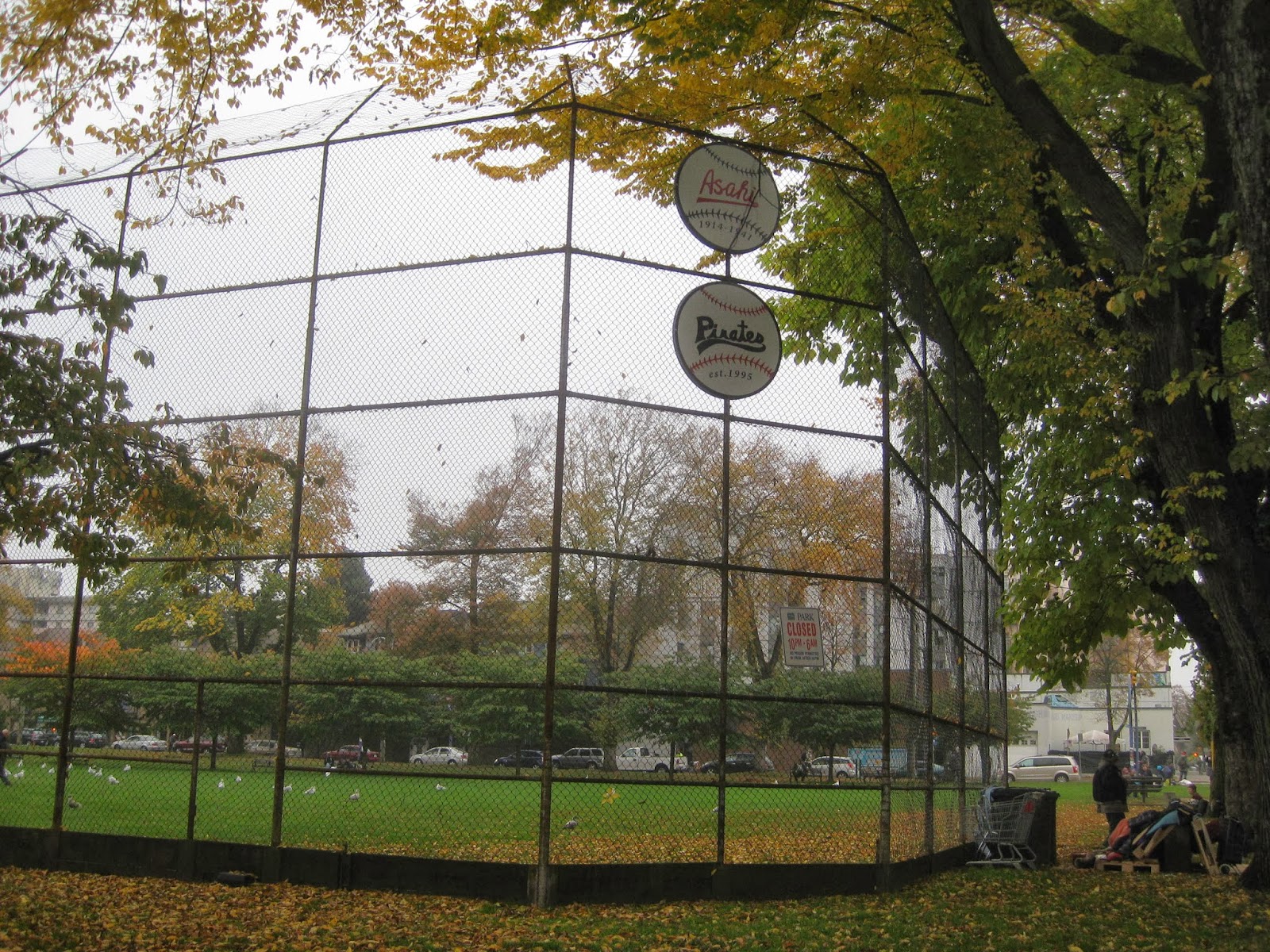
Just a few blocks down the street is Oppenheimer Park, which contains an old baseball backstop, which is the remnants of Powell Grounds where the Asahi Baseball team played. The team was very success in the in the city league and an inspiration for Japanese-Canadians who faced discrimination. The team was widely supported and played a brand of baseball (known as “small ball”) that is relies on skill and timing rather than simple brawn. (A 1931 picture of the team at Powell Grounds)
Ultimately, both Fuji Chop Suey Restaurant and the Asahi Baseball Team found their demise because of fear in the early 1940s. The team played its last season in 1941 and the restaurant closed in 1942 primarily because of the deportation of policy of the government of Canada. After the bombing of Pearl Harbor in December 1941, those who were born in Japan or Canadian-born citizens of Japanese heritage living in Vancouver were obliged to move east:

“2. Japanese Canadians who want to remain in Canada should now re-establish themselves East of the Rockies as the best evidence of their intentions to co-operate with the Government policy of dispersal.” (T. B. Pickersgill, Commissioner of Japanese Placement)


In 2013 the only minor league team in MLB-affiliated baseball located in Canada was the Vancouver Canadians. Although baseball has a rich tradition in Canada, it is often under appreciated. 

Tuesday, October 22, 2013

Carnegie Library (Vancouver)

The Carnegie Library, which is adjacent to Chinatown, is a majestic structure that was once an important facility in civic education and now serves the Vancouver Public Library until 1957. Today, the Carnegie branch is located in an area of town that faces substantial economic challenges. The building, in addition to continuing to host a small collection, serves as a recreational facilities and low-cost cafeteria for local residents. Inside the library there is a remarkable stained-glass window that honors English literary greats: Milton, Shakespeare and Spenser. Because of renovations inside the library, the bottom section of the window is not seen in this photograph, but honors Burns, Scott and Moore. 
community in various ways. Built in 1903, it was among the 2,507 libraries paid for Andrew Carnegie. The building housed the main branch of the

Saturday, October 19, 2013

Whither the Book?

Angie turned to me and said, “Anyone who thinks the book is dead should come here.” The here to which she was referring is Strand Books in New York. We were visiting the famed bookstore on a Saturday afternoon in late September. The store, which is very big, was so crowded it was often difficult to browse for books because people were moving in and out between shelves. The line at the checkout counter stretched 20-25 people, long enough that I could overhear conversations about twenty-something dating rituals as we waited to complete our purchases.
There are other famous bookstores that engender such passion as well. Located at the corner of Pender and Richards streets in Vancouver, MacLeod’s Books is one of those used book stores where one can lose yourself for hours. It is a small space; however, there are so many books stuffed into the store that it makes shopping a treasure hunt for unknown goods.
MacLeod's Books
Featured in Macleans two years before my visit, I spent almost two hours searching through stacks of books. There are so many books that line the aisles that it leaves little room to walk, and this did not include the books that are on the shelves and perched on top of bookcases. While I was browsing the multitude of books, contorting myself to read spines that were not in an orderly fashion, I thought to myself that I was searching for books I did not know I wanted.

As I was browsing I could overhear a number of conversations between customers and the staff. The staff was knowledgeable and friendly, but not in an artificial manner that one finds in chain stores. The man and woman who worked the store while I was there figured out queries with minimum information. Among the customers was a woman from Germany, who purchased a couple of books and said that she had read about the store online. 

Friday, October 18, 2013

Persons Day

As I sit in a coffee shop in Vancouver, I write to take note that today is Persons Day in Canada. On this date (18 October) in 1929 the Privy Council declared that the word “persons” in Section 24 of the British North American Act (1867) includes females. The Act was the constitution of the country at the time and the ruling set the stage for gender equality in Canada and the subsequent expansion of rights to indigenous and minority communities. The five women who petitioned the Privy Council for the ruling adorn the $50 bill in Canada today. 

Thursday, October 17, 2013

Sports in Massillon and beyond

Even the unobservant traveler will notice that Massillon has an affinity for football, in fact football legend Paul Brown was born here. Football is inescapable as one walks around town. There is a mural on the side of a building along Lincoln Way that treats football as akin to Greek mythology; its greats as gods. At the bottom of the mural is a poem:
Mural on Lincoln Way, Massillon, OH

“In the Beginning when the great creator was drawing plans for this world of ours, he decided there should be something for everyone. He gave us mountains that reach to the sky, deep blue seas, green forests, dry deserts, gorgeous flowers, and gigantic trees. Then he decided there should be football, and he gave us Massillon. He created only one Massillon, he knew that would be enough.”
Virtually every business in town has a sign in the window exhorting the local high school football team to do well. The woman working the breakfast this morning in my hotel wore a t-shirt that read: “One team, one town, one goal.” While at first glance this source of civic pride is admirable. Yet I find some of the aspects of this as troubling. High school football players adorn the flags along the main street of town (Lincoln Way) posed in their uniforms, like football players outside a NFL stadium. Pictures of the town’s cheerleaders are found in the windows of many businesses in Massillon, exhorting the team to greatest. The implicit message is: “This is as good as it gets.” High school is the apex of one’s life and our heroes are the 15-18 year olds who represent our town each weekend.
My trip to Massillon coincided with a number of articles and book releases that caught my eye. The emphasis on sports, particularly football is the subject of Amanda Ripley’s article in The Atlantic. The author examines the amount of money that is spent on high school athletics in the United States, much of it hidden and compares it with the money spent on scholastic programs. Rarely do people calculate coaches’ salaries, bus rides, and equipment refurbishment. There are stunning figures to make high school sports happen and it is not recouped through ticket sales. It probably goes without saying that the most expensive sport is football; however, in the Pacific Northwest one school was spending $328 per student for math instruction while at the same time spending $1348 per cheerleader. While most arguments that favor sports in high school point to keeping marginal students in school, this segment of the student population is small. Yet the emphasis on sports keeps resources from making classes interesting and innovative with fully qualified teachers.
It is difficult to think about America, or its popular culture, without its emphasis on sports. No doubt I am one who enjoys the history and lore of sports. One of my favorite films of the 1980s is Hoosiers, a semi-fictional story based upon the real team of Milan, which won the 1954 Indiana High School Basketball Championship. The swelling music and compelling visuals celebrate a romantic notion of small-town America. The love of high school sports is woven into the fabric of America. My high school, duPont Manual was one of the principals for the legendary Male-Manual rivalry, touted as the nation’s oldest high school rivalry and I know plenty of people who either attend or intend to attend the game each year. I even co-authored a history of the rivalry for my high school newspaper.
In the closing sequence of Hoosiers, a photograph of the winning team adorns the wall of the high school gymnasium. As Ripley points out, in 1961 sociologist James Coleman wrote that where one interested a high school you are confronted with trophy cases that celebrate athletic, not scholastic, achievements. Nowhere in Massillon are there pictures of students who so well in things other than football and cheerleading. Nevertheless, education is supposed to be a school’s raison d’etre.
We little realize how much high school sports dictate high school academics. I have long known that a later starting time could greatly improve students’ lives and learning. In fact, research demonstrates that a later starting time results in improved student performance; however, most schools have early morning starts to facilitate afternoon daylight sports practices.

Two other articles in The Atlantic tangentially deal with similar themes. One piece by Karl Taro Greenfeld smartly and amusingly examines how much homework students do each night. Greenfeld spent a week doing the same homework assignments as his daughter and found that the assignments tended to be unrealistic and inane. Read in context with Ripley’s piece, one comes to the conclusion that the problems of American education are not simply about one issue. Another article in the same issue examines the amount of money taxpayers give to one of the richest and most profitable organizations in the United States – the NFL. Yet another indication of the power and importance of sports in the United States.