Showing posts with label Spain. Show all posts

Wednesday, July 20, 2022

Depictions and Colonialism


The first exhibit at the Museo de America is a collection of drawings and renderings from the sixteenth and seventeenth centuries that purportedly depict what people who lived in South America looked like to Europeans. Various depictions are grotesque and disturbing; others are comical and challenges us to wonder if the depictions were believed by Europeans who saw them. European conquerors went out into the world and found people who were different from them and believed themselves superior. Drawings and accounts exaggerated customs, beliefs, and practices. In some instances, especially in tropical regions, they found people who wore very little clothing, which was weather appropriate. But concepts like nakedness, sin, and guilt did not always translate in the same way across cultures.

If you think local people are not quite human, it removes the psychological barrier to harm or murder them. Renderings and information, even if erroneous, helped to justify some of these cognitive barriers. Hence, the interaction with Inca or Aztec, or other indigenous cultures, did not go well (to say the least). The land, people, and riches of South America were open for discovery, conquest, and appropriation. It is easy to dismiss what happened in the sixteenth and seventeenth centuries as a byproduct of an ancient age. Yet, into the twentieth century the exoticization of South America continued. Arthur Conan Doyle’s The Lost World, published in 1912, led the reader to believe that there were prehistoric and fantastical creatures that inhabited the far reaches of the Amazon basin. The British explorers who discover the “lost world,” tout their racial superiority and greater intelligence throughout the novel, justifying some of the more provocative actions. 

Headless of Guyana (published Nuremberg, 1599)

The Museo de America contains a collection of artifacts primarily from the colonial period. Away from the center of Madrid, it is not one of the more popular museums in the capital. Many museums have begun to return cultural items to former colonies, and some of my students suggested that the Museo de America should do the same. A nice thought, I contend, but so many indigenous peoples have been so thoroughly decimated, I reply to the students, “to whom do you return these items to?” 

The New World (1621)


Sunday, July 17, 2022

At the Museo Nacional del Prado


The quote, “The past is a foreign country. They do things differently there,”[1] came to mind while doing an in-depth examination of the work of Hieronymos Bosch (c.1450-1516), better known as Bosch [El Boscho].  His work, The Garden of Earthly Delights triptych (c.1490-1500), is other worldly; something that is reminiscent of a science fiction rendering. At first glance, one might even consider it bordering on pornography, yet the goal of work was to warn parishioners away from such behaviors.

As the museum’s explanation notes, “The artist derived his inspiration from medieval visual culture: devils, monsters, fantastical beasts, and anthropological forms.” Yet the display goes on to note it is difficult for us to understand, or appreciate, the full impact of the work and its meaning. The ability to decipher the images have been lost, according to the museum.

The three scenes of the triptych focus on the theme of sin. On the left: Adam and Eve are depicted in the Garden of Eden. In the center panel, Bosch depicts the false paradise given over to lust where people engage in all manner of pleasurable activities that will lead to an ultimate punishment. On the right, is the depiction of God’s punishment for sin is hell. Principal message of the triptych is “the fragile and transient nature of happiness and the enjoyment of those sinful pleasures.”[2] As I was staring, trying to process the images of Bosch, I was reminded of Orwell contention that the images of afterlife paradise changes over time depending on the hardships of the day, Hence, in a society where there is a lack of food, heaven is depicted as place where there is a never ending banquet.

In the same room at the Prado, The Haywain Triptych (1512-1515) by Bosch is similar. It does not have the same number of people jostling to inspect the Garden of Earthly Delights, but has the same theme, with slightly less audacious renderings. I found it helpful in understanding both works. The explanation provided by the museum notes, “[The triptych] illustrates the verse from Isaiah, “All flesh is like the grass. All its glory is like the flower of the fields”[3] Furthermore, the work recalls the Netherlandish proverb, “The world is a Haywain [Haywagon], and each man plucks from it what he can.”


[1] Attributed to L.P. Hartley, The Go-Between.
[2] When closed the painting represents the third day of creation of the world in grisaille.
[3] Isaiah 40:6.

Friday, July 15, 2022

Antonio Gaudi 1852-1926


Gaudi was a famed architect and a great exponent of Catalan Modernism and today, his houses and works are destinations for many travelers to Barcelona. His work has come to symbolize what make Catalonia different from the rest of Spain. Early in his career, he was influenced by the neo-gothic movement. His later work, however, reflected his love of nature and his religious beliefs. Seven of his designs have been designated UNESCO World Heritage sites.

Gaudi died after being struck by a streetcar in 1926, while undertaking his most famous and ambitious project, the Basilica La Sagrada Familia.

Casa Vicens (1883-1888) 

Casa Batlló (1904-1906) 

Casa Milà (1906-1910) often referred to as La Pedera


La Sagrada Familia (1915-2026) Completion of the Basilica is slated to be completed in time to coincide with the one hundredth anniversary of Gaudi’s death 


Sunday, July 10, 2022

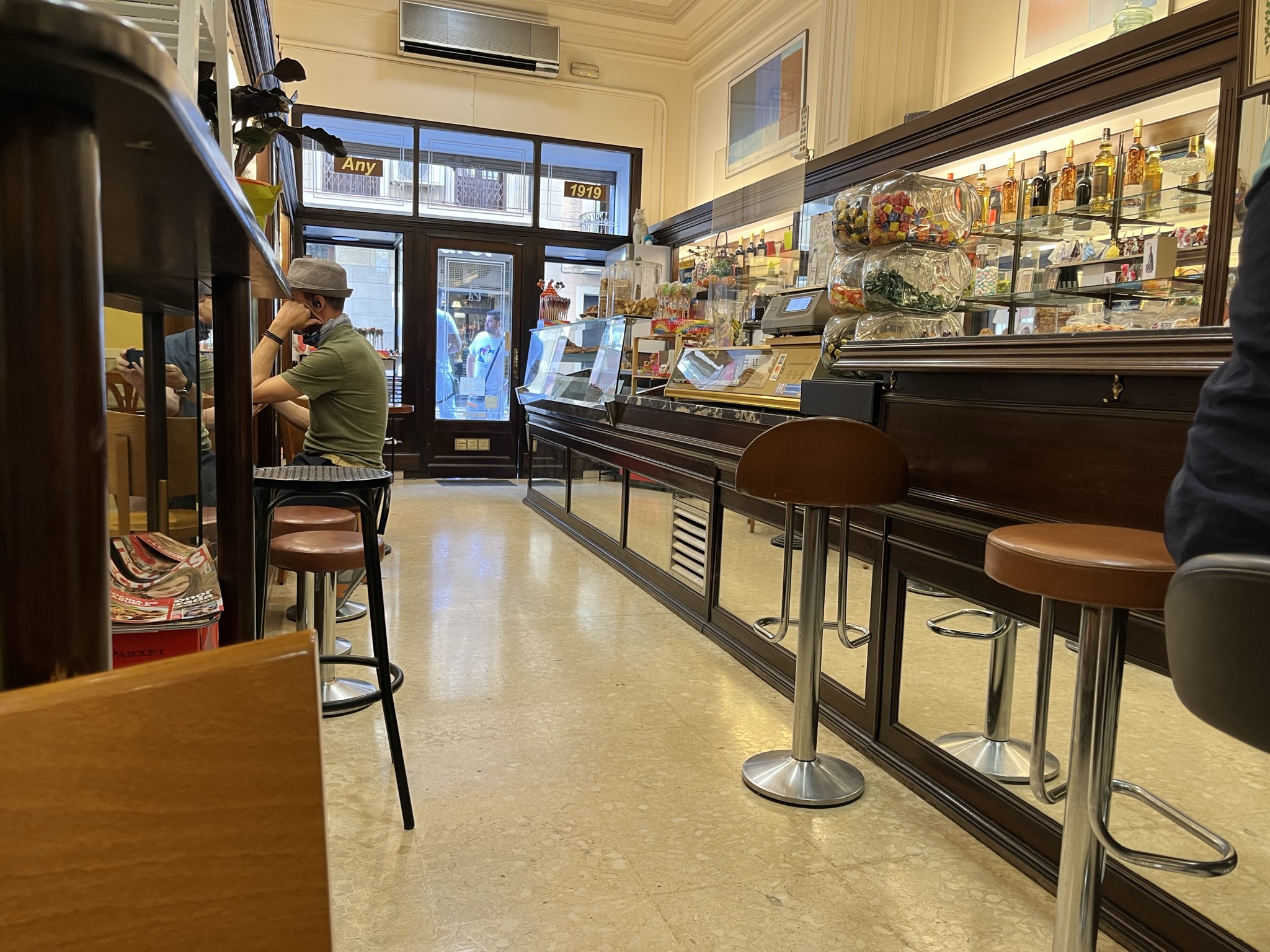
Pastisseria Ideal


Located on La Vila de Gràcia in Barcelona, walking into the café is to observe the intimate life of a small portion of Gràcia. I stopped in for a simple breakfast at 9:30, ordered my café americano and two croissants in my moderately passable Spanish, which was understood even if it was not Catalan.

Dating from 1919, the café is a long narrow space with a bar that runs its entire length, save for a small room at the back where four small tables were occupied by regulars. On the walls that hold up the bar, hooks allow patrons to hang their hats or purses, which are still regularly used.  Many mirrors that line the walls, the display shelves and virtually everywhere else gives the café an appearance of being much bigger than it is. 


The clientele is predominantly older people, but not exclusively. Since I was there rather late for breakfast, perhaps this was just a function of timing. The back room seemed informally reserved for regulars. I would occasionally take furtive glances to see what was going on. Most of the conversation took place in Catalan, so I am only catching a few words and had a general sense of the topic. One elderly woman sat and did a puzzle in the newspaper, and occasionally made comments into the more general conversation of the room. Meanwhile, a woman, sipping an expresso, sat at the bar, and listened attentively to a man who had finished his coffee long ago, talk about his recent travels. She would occasionally interject or ask a question, nodding knowingly about his adventures.


Monday, June 10, 2019

Plaça de la Vila de Gràcia, 6PM, Tuesday evening


It is a simple square with a 19th-century tower dominating the center in a nice neighborhood in Barcelona, surrounded by four and five-story buildings. Catalonian flags and banners hang from several windows. The sky is crystal clear; the trees are iridescent green. About a dozen oranges almost glow in the setting sun on a puny tree that is growing next to building 38. It is warm, but not hot. Can one imagine a more perfect evening?
My colleagues send me a message apologizing for being late, but I am content to sit and watch people. When we travel people become a blur. Sometimes we do not consider that there are residents of the places we visit. If you want to know if people are people, then sit here for a few minutes, or several, and observe.
Plaça de la Vila de Gràcia, Barcelona
Three cafés set up tables around the edges of the square, where people are enjoying a drink, conversation, and music provided by a steel drum and guitar duo. Included in their repertoire are standards such as “Yesterday” and “All of Me.” No one is actively listening to the duo, but it provides ambience to the evening.
If adults occupy the cafés and edges of the square, then children dominate the center. A group of boys earnestly engage in a frenetic game of football (soccer), using the door of the tower, damage in the revolt of 1870, as a makeshift goal. The pitch seems to be the entire square and occasionally extends into the tables and benches that line the plaça. Despite the conquest of square by children, adults are there as well. A father and grandfather teach a young brother and sister how to ride a skateboard, with each adult taking a turn in demonstration. Suddenly, an American football appears across the way from me. A woman has brought it to entertain those too young to engage in the soccer game.
There is a nationalist battle between the Spanish and Catalan languages in Barcelona, but the predominant language on t-shirts here is English. One boy has a NYPD shirt, which seems out of place because there is not a police officer in sight, and no need for any their services. A little girl has an aqua blue shirt with sea turtles, imprinted with the words, “Explore the Ocean.” A middle age man with shorts and sunglasses is wearing a shirt that suggest to the reader, “Go Surfing.” Where, I wonder, are the shirts in the local languages?
Some adults cross the square without fear. Old women with canes navigate the games and people seemingly impervious or oblivious to the hectic feel of the evening. Unconsciously, the soccer ball steers clear of the elderly women. Others are crossing the square evidentially coming home from work. I like to think that they traverse the plaça to see what is happening in the neighborhood or to be seen. Perhaps not, but I am willing to bet that I observed several people take a quick scan to see if friends or family might be there.
I share the bench with a woman sitting at the opposite far end reading a literary magazine, although she is occasionally distracted from her endeavor. During my repose, we have several who occupy the middle space between us: two older women eating ice cream, a young mother catching up with a friend, and a man stopping to check the messages on his phone. It is a joyful evening, not a holiday and not the beginning of a weekend. It is not planned and is very public. It is not a gathering of friends, but the gathering of a community. I wonder to myself, were this plaça outside my house or apartment would I be the participant-observer I am now? Would I take the time to sit and observe? Would I read my book or newspaper outside?